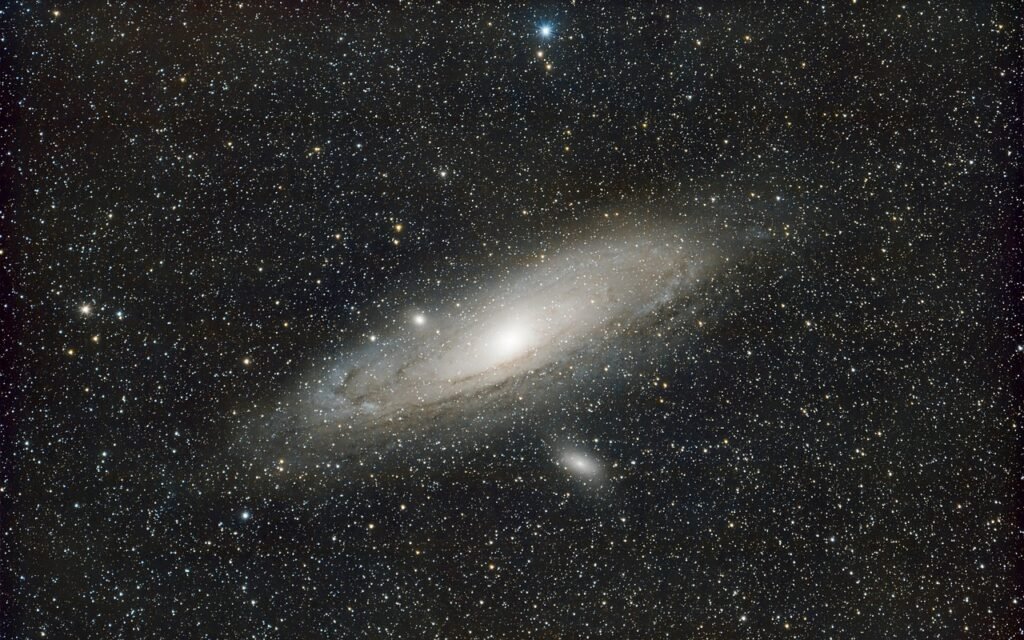
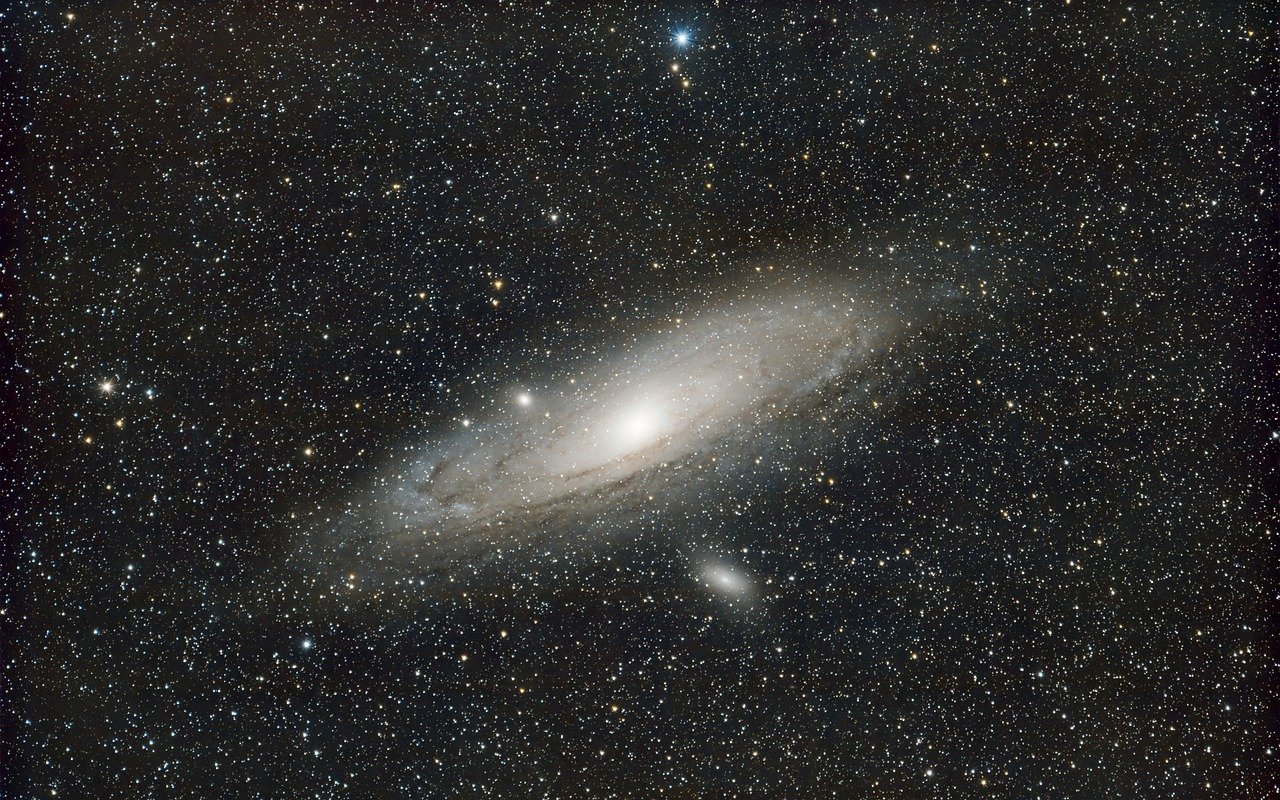
Unlocking the Secrets of Cosmic Dawn (Image Credits: Pixabay)
Astronomers using the James Webb Space Telescope uncovered galaxies from cosmic dawn that converted gas into stars at rates far exceeding predictions, thanks to abundant pristine hydrogen and scant dust.[1]
Unlocking the Secrets of Cosmic Dawn
Galaxies spied at redshifts greater than nine formed stars on timescales as short as 10 to 100 million years, a pace that outstripped expectations from both local observations and computer simulations.[1] Researchers led by Clara L. Pollock, Kasper E. Heintz, and Joris Witstok targeted these distant objects with JWST’s NIRSpec Prism spectroscopy. The instrument captured detailed spectra with median signal-to-noise ratios above three in the rest-frame ultraviolet at 1500 angstroms. Damped Lyman-alpha absorption lines revealed hydrogen column densities surpassing 10^22 per square centimeter. This dense neutral gas appeared directly linked to the galaxies’ intense activity.
Such efficiency marked a departure from the Kennicutt-Schmidt relation, which governs star formation in nearer galaxies. The team modeled emission lines like H-beta, oxygen triplets, and neon to map physical conditions. Convolution adjustments sharpened the resolution by a factor of 1.3. These steps yielded the first firm limits on pristine atomic hydrogen’s role in early cosmic structures.[1]
The Engine of Rapid Star Birth
Star formation in these primordial galaxies proceeded with extraordinary speed, converting dense gas reservoirs into new stars far quicker than models anticipated. The process fueled their brilliant ultraviolet output, visible despite the vast distances. Minimal dust interference allowed this light to shine through, unlike dustier environments in later epochs. Researchers noted offsets from the fundamental metallicity relation, hinting at distinct chemical paths in the young universe.
Key measurements highlighted the anomaly:
- Redshifts exceeding nine, placing galaxies shortly after cosmic dawn.
- Star formation timescales of 10-100 million years.
- Hydrogen column densities over 10^22 cm^{-2}.
- Dust-to-gas ratios matching local galaxies, save for the lowest-metallicity cases.
- High UV luminosity unexplained by size or mass alone.[1]
Pristine Gas Powers the Fireworks
Dense, neutral hydrogen gas stood out as the primary driver. Damped Lyman-alpha profiles indicated thick slabs of pristine material fueling the starbursts. This gas, largely untouched by prior stellar processing, enabled near-maximal conversion rates. Low dust levels preserved the ultraviolet glow, resolving a long-standing puzzle about these galaxies’ brightness.
The findings aligned dust properties with local benchmarks but emphasized the gas’s purity. Emission line modeling fixed ratios, such as the oxygen doublet at 1:2.97, to refine estimates. Such conditions prevailed during the reionization epoch, when early stars began clearing the universe’s hydrogen fog. The work, detailed in an arXiv preprint, came from collaborators at the Cosmic Dawn Center, Niels Bohr Institute, and others.[1]
Reshaping Views of Galaxy Origins
These observations challenged galaxy formation simulations, which underestimated early efficiencies. The rapid buildup suggested the early universe favored swift assembly in gas-rich disks. Pristine inflows, rather than intergalactic medium alone, supplied the raw material. Future multi-wavelength studies will test if these galaxies represent the norm or outliers.
Refinements to models now appear essential for tracing elements’ origins and structures akin to the Milky Way. The results illuminated reionization dynamics, where such galaxies contributed key ionizing photons.
Key Takeaways
- Early galaxies achieved star formation efficiencies beyond local and simulated norms.
- Dense neutral hydrogen, with columns over 10^22 cm^{-2}, drove the process.
- Minimal dust enabled detection of their bright UV light at z > 9.
This discovery from JWST reshapes our timeline of cosmic evolution, proving the universe’s dawn hosted fiercer stellar nurseries than thought. How might these insights alter predictions for the first billion years? Share your thoughts in the comments.