
You’ve probably heard the term “quantum” thrown around these days. Quantum computers promise breakthroughs. Quantum physics sounds mysterious, even magical. Yet beneath all the hype lies something profoundly unsettling: at the tiniest scales of existence, reality doesn’t operate the way you think it does. Particles don’t occupy fixed positions. They exist in multiple states simultaneously. They tunnel through walls. They remain connected across vast cosmic distances.
This isn’t science fiction. This is the quantum realm, a domain where certainty dissolves into probability and where observation itself shapes what becomes real. Here, the universe plays dice with existence, and the rules that govern everyday life simply don’t apply. Let’s dive into this strange landscape where reality becomes something far more fluid than you ever imagined.
When Particles Refuse to Choose: The Mystery of Superposition
Imagine flipping a coin and watching it hang in midair, neither heads nor tails, somehow both at once until you catch it. In the macroscopic world we inhabit, this seems absurd. Yet quantum superposition means particles exist in multiple states simultaneously, and when you measure the spin of a particle, it’s as if the particle selects one of the states in the superposition. An electron doesn’t commit to being “here” or “there” until something forces it to decide.
This behavior emerges from the wave-like nature of quantum particles, described by something called the wave function. Think of it as a map of probabilities stretched across space. The wave function is like a magical probability map that encapsulates all the possible states a quantum system could be in and the likelihood of each. Your everyday intuition screams this can’t be right, that things must have definite properties before we look at them. The quantum realm doesn’t care what your intuition thinks.
Here’s the truly mind-bending part: quantum mechanics is probabilistic, rather than deterministic. You can calculate the odds perfectly, predicting exactly what might happen across thousands of experiments. What you cannot do is say with certainty what will happen in any single measurement. Nature, at its deepest level, seems to genuinely roll the dice.
The Collapse: How Ghosts Become Real
So what happens when you finally measure that particle in superposition? Wave function collapse occurs when a wave function, initially in a superposition of several eigenstates, reduces to a single eigenstate due to interaction with the external world. The multiple possibilities suddenly condense into one concrete outcome. The particle that was everywhere becomes somewhere.
Scientists have argued about this collapse for nearly a century. The Schrödinger equation describes quantum systems but does not describe their measurement, and solution to the equations include all possible observable values but measurements only result in one definite outcome. This gap between quantum possibility and measured reality constitutes what physicists call the measurement problem.
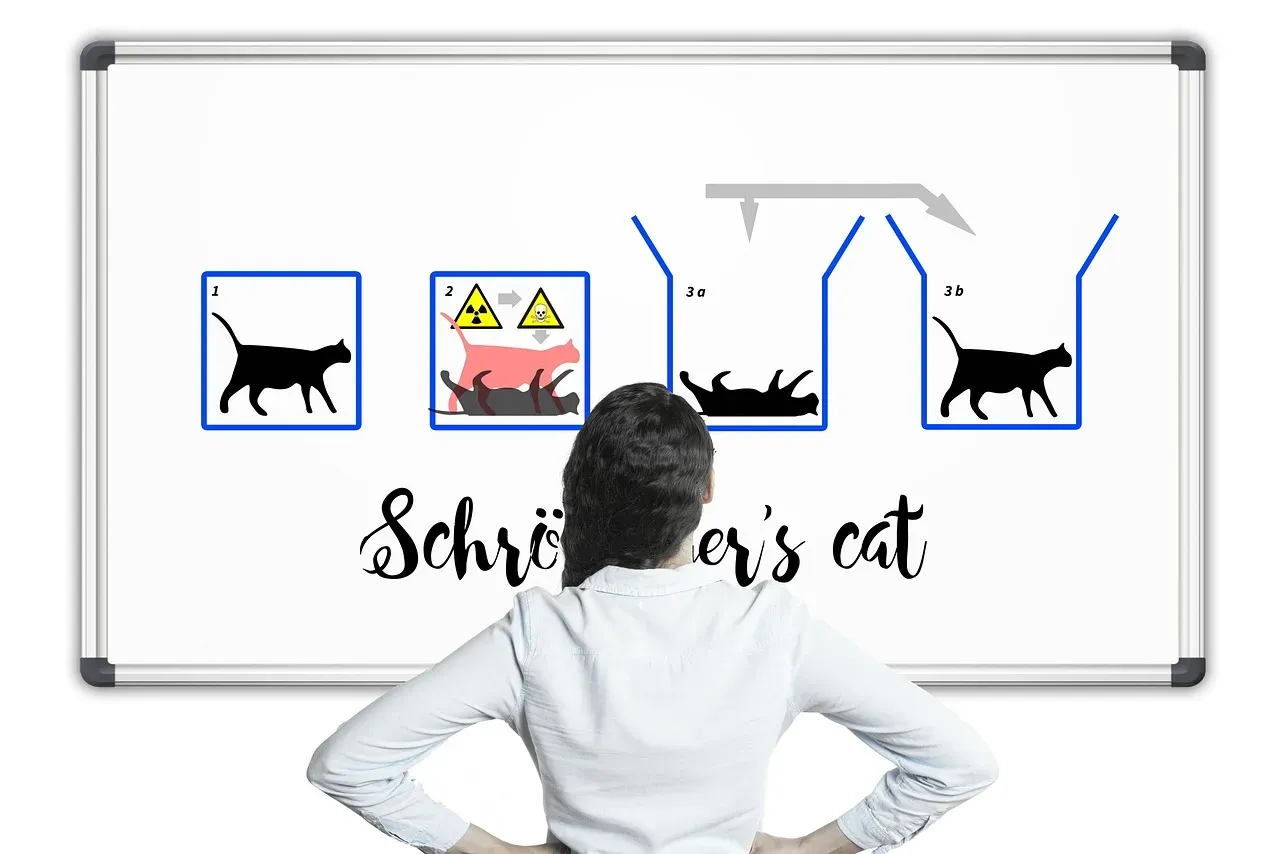
The famous thought experiment involving Schrödinger’s cat dramatizes this weirdness. Seal a cat in a box with a quantum trigger that has a fifty-fifty chance of killing it. Until you open the box, quantum theory suggests the cat exists in a superposition of alive and dead. Yet when you peek inside, you always find a cat that’s definitively one or the other, never both. The multi-possibility wave function has collapsed to a single reality, but nobody fully understands how or why.
What counts as a measurement anyway? Does it require a conscious observer? The answer remains genuinely uncertain. Some experiments even suggest consciousness might play a role, though this remains controversial. What we know for sure is that observation transforms quantum possibility into classical certainty, and the mechanism behind this transformation remains one of physics’ deepest mysteries.
Spooky Action at a Distance: When Separated Things Stay Connected
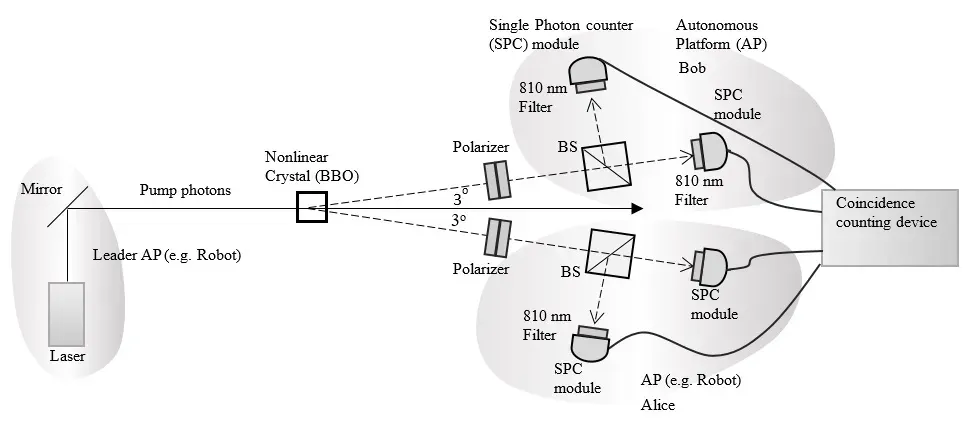
Now things get really weird. Quantum entanglement is the phenomenon wherein the quantum state of each particle in a group cannot be described independently of the state of the others, even when the particles are separated by a large distance. Create a pair of entangled particles, separate them by any distance you like, and measuring one instantly determines the state of the other.
Einstein famously hated this idea. He called it “spooky action at a distance,” since the particles seemed to be communicating faster than the speed of light. His intuition told him quantum mechanics must be incomplete, that hidden variables we couldn’t measure were secretly determining outcomes all along. Experiments eventually proved Einstein wrong on this point, one of the rare occasions where his legendary intuition failed him.
The implications are staggering. Measurements of physical properties such as position, momentum, spin, and polarization performed on entangled particles can be found to be perfectly correlated, and if a pair of entangled particles is generated such that their total spin is known to be zero, and one particle is found to have clockwise spin on a first axis, then the spin of the other particle measured on the same axis is found to be anticlockwise. The universe maintains these correlations instantaneously across any separation.
Recent experiments have pushed this even further. Measurement shows that there is indeed spooky action at a distance between the heaviest known particles, including top quarks separated at distances where they couldn’t possibly exchange information at light speed. Entanglement isn’t some exotic laboratory curiosity. It’s a fundamental feature woven into the fabric of reality itself.
Tunneling Through Impossible Walls: Probability Trumps Energy
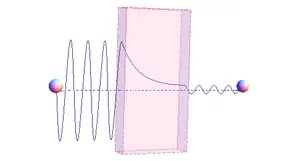
Classical physics says if you roll a ball at a hill and it doesn’t have enough energy to reach the top, it stops and rolls back. Simple. Obvious. Completely wrong at quantum scales. Quantum tunneling demonstrates the ability of a particle to overcome a barrier which in classical physics it could not because it doesn’t have the energy needed to do so, arising because of Heisenberg’s Uncertainty Principle. Particles can appear on the other side of barriers they absolutely should not be able to cross.
This isn’t just theoretical weirdness. Quantum tunneling is essential for life itself to exist, as the thermonuclear fusion processes that power the Sun would not be possible if hydrogen nuclei couldn’t use it to overcome electromagnetic repulsion. Without tunneling, stars wouldn’t shine. The universe would be cold, dark, and lifeless.
The applications extend far beyond stellar physics. Tunneling applications include tunnel diode, quantum computing, flash memory, and scanning tunneling microscope. The USB drive storing your vacation photos relies on electrons tunneling through thin barriers to trap charge. Modern electronics would be impossible without this quantum effect.
Here’s what makes it so counterintuitive: tunneling probability decreases exponentially with barrier width. Make the barrier just slightly thicker and the probability plummets. Yet at nanometer scales, tunneling becomes routine, happening constantly in the devices you use every day. Reality at small scales operates on probabilities that would seem impossible in our everyday experience.
Quantum Computing: Harnessing Uncertainty as Power
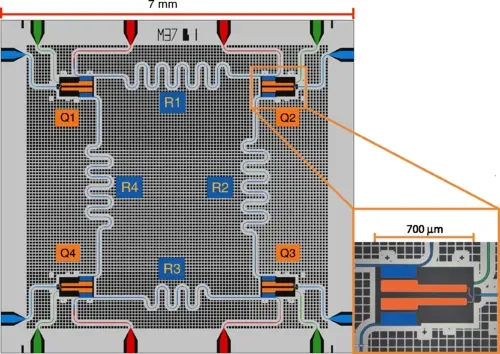
All these bizarre quantum effects – superposition, entanglement, probabilistic behavior – turn out to be more than curiosities. They’re resources. 2026 is poised to be a pivotal year where quantum computing begins to demonstrate clearer pathways toward commercial viability, with compelling proof-of-concept demonstrations expected in quantum chemistry and materials science. Classical computers manipulate bits that are either zero or one. Quantum computers use qubits that can be both simultaneously.
The progress is stunning yet humbling. A chip built by Princeton’s team supports qubits with coherence times longer than 1 millisecond, three times longer than the best ever reported in a lab setting and nearly fifteen times longer than industry standard. That might not sound impressive until you realize these fragile quantum states typically collapse in microseconds. Every improvement in coherence time opens doors to more complex calculations.
Yet challenges remain formidable. Markets show broad skepticism that quantum computers will outperform classical systems in cryptography or complex biological simulation in the near term, as hardware scaling, fault-tolerant architectures, and system reliability are expected to dominate industry attention. The quantum advantage everyone anticipates still hovers just beyond reach, tantalizing but not quite graspable.
Think about what’s actually happening inside these machines. Qubits leverage superposition to represent multiple values at once. Entanglement links them into correlated networks. Quantum algorithms exploit these connections to explore solution spaces exponentially faster than classical approaches. We’re literally harnessing the probabilistic nature of reality as computational fuel.
The Measurement Problem: Why Observation Changes Everything
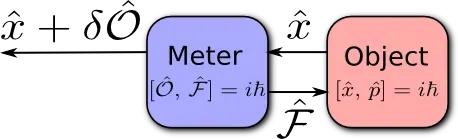
Return to that fundamental question: why does measuring something force it to choose? Before measurement, an electron exists as a wave of possibilities. Measure it, and suddenly it has a definite location. Quantum theory offers no dynamical description of the collapse of the wave function. The theory predicts probabilities beautifully but provides no mechanism explaining why one outcome actually occurs.
Interpretations abound, each with devoted followers and troubling implications. The Copenhagen interpretation suggests measurement itself causes collapse, but doesn’t explain what counts as measurement. The Many Worlds interpretation proposes that all outcomes occur, each in separate branching universes. Honestly, every interpretation sounds crazy because the underlying reality is genuinely strange.
Predictions suggest that if we find a post-quantum theory, it will not restore our notion of classical reality of pre-existing things having properties before we measure them, and it will be even weirder than quantum mechanics. That’s a sobering thought. We’ve spent a century struggling to accept quantum mechanics’ counterintuitive nature. The next level might be even more bizarre.
What’s clear is that observation fundamentally alters quantum systems. This isn’t some technical quirk or measurement error. It’s built into how reality operates at small scales. The observer and the observed cannot be cleanly separated in the quantum realm. Your presence changes what becomes real.
Living in a Quantum Universe: What It All Means
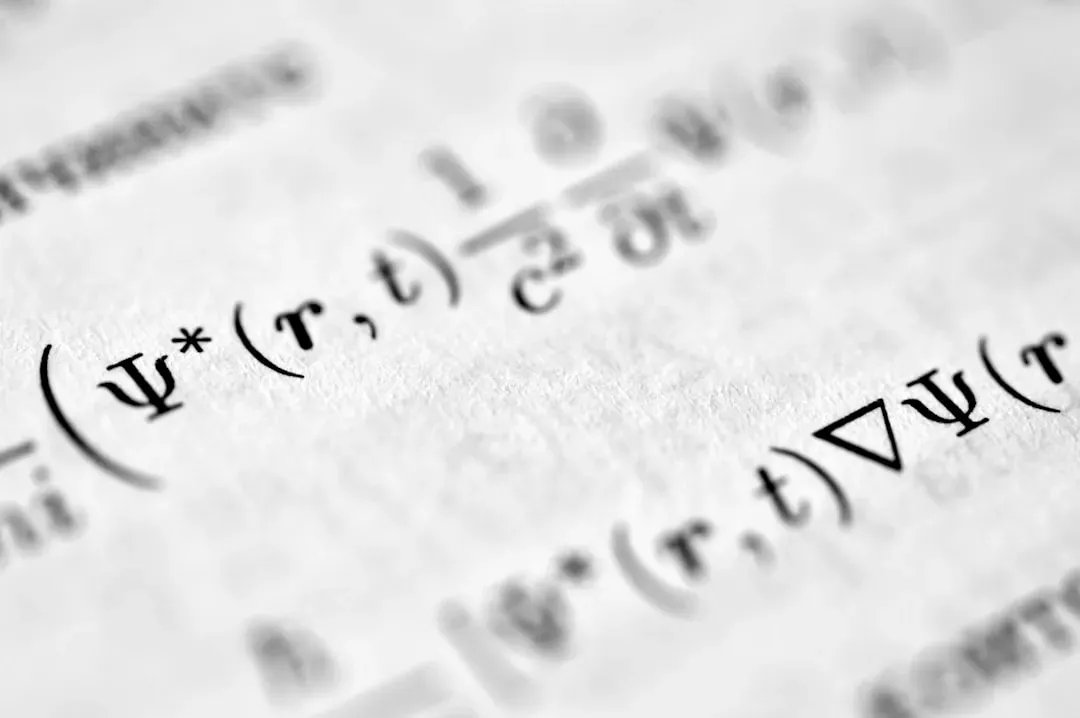
Step back and consider what quantum mechanics tells us about existence. At the deepest levels, reality is not a collection of definite things with fixed properties. It’s a shimmering field of possibilities, probabilities that crystallize into actual events only when observed or interacting with their environment. Quantum whispers: maybe the truth is more fluid than the solid certainties our everyday experience suggests.
The probabilistic nature of quantum mechanics invites viewers to embrace the uncertainty and wonder of the quantum realm, contrasting sharply with the deterministic world of classical physics. You might find this unsettling. Our brains evolved to navigate a world of solid objects and predictable cause and effect. The quantum realm operates on fundamentally different rules.
Yet this probabilistic foundation makes the universe richer, not poorer. Quantum tunneling powers the stars. Quantum superposition enables new forms of computation. Quantum entanglement might one day connect a quantum internet spanning the globe. These aren’t abstract concepts. They’re reshaping technology and revealing the universe’s deeper architecture.
Perhaps most profound is recognizing that uncertainty is not a bug in reality’s code. It’s a feature. Wave function collapse and its inherent randomness is an essential part of quantum theory’s toolkit for connecting the math to what we observe. The dice-rolling nature of quantum mechanics isn’t something to overcome. It’s how the universe actually works.
The Dance Continues: What Lies Ahead
2026 might be the year quantum quietly begins reshaping real worlds, moving from laboratory curiosity to practical application. The quantum realm is no longer just physicists’ playground. It’s becoming the foundation for next-generation technologies that will transform computing, communication, and materials science.
We’re learning to not just observe quantum effects but to control and exploit them. Quantum error correction improves. Qubit coherence times extend. New materials and techniques emerge. Each advance brings useful quantum computers closer to reality. The probabilistic dance of possibilities is being choreographed into something useful.
Yet for all our progress, mysteries remain. How exactly does collapse occur? Can we ever truly understand quantum mechanics’ counterintuitive implications? What lies beyond quantum theory? These questions drive researchers forward, seeking deeper understanding of reality’s quantum foundations.
The quantum realm reveals a universe far stranger than our ancestors imagined. Reality itself dissolves into probability at small scales. Particles exist in multiple states until observed. Separated things remain mysteriously connected. Impossible barriers become permeable. This isn’t the universe of solid objects and deterministic laws we thought we lived in. It’s something far more fluid, uncertain, and ultimately fascinating.
So the next time you hear “quantum,” remember it’s not just a buzzword. It’s a window into reality’s deepest nature, where the classical certainties we depend on give way to a probabilistic dance of possibilities. The universe plays dice after all, and that makes everything possible, including you, more remarkable than it seems.
What do you think about living in a fundamentally probabilistic universe? Does it change how you see reality?