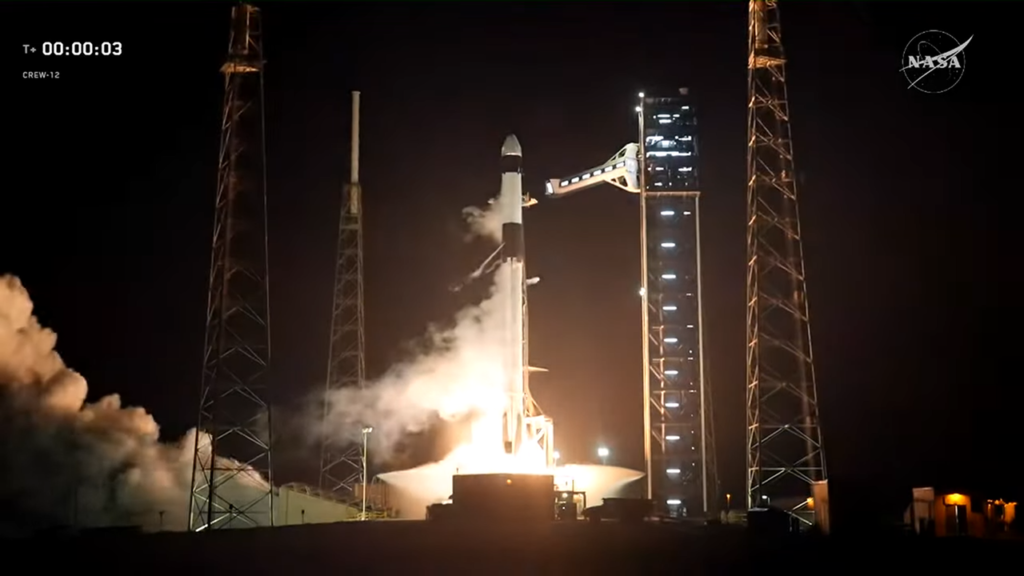
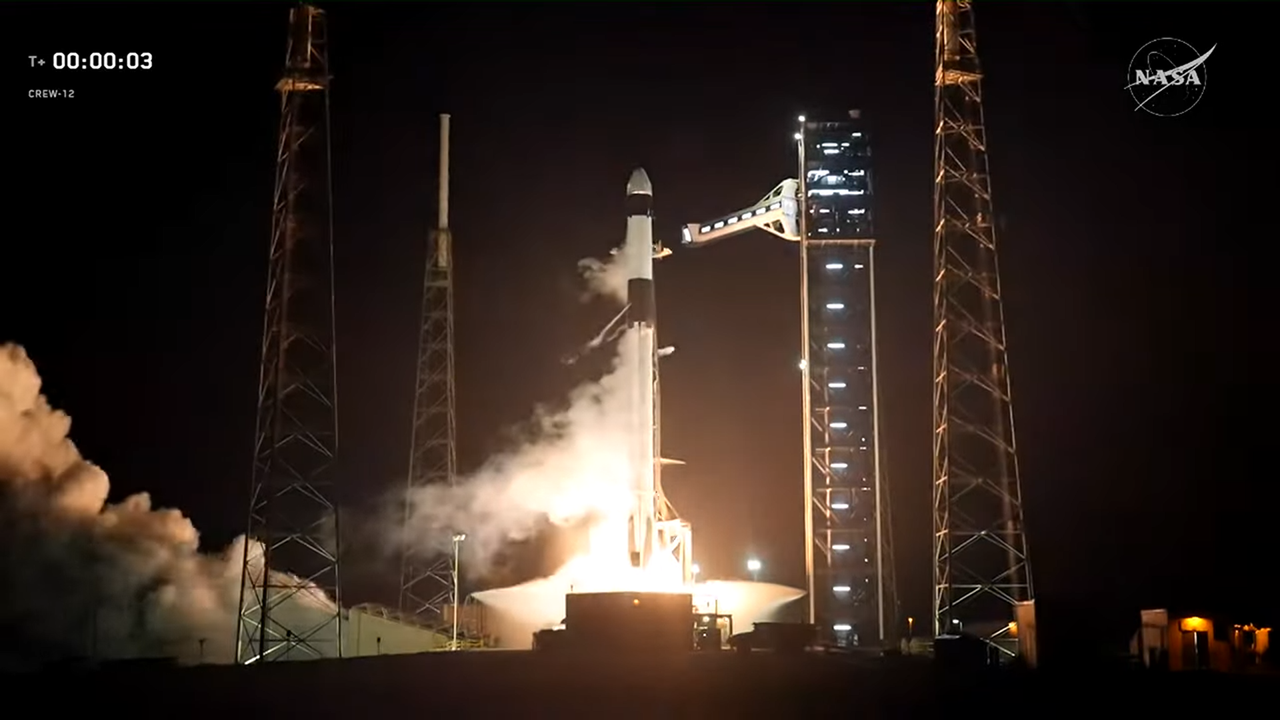
Smooth Launch Ushers in Relief for Space Station (Image Credits: Cdn.mos.cms.futurecdn.net)
Cape Canaveral Space Force Station, Florida – A SpaceX Falcon 9 rocket propelled four astronauts toward the International Space Station early Friday morning, restoring full operational capacity to the orbiting laboratory.[1][2]
Smooth Launch Ushers in Relief for Space Station
The mission lifted off at 5:15 a.m. EST from Space Launch Complex 40, marking the 12th operational flight under NASA’s Commercial Crew Program.[3] Commander Jessica Meir captured the moment shortly after ascent with a poignant reflection: “We have left the Earth, but the Earth has not left us.”[4]
The Dragon spacecraft now travels at about 17,000 mph, set for autonomous docking to the Harmony module at 3:15 p.m. EST on Saturday.[5] This 34-hour journey ends a period of limited staffing aboard the ISS.
Crew members expressed gratitude to the ground teams during post-launch communications, highlighting the flawless execution of the predawn liftoff.[6]
ISS Operated on Skeleton Crew for Weeks
The space station ran with just three residents since last month, following a medical evacuation that shortened the prior crew’s stay.[7] NASA accelerated Crew-12’s timeline to address the shortfall and ensure continuous research.
Typically, rotations overlap to maintain seven-person teams, but the unexpected return left the outpost short-handed.[8] Arrival of the new quartet will normalize operations for Expedition 74.
- Previous crew departed early due to health concerns.
- Station crew dwindled to minimal levels.
- Crew-12 provides immediate reinforcements.
- Full complement resumes advanced experiments.
Diverse Crew Brings Global Expertise
NASA astronauts Jessica Meir and Jack Hathaway lead as commander and pilot, joined by European Space Agency’s Sophie Adenot and Roscosmos cosmonaut Andrey Fedyaev, both mission specialists.[9][10]
Meir, a veteran of prior ISS expeditions, pilots the Dragon alongside Hathaway in his first long-duration flight. Adenot represents France through ESA, while Fedyaev contributes Russian expertise.
This multinational composition underscores ongoing international cooperation in low-Earth orbit.
Research Priorities Target Deep Space Goals
Over eight months, the team will advance experiments preparing for Moon and Mars missions while yielding Earth benefits.[11]
Key studies include pneumonia bacteria analysis for better treatments, on-demand IV fluid production, and blood flow impacts from physical traits in microgravity.
| Experiment Focus | Goal |
|---|---|
| Plant health monitoring | Automated systems for space agriculture |
| Microbe-plant interactions | Enhanced food production |
| Bacteria research | Improved cardiovascular care |
These efforts build on NASA’s push beyond low-Earth orbit.[1]
Key Takeaways
- Crew-12 restores ISS to seven astronauts after medical-related delays.
- Eight-month mission emphasizes Artemis-era science.
- Launch success reinforces SpaceX’s reliability in crewed flights.
As Crew-12 settles into orbit, their arrival promises renewed momentum for station science. What do you think this mission means for future space exploration? Tell us in the comments.