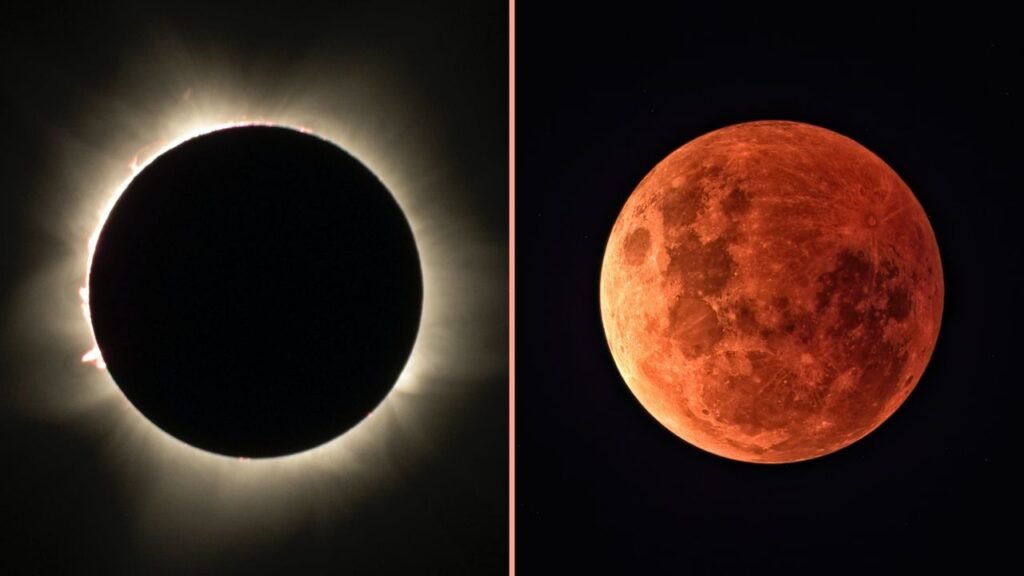
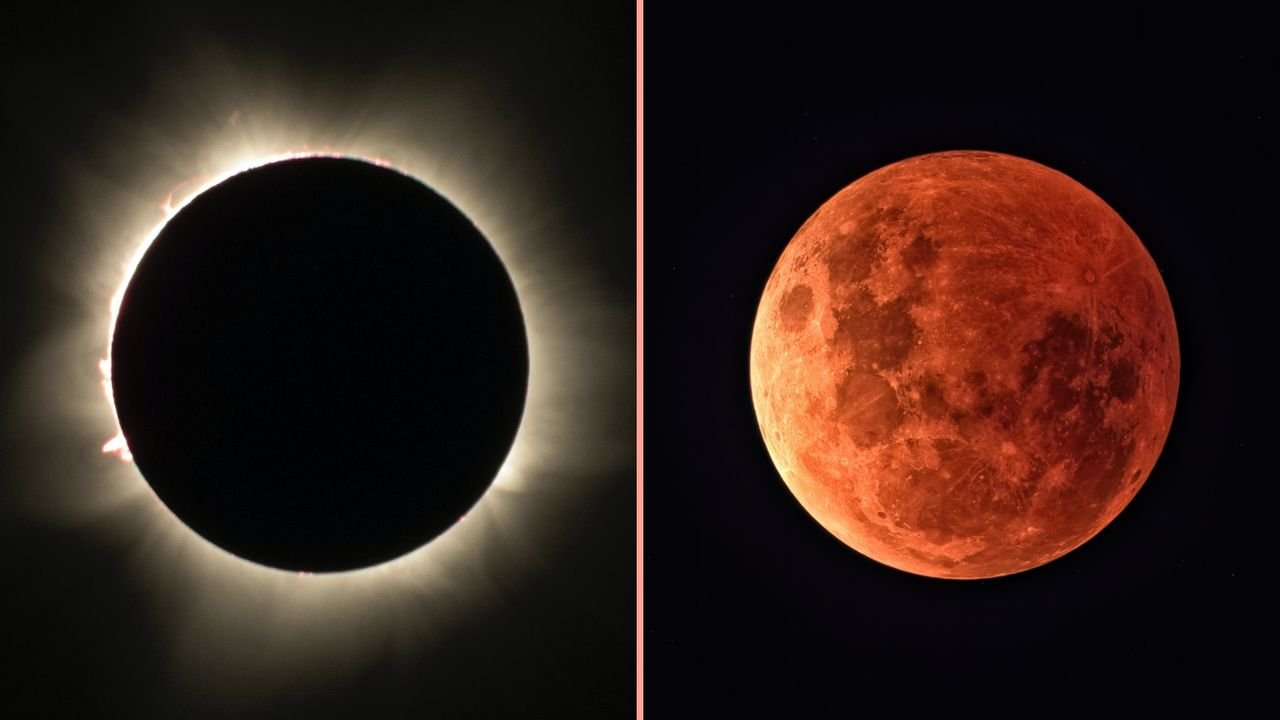
Twice-Yearly Windows Ignite Eclipse Possibilities (Image Credits: Cdn.mos.cms.futurecdn.net)
Spectacular alignments of the sun, Earth, and moon deliver solar and lunar eclipses in tandem roughly twice each year, following a precise celestial schedule.[1]
Twice-Yearly Windows Ignite Eclipse Possibilities
Imagine the sky conspiring for drama: within brief periods spanning 31 to 37 days, eclipses become not just possible, but probable. These intervals, known as eclipse seasons, unfold approximately every 173 days.[1]
During these times, the new moon and full moon phases align closely with the ecliptic, the plane of Earth’s orbit around the sun. Astronomers term the straight-line configuration of sun, Earth, and moon as syzygy. A new moon in this setup casts the moon’s shadow onto Earth for a solar eclipse, while a full moon slips into Earth’s shadow for a lunar eclipse.[1]
Outside these seasons, no eclipses occur, no matter the moon phase.
The Moon’s Subtle Tilt Foils Monthly Eclipses
New moons arrive every 29.5 days, followed swiftly by full moons, yet eclipses elude us most months. The culprit resides in geometry: the moon’s orbit tilts about 5 degrees relative to the ecliptic.[1]
This inclination causes the moon to pass slightly north or south of perfect alignment during typical cycles. New moons skim harmlessly above or below the sun’s disk from Earth’s vantage, and full moons evade Earth’s shadow.
Only when conditions converge precisely do shadows play across our world.
Lunar Nodes: The Pivotal Crossing Points
Two unseen spots in the sky hold the key: the lunar nodes, where the moon’s orbit intersects the ecliptic. Eclipse seasons commence as the sun approaches one of these nodes.[1]
For roughly a month, the setup favors eclipses. As the sun departs the node, the window closes. NASA calculations reveal these nodes drift westward by 19.3 degrees annually, nudging seasons about 19 days earlier each year.[1]
- Sun nears ascending node: northern summer eclipse season.
- Sun nears descending node: northern winter counterpart.
- Regression ensures no two seasons mirror exactly.
Pairing Mechanism: From Solar to Lunar in Two Weeks
A season’s new moon near a node triggers a solar eclipse as the moon interposes between Earth and sun. About 14 days later, the full moon aligns near the opposite node, positioning Earth between sun and moon for a lunar eclipse – or the sequence reverses.[1]
Most seasons yield this duo; occasionally, a third eclipse squeezes in.
| Season Feature | Typical Outcome |
|---|---|
| Duration | 31-37 days |
| Frequency | Every 173 days |
| Common Eclipses | One solar, one lunar |
2026 Showcases Perfect Eclipse Pairs
The year ahead offers vivid examples. The first season launches February 17 with an annular solar eclipse: the moon obscures 96 percent of the sun, forming a “ring of fire” lasting up to 2 minutes 20 seconds over remote Antarctic reaches, with partial views in southeastern Africa and South America.[1]
Precisely 14 days on, March 3 brings a total lunar eclipse. The moon lingers 58 minutes 18 seconds in Earth’s umbra, glowing reddish-coppery for viewers in East Asia, Australia, the Pacific, and western North America.[1]
August’s season peaks August 12 with a total solar eclipse – the first since April 8, 2024 – crossing Greenland, Iceland, and northern Spain. Totality unveils the sun’s corona amid sudden darkness and cooling air. A partial lunar eclipse follows August 28, shadowing the moon for observers across the Americas, Europe, and Africa.
- Eclipse seasons cluster events due to lunar nodes and orbital tilt.
- Pairs form from new moon solar and full moon lunar alignments 14 days apart.
- 2026 delivers two seasons with annular, total solar, total, and partial lunar eclipses.
Eclipse seasons remind us of the sky’s reliable choreography, turning rare shadows into anticipated wonders. What upcoming eclipse excites you most? Share in the comments.