
Imagine waking up one day and realizing that almost everything you thought you knew about the universe is only about a tiny fraction of what’s really out there. That’s what dark matter does to your sense of reality: it quietly whispers that most of the cosmos is invisible, untouchable, and deeply mysterious. We look up at the night sky and see stars, galaxies, and glowing nebulae, but those bright pinpricks are just the tip of an enormous, hidden iceberg.
In modern cosmology, dark matter is not a niche idea; it’s the backbone of how we think the universe works. It doesn’t shine, it doesn’t reflect light, and it passes through you, your house, and the entire Earth as if we were mostly empty space. And yet, without it, galaxies would fly apart, cosmic structures wouldn’t form, and the universe would look nothing like it does today. Let’s walk through what we actually know, what we suspect, and why this unseen substance has scientists both frustrated and completely obsessed.
The Shocking Realization: Most of the Universe Is Invisible
It sounds almost absurd, but according to current measurements, ordinary matter – everything made of atoms, from your coffee mug to the Sun – makes up only a small slice of the universe’s total content. The rest is dominated by dark energy and dark matter, with dark matter alone accounting for several times more mass than all visible matter combined. When scientists first pieced that together, it wasn’t an elegant theoretical prediction; it was more like the universe forcing an uncomfortable confession on us: we’ve been missing almost everything.
This realization came from adding up all the ways matter affects the cosmos and discovering that visible stuff simply doesn’t cut it. If you only count stars, gas, dust, and planets, galaxies spin too fast, galaxy clusters don’t hold together, and the cosmic web of structure doesn’t form properly in simulations. It’s like weighing a person based on the clothes they’re wearing and realizing the number is way too high – something heavy but invisible must be hiding underneath. In this case, that “something” is dark matter, and it outweighs our familiar matter by a wide margin.
How We Know Dark Matter Is There (Even Though We Can’t See It)
The most famous clue comes from galaxy rotation curves. When astronomers measured how fast stars orbit in the outer regions of galaxies, they expected speeds to drop with distance from the center, similar to how planets move around the Sun. Instead, those speeds stayed stubbornly high and almost flat, as if an enormous, unseen mass was spread throughout and beyond the visible galaxy. Without extra gravity from hidden matter, those stars should be flung off into space like mud from a spinning tire.
Then there’s gravitational lensing, where light from distant galaxies is bent by the gravity of massive objects in front of them. Observations show that the amount of bending often far exceeds what visible matter alone can produce. Galaxy clusters, like the famous Bullet Cluster, reveal mismatches between where most of the light comes from and where most of the mass must be. The glowing gas gets separated during collisions, but the main gravitational mass – inferred from how it lenses light – seems to sail right through, as if it doesn’t interact much except through gravity. That behavior fits dark matter far better than any simple tweak to gravity itself.
What Dark Matter Might Be Made Of
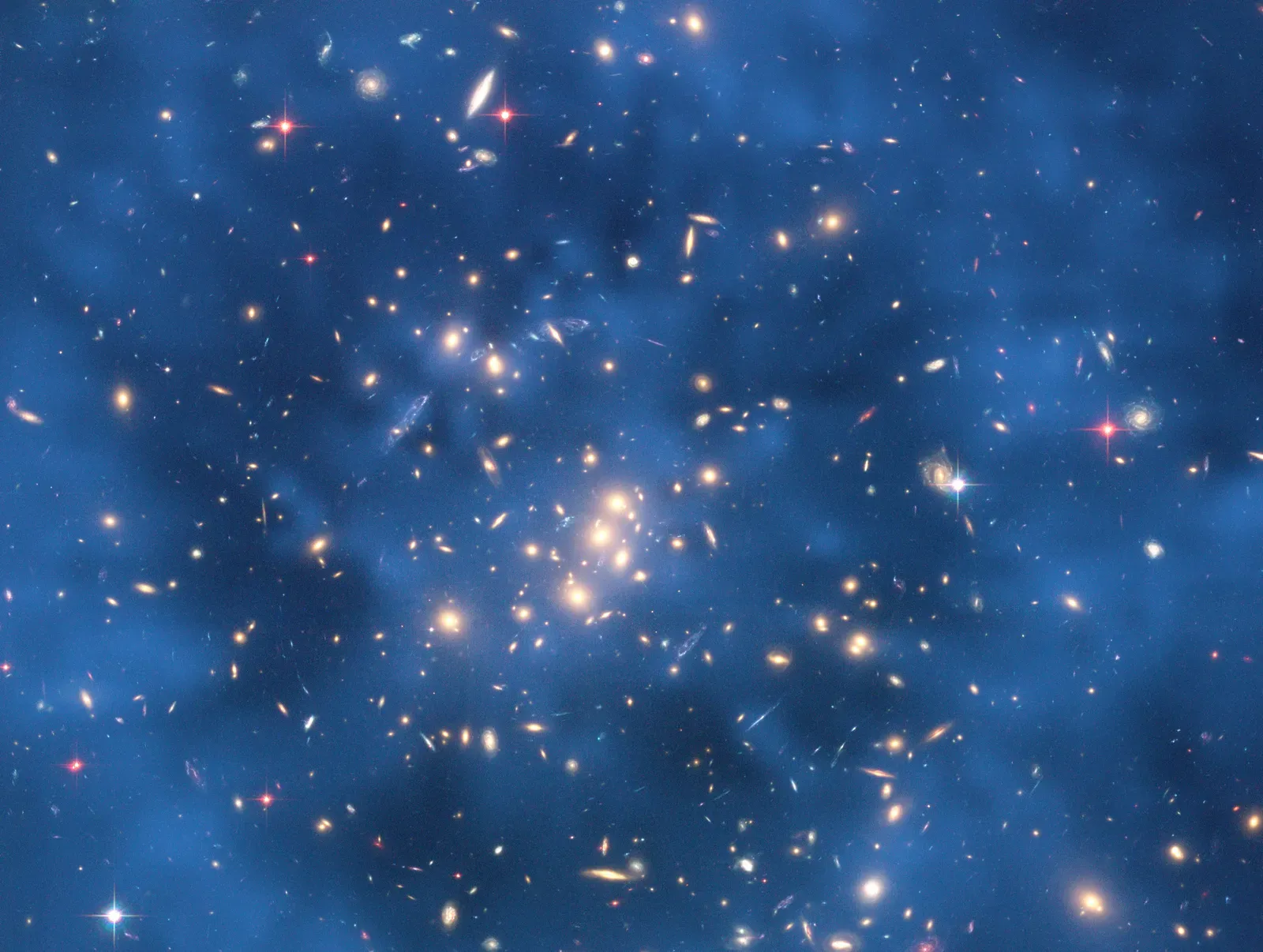
Even though dark matter feels almost like a ghostly presence, most physicists suspect it’s made of real particles, just not the kind our current experiments have confirmed. One long-standing favorite idea is that dark matter consists of weakly interacting massive particles, often called WIMPs. These hypothetical particles would be heavy, neutral, and interact so rarely with normal matter that they’d essentially pass through us unnoticed. For decades, huge underground detectors have waited for a single WIMP to bump into an atomic nucleus and leave a telltale signal.
More recently, attention has shifted to other candidates like axions – ultra-light particles that behave more like a diffuse field than individual billiard balls – or entire families of new particles beyond the standard model. Some proposals even suggest that dark matter might be made of primordial black holes formed in the very early universe, though current observations heavily restrict how many such objects could exist. So far, every time we think we’re getting close, the data stubbornly say “not yet,” which is both maddening and exciting. It means nature is still keeping a major secret from us.
Why Dark Matter Matters for Galaxies and Cosmic Structure
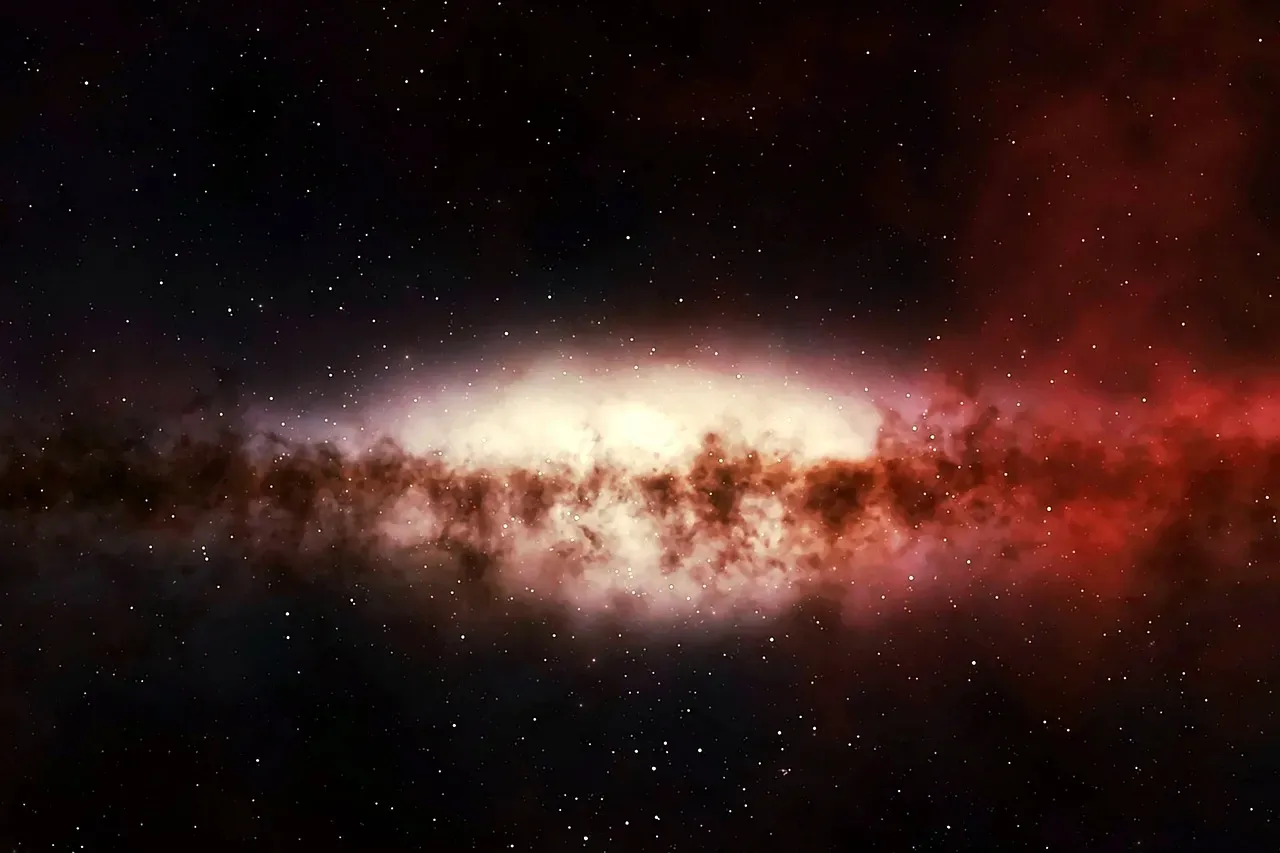
Without dark matter, our universe would be a very different – and probably much duller – place. In the early universe, matter was almost evenly spread out, with only tiny ripples in density. Dark matter, being unaffected by light and radiation, started clumping under gravity long before ordinary matter could. Those early dark matter “halos” acted like invisible scaffolding, pulling in gas that eventually cooled and formed stars and galaxies. In computer simulations, you see dark matter form a vast cosmic web first, and then visible galaxies light up along its filaments like dew drops on a huge, three-dimensional spiderweb.
Inside individual galaxies, dark matter acts as a stabilizing glue. The extended halo of dark matter provides extra gravitational pull to keep fast-moving stars bound to the galaxy, especially in the outer regions where visible matter thins out. On larger scales, dark matter halos merge and grow, building galaxy clusters and superclusters. If you remove dark matter from these models, galaxies don’t form at the right times, they don’t cluster correctly, and the large-scale pattern of the universe stops matching what we actually observe. In that sense, dark matter isn’t a minor tweak; it’s the backbone of cosmic architecture.
The Experiments Hunting for the Invisible
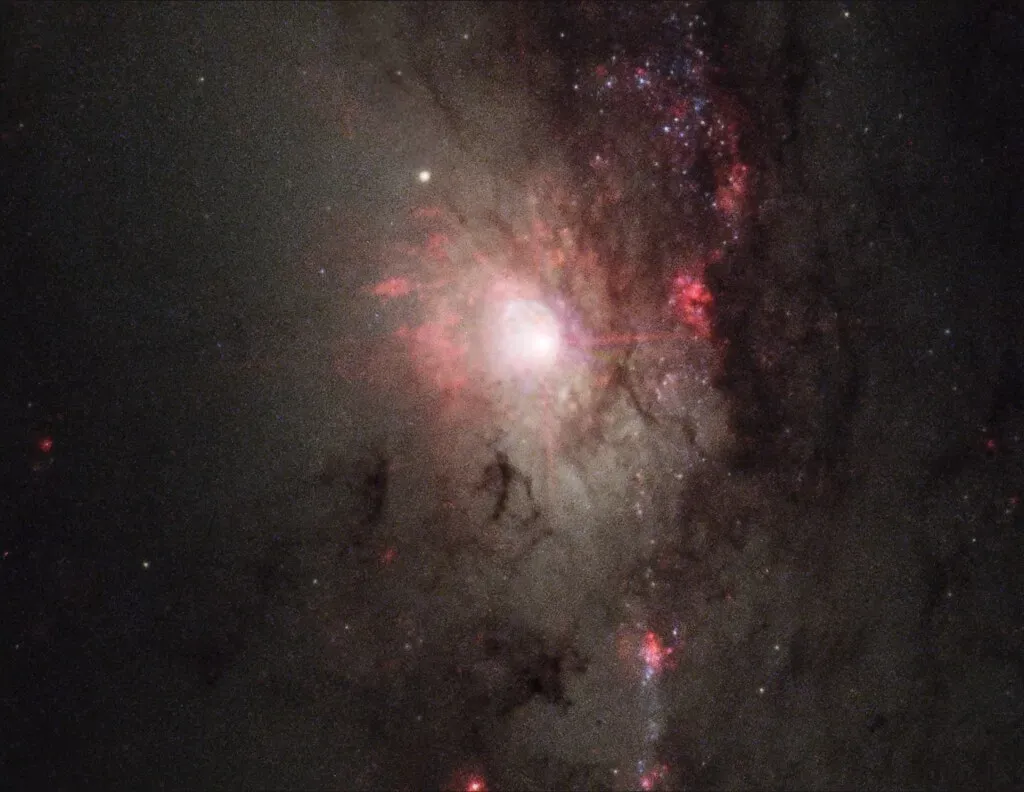
Right now, some of the most sensitive dark matter detectors on Earth sit deep underground in old mines or inside mountains, shielded from cosmic rays and other noise. They’re usually tanks of ultra-pure liquids or crystals cooled to extremely low temperatures, waiting for a single rare collision between a dark matter particle and an atom. When a bit of energy appears in just the right way, scientists analyze it obsessively, hoping it’s not just a stray neutron or background radiation fooling them again. So far, no convincing, repeatable signal of a new particle has emerged, forcing experiments to become ever larger and more precise.
At the same time, particle colliders like the Large Hadron Collider look for missing energy in high-energy collisions, a possible hint that dark matter particles were produced and escaped undetected. Astronomers also search the sky for unusual gamma rays, X-rays, or other emissions that might come from dark matter particles annihilating or decaying. Each null result cuts away at specific theories, narrowing down what dark matter can be. It’s a bit like searching a huge, dark house room by room – you haven’t found the person you’re looking for yet, but you can say for sure where they’re not.
Even though the lack of a clear detection can seem disappointing, it has forced the community to get more creative. New ideas involve lighter and lighter particles, clever quantum sensors, and even using stars or entire galaxies as detectors by watching their behavior for subtle dark matter effects. There’s a quiet stubbornness in this search: nobody’s walking away, because the gravitational evidence for dark matter is simply too strong to ignore.
Could We Be Wrong? Alternative Ideas Challenging Dark Matter
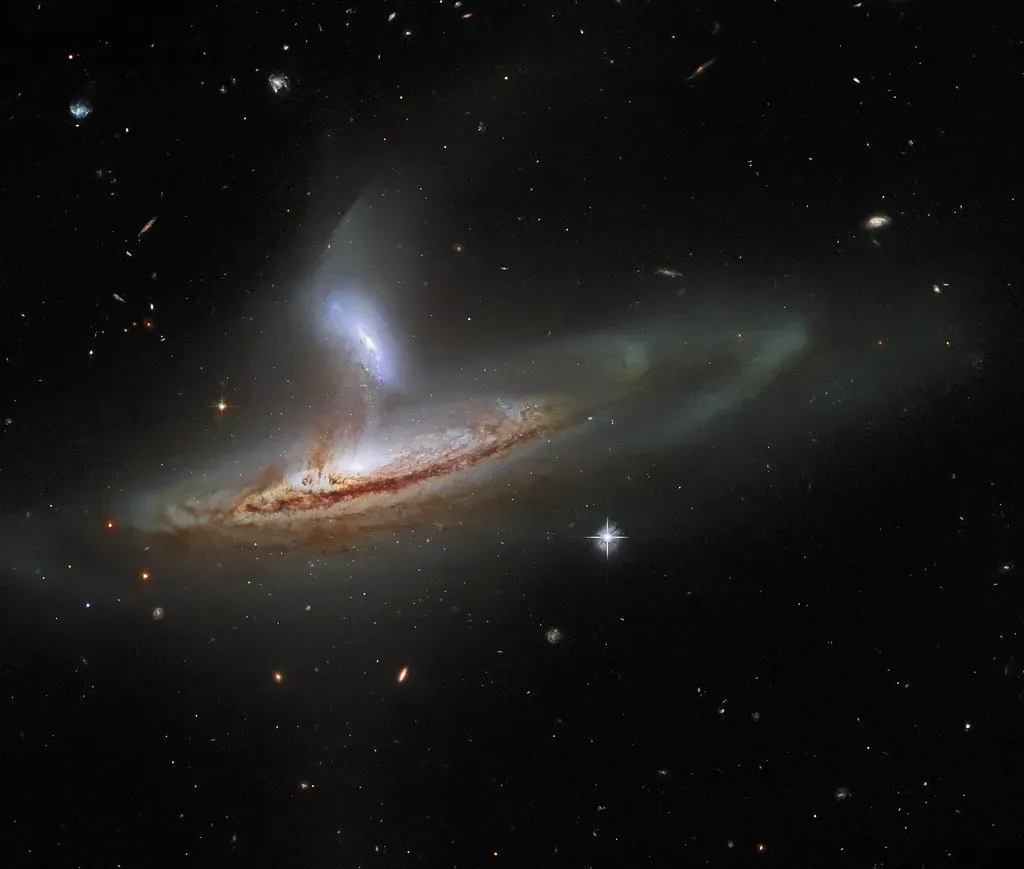
Not everyone is convinced that adding a whole new category of matter is the only way to explain the data. Some physicists argue that our understanding of gravity itself might need to be revised, especially at very low accelerations or on galactic scales. Modified gravity theories try to tweak the laws of motion so that galaxies rotate as observed without invoking extra unseen mass. These ideas are appealing in their simplicity: instead of inventing new matter, adjust the rules of the game. In some cases, they do a surprisingly good job of matching galaxy rotation curves.
The problem is that dark matter isn’t just about how galaxies spin; it also shapes the cosmic microwave background patterns, the growth of cosmic structure, and the behavior of colliding galaxy clusters. So far, no alternative gravity theory has matched all of those observations as cleanly as the standard dark matter model. That doesn’t mean alternatives are worthless – they push the mainstream view to sharpen its arguments and improve simulations. As someone who likes seeing assumptions challenged, I find it healthy that dark matter has to constantly defend its position. But at this point, most cosmologists still see it as the best overall explanation, even if the details remain fuzzy.
What Dark Matter Means for Us and the Future of Cosmology
On a day-to-day level, dark matter doesn’t affect your morning commute or your phone’s battery life, and that can make it feel oddly distant. But at a deeper level, it’s part of the origin story of everything you care about. The formation of the Milky Way, the distribution of galaxies that eventually led to stars like our Sun, and even the chance for planets and life to arise are all intertwined with how dark matter shaped the early universe. It’s like the backstage crew of a theater production: you never see them on stage, but without them, the show simply wouldn’t happen.
Looking ahead, the hunt for dark matter is one of the few scientific quests that could genuinely change how we see reality on a fundamental level. A confirmed detection of a dark matter particle – or a radical new theory that replaces it convincingly – would open a new chapter in physics, much like the discovery of the electron or the expansion of the universe did in the past. Personally, I suspect that when we finally crack this mystery, it will feel obvious in hindsight, and we’ll wonder how we ever thought the universe was mostly made of the stuff we can see. In a universe where the invisible outweighs the visible, what else might we still be missing?