
Imagine discovering that every choice you never made is still playing out somewhere else, in a different version of reality where another you is living with its consequences. That idea sounds like pure science fiction, the kind of thing you’d expect from a late‑night movie rather than serious physics. Yet, over the last century, quantum theory has quietly pushed us toward an unsettling possibility: parallel universes might not just be fantasy, they might be a logical outcome of how nature actually works.
We’re in a strange moment in 2026: our technology is precise enough to test quantum predictions to an almost absurd degree, and so far, quantum theory has never been wrong. The weirdness hasn’t gone away; it’s only become harder to ignore. I still remember the first time I tried to really understand quantum mechanics and ended up staring at my wall, half convinced reality was glitching. If you’ve ever had that dizzy feeling, this is the article that walks you through it – step by step, but in plain language.
The Strange Rules Of The Quantum World
At everyday scales, the world feels solid, predictable, and reassuringly boring: dropped cups fall, lights turn on, doors stay where you left them. But zoom down to the level of atoms and smaller, and the rules turn almost surreal. Particles don’t move like tiny billiard balls; instead, they behave more like smeared-out waves of possibility, existing in many potential states at once until something forces a concrete outcome.
In quantum physics, this blurry in‑between is called superposition, and it isn’t just a poetic idea; it’s a measurable, experimentally confirmed fact. We’ve built technologies like MRI machines, lasers, and modern electronics on top of this weirdness. Yet, the more accurate our experiments become, the more quantum behavior looks less like a temporary oddity and more like the fundamental language of reality. Ordinary, classical behavior seems to be the exception, not the rule.
Superposition: When One Thing Is Many At The Same Time
Superposition is the heart of the parallel universe story, because it says that before you measure a quantum system, it isn’t in one state or another – it’s in a combination of all possible states. A single electron can be in multiple positions at once, or spin in two opposite directions simultaneously, described mathematically by a wave function. It’s as if nature stubbornly refuses to pick just one option until it absolutely has to.
What’s wild is that this isn’t just an abstract concept living on a chalkboard. In labs around the world, scientists routinely create particles, atoms, and even small molecules that exist in superpositions of different places or properties. Quantum computers, one of the hottest areas of research right now, depend on exactly this kind of behavior: their basic units, qubits, can represent many possible configurations at once. Superposition makes it feel like reality is fundamentally layered, with many “might be” states stacked together underneath every “this is how it is” we see.
Entanglement: Spooky Links Across The Multiverse
If superposition is strange, entanglement is the part that makes your brain quietly scream. When two particles become entangled, their properties link so deeply that measuring one instantly tells you something about the other, no matter how far apart they are. Change the conditions on one side of the universe, and the other side seems to “know” immediately. Einstein famously hated this, calling it spooky, but experiment after experiment has confirmed it.
In the last few years, entanglement has gone from philosophical headache to technological tool. Quantum communication devices and early quantum networks rely on entanglement to securely share information. But from the perspective of parallel universes, entanglement hints at something bigger: a deeply interconnected structure where outcomes are not isolated events, but branches of a shared underlying reality. It’s like seeing threads of an invisible tapestry connecting what we used to think were separate, independent moments.
The Double‑Slit Experiment: Where Reality Splits
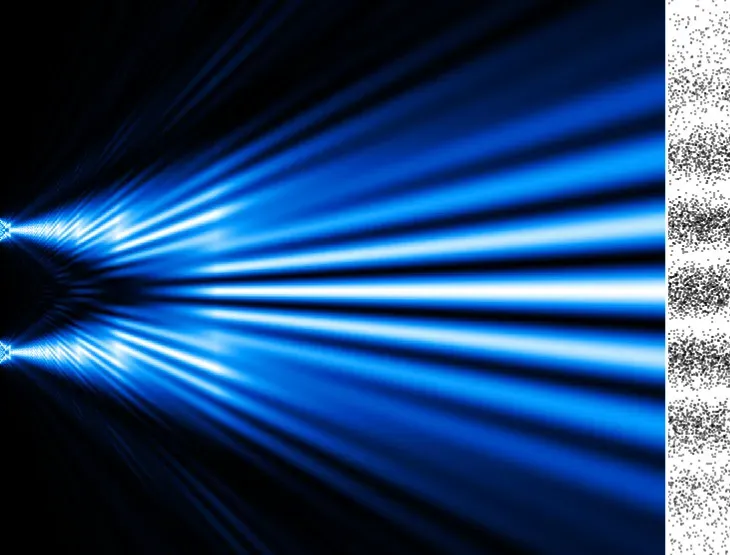
If there’s a single experiment that forced physicists to confront the possibility of many worlds, it’s the famous double‑slit experiment. When individual particles like electrons are fired at a barrier with two slits, they mysteriously form an interference pattern on a screen behind it – as if each particle went through both slits at once and interfered with itself, like a wave. But the moment you try to watch which slit the particle actually goes through, the interference pattern disappears, and the results look classical again.
This is where interpretations differ. In the many‑worlds view, the particle really does go through both slits, but in different branches of reality. When you measure which slit it goes through, you become part of that branching process: in one universe you see it go through the left slit, in another you see the right. You never experience the split directly because each version of you only remembers one outcome. The experiment doesn’t just look like a magic trick; it’s more like you’re in a story that keeps forking, and you only ever read one page at a time.
The Many‑Worlds Interpretation: Infinite Yous, Infinite Outcomes
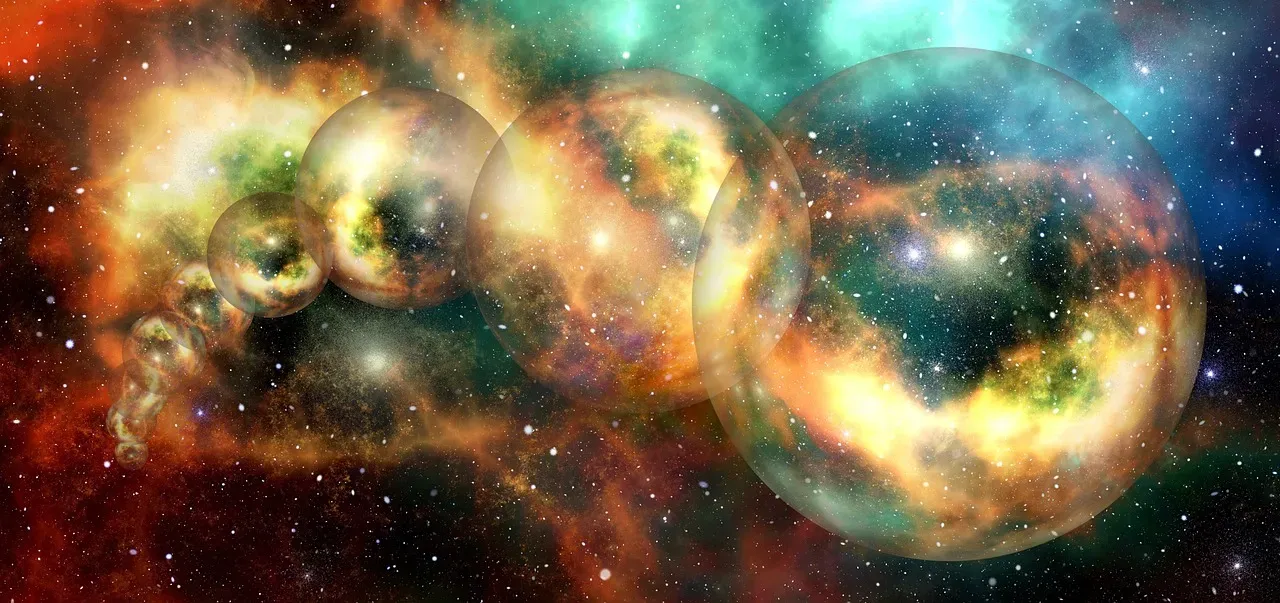
The many‑worlds interpretation, proposed in the mid‑twentieth century, takes quantum theory shockingly literally: every time a quantum event can have multiple outcomes, reality splits, and all outcomes happen, each in its own branch. There’s a version of you who hit “send” on a risky email, one who didn’t, and another who changed careers five years ago. You don’t remember the split because each copy continues as if nothing unusual happened, carrying on inside its own version of the world.
What makes many‑worlds hard to dismiss is that it doesn’t require new equations or special rules for measurement. It uses the same math that already works incredibly well and simply refuses to add extra ingredients like wave function collapse. From that angle, the multiverse isn’t a wild extra theory; it’s the straightforward reading of quantum mechanics. The cost is enormous, though: you have to accept an unimaginable number of unseen realities, like living in a house and learning there are infinite identical houses stacked on top of yours, each with slightly different furniture.
Are Parallel Universes Testable Science Or Just Cool Stories?
A fair pushback here is obvious: if we can’t directly access these other branches, is any of this actual science or just a stylish narrative? Physicists still argue about that. Many‑worlds doesn’t currently predict different experimental outcomes from other interpretations, which makes it hard to test in the usual way. That said, as quantum technologies scale up, some researchers are trying to design experiments that probe how large superpositions can realistically get and whether we see any hints of a fundamental limit.
There’s also a more subtle point: some interpretations need extra assumptions or invisible mechanisms to explain why we only see one outcome, while many‑worlds doesn’t. In practice, scientists care about which explanation is simplest, least ad‑hoc, and most consistent with all known data. Right now, the multiverse sits in a strange spot: not confirmed, not ruled out, but taken seriously enough that it shows up in serious talks, research papers, and quiet conversations in physics departments everywhere. It’s less like a comic book fantasy and more like an uncomfortable guest that refuses to leave the party.
What Parallel Universes Would Mean For You And Free Will

If many‑worlds is even partly right, the implications are deeply personal. Every decision you agonize over – who to date, where to live, whether to apologize – plays out in multiple ways across different branches. In some sense, you’ve both succeeded and failed, loved and lost, stayed and left. That can feel either liberating or disturbing: your choices still matter in your branch, but there’s always a version of you who chose differently.
It also shakes up how we think about luck, risk, and meaning. When people say they barely survived a close call, in a multiverse picture there are other branches where that ended badly, and no one is left to talk about it. It doesn’t make your experience less real, but it can make the world feel less neatly ordered and more like an endless web of possibilities. Thinking this way for the first time is a bit like realizing Earth is not the center of the universe; it doesn’t instantly change your daily routine, but it quietly rearranges everything you thought you knew about your place in reality.
Living With A Multiverse Mindset
Quantum theory has dragged us to a strange crossroads where the most straightforward reading of the math seems to point toward parallel universes, while our everyday intuition screams that this can’t possibly be how things work. Superposition, entanglement, and experiments like the double‑slit don’t prove many‑worlds beyond all doubt, but they make it increasingly hard to cling to a simple, single‑track universe without adding extra complications. For now, parallel universes remain a serious, if unconfirmed, contender for describing what reality is really like underneath the surface.
Whether or not we ever find a decisive test, thinking in terms of many worlds can change how we see our own lives: not as a single fragile line, but as one thread in a vast, branching tapestry of possibilities. You still only get to experience one path, so your choices still carry real weight – but you might see them with a little more curiosity and a little less fear. If the quantum realm really does contain endless versions of us, each living out different outcomes, the most interesting question may not be whether they exist, but what you decide to do in the one universe you actually feel.