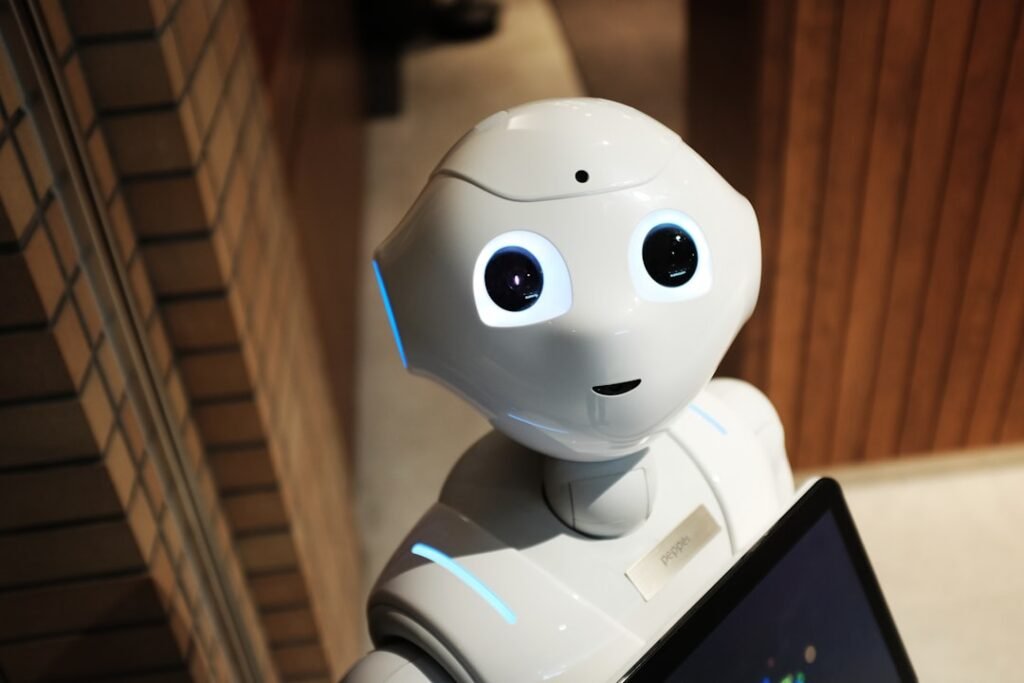

Rigid Hardware Stifles Robot Progress (Image Credits: Unsplash)
Tokyo, Japan – Researchers have outlined how flexible electronics address key limitations in robot hardware, paving the way for more autonomous and adaptable machines.
Rigid Hardware Stifles Robot Progress
Robots increasingly handle tasks in homes and factories, yet their path to full autonomy faced a major hurdle: inflexible components. Hard electronics resisted mounting on curved or irregular robot bodies. This mismatch hampered essential functions like sensing the environment, processing data, and executing movements.
A comprehensive review exposed these constraints. Led by Professor Xiaodong Chen from Nanyang Technological University, along with colleagues from Harbin Institute of Technology, the study appeared in the journal SmartBot.[1]
Conventional setups relied on sparse sensors at fixed points. Such arrangements delivered incomplete data for decision-making. Flexible alternatives promised denser, more uniform coverage.
Three Pillars of Flexible Innovation
Flexible devices emerged from advanced manufacturing techniques. Methods included 3D printing, screen printing, and inkjet printing on stretchable substrates. The review categorized them into sensors, circuits, and actuators.
Flexible sensors conform to robot contours, detecting pressure, strain, and contact across entire surfaces. Robots gain a skin-like awareness, far surpassing point-based detection.[1]
- Sensors laminate onto curves for continuous tactile feedback.
- Circuits bend with the body, simplifying wiring and local processing.
- Actuators deliver compliant motion, syncing with soft structures.
- Integration supports high-density networks for precise control.
- These elements reduce bulk while boosting responsiveness.
Mastering Conformal Attachment
Success hinged on reliable bonding to complex shapes. The authors examined strategies for attachment, interconnection, and protection. Seamless coverage ensured durability and performance.
High device density became feasible without compromising signals. This approach enabled modular designs where components worked in unison. Robots achieved tighter coupling of perception and action.
Boosting the Full Intelligence Chain
Flexible tech enhanced every phase of robot operation. At input, skin-like interfaces captured human gestures naturally. Dense sensing fed richer context into decision algorithms.
Local circuits handled processing efficiently. Actuators then produced adaptive outputs. Professor Chen’s team noted performance gains across interaction, planning, and manipulation.[1]
| Stage | Rigid Limitation | Flexible Gain |
|---|---|---|
| Command Reception | Sparse inputs | Natural touch detection |
| Decision Making | Incomplete data | Rich environmental awareness |
| Action Execution | Stiff responses | Precise, adaptive motion |
Key Takeaways
- Flexible electronics enable conformable integration, transforming robot sensing, thinking, and acting.
- Review by Chen et al. catalogs sensors, circuits, actuators as foundational for next-gen bots.
- Future holds natural interactions and robust autonomy in challenging settings.
Flexible electronics marked a shift beyond mere enhancements. As the authors stated, they represent “a foundational technology for next-generation intelligent robots.” By fostering high-density, body-wide electronics, these innovations birthed forms unattainable with rigid tech. Deeper fusion with robotics promises breakthroughs soon. Ongoing work targets deployment hurdles. What advancements in flexible tech excite you most for everyday robots? Share in the comments.