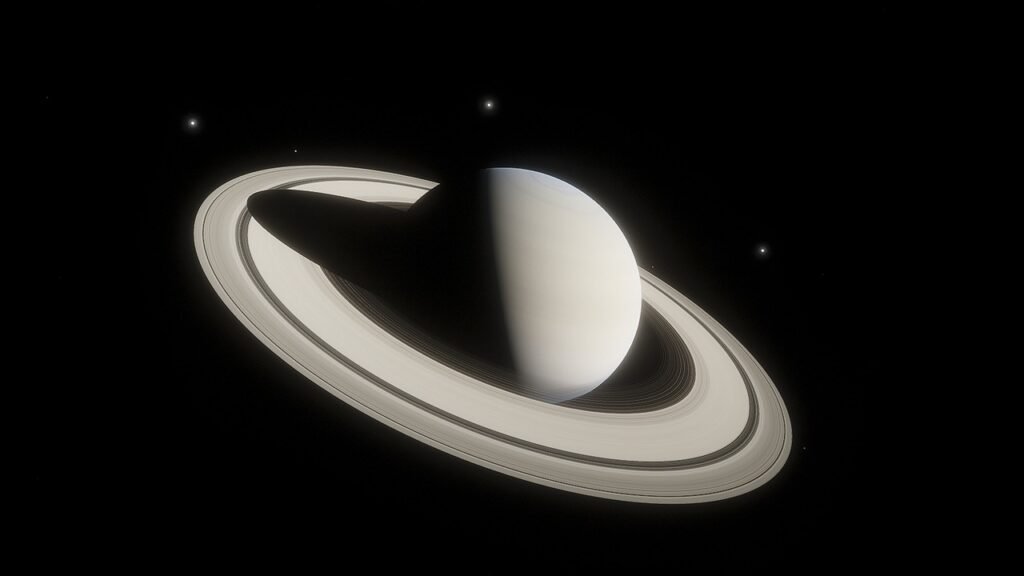
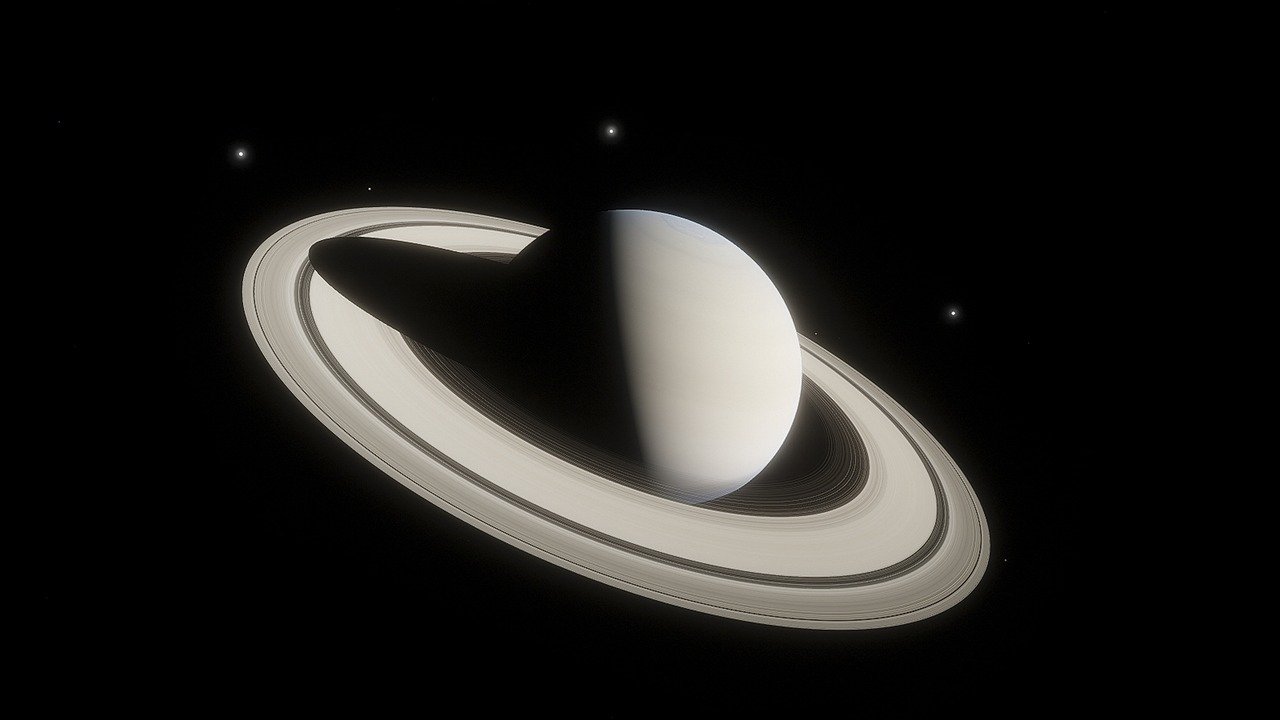
A Tiny Moon’s Planetary-Scale Power (Image Credits: Pixabay)
Paris – Saturn’s icy moon Enceladus drives electromagnetic waves that extend more than 504,000 kilometers across the planet’s space environment, far beyond what scientists previously anticipated.[1][2]
A Tiny Moon’s Planetary-Scale Power
Enceladus measures just 504 kilometers across, yet it functions as a massive generator of Alfvén waves capable of altering Saturn’s magnetosphere on the grandest scales.[3] Researchers led by Lina Hadid at France’s Laboratoire de Physique de Plasmas pored over 13 years of data from NASA’s Cassini spacecraft. They combined readings from four instruments to trace magnetic, plasma, and wave signatures linked to the moon.
The team identified these wave patterns on 36 separate occasions, including during distant flybys that never approached Enceladus closely. “Enceladus is famous for its water geysers, but its actual impact and interaction with the giant planet has remained partly unknown,” Hadid noted. “This result from Cassini transforms our vision of the moon’s role in the Saturnian system.”[1] Such findings elevate Enceladus from a curiosity to a key player in Saturn’s space dynamics.
How Plumes Ignite Electromagnetic Ripples
Water vapor and dust erupt from fractures in Enceladus’ south pole, known as tiger stripes. Radiation quickly ionizes these materials into a conductive plasma. Saturn’s rapidly rotating magnetic field then sweeps this plasma into a torus that shadows the moon’s orbit.[4]
This moving plasma interacts with the magnetic field lines, spawning a primary Alfvén wing – a structure that channels energy and momentum toward Saturn’s poles, much like vibrations along a taut string. Waves reflect repeatedly between the planet’s ionosphere and the plasma torus, forming a intricate lattice of crisscrossing paths. Turbulence within the plasma further refines these waves into fine filaments, enhancing their reach and complexity.
Tracing Waves Across Immense Distances
Cassini detected Enceladus’ influence over distances exceeding 504,000 kilometers – more than 2,000 times the moon’s own radius. These waves not only trail behind the moon in Saturn’s equatorial plane but also climb to high northern and southern latitudes.[2] There, they connect to auroral displays powered by the moon.
Co-author Thomas Chust highlighted the breakthrough: “This is the first time such an extensive electromagnetic reach by Enceladus has been observed, proving that this small moon acts as a giant planetary-scale Alfvén wave generator.”[3] The observations spanned both close encounters and remote passes, confirming the waves’ persistence.
- 36 wave signatures detected across Cassini’s mission.
- Primary wing guides energy to polar regions.
- Reflected wings create a lattice structure.
- Turbulent filaments boost wave propagation.
- Links to intermittent auroras at high latitudes.
Lessons for Magnetospheres Near and Far
The Enceladus system serves as a natural laboratory for plasma physics in gas giant environments. It illuminates processes governing auroral emissions, radiation belts, and plasma flows around worlds like Saturn and Jupiter. Similar dynamics likely play out at Jupiter’s icy moons or even exoplanets with conductive atmospheres in strong magnetic fields.
Future missions stand to gain immensely. Hadid stressed that proposed ESA efforts – an orbiter and lander targeting Enceladus in the 2040s – must equip advanced tools to probe these electromagnetic ties in greater depth.[1]
Key Takeaways
- Enceladus generates Alfvén waves extending over 504,000 km, dwarfing its size.
- Plasma from south pole plumes fuels a torus that spawns wave wings.
- Reflections and turbulence create complex structures tied to Saturn’s auroras.
Cassini’s legacy endures through revelations like these, underscoring how modest moons can command vast cosmic forces – what role might Enceladus play next in our exploration of habitable ocean worlds? What do you think about these findings? Tell us in the comments.