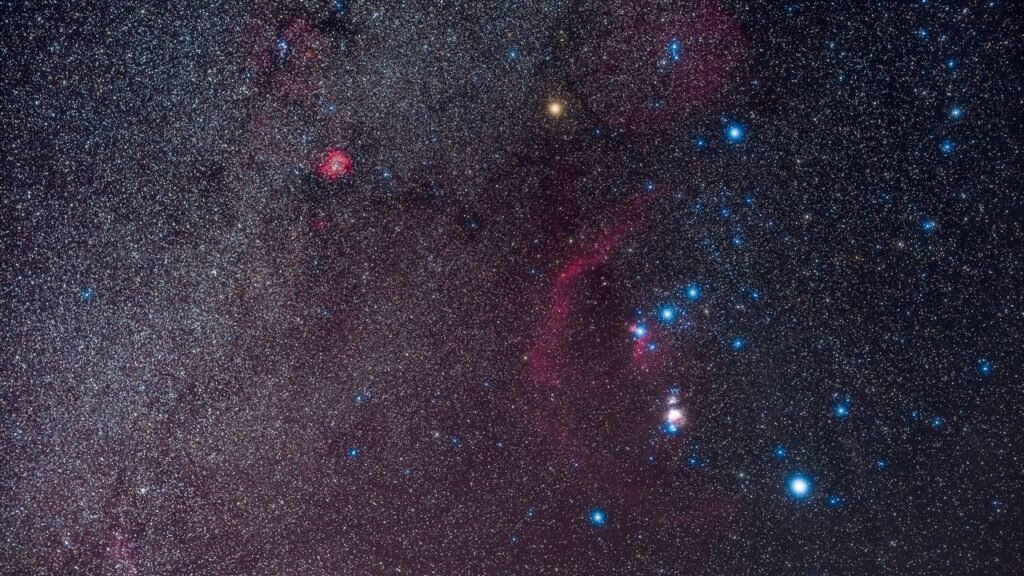
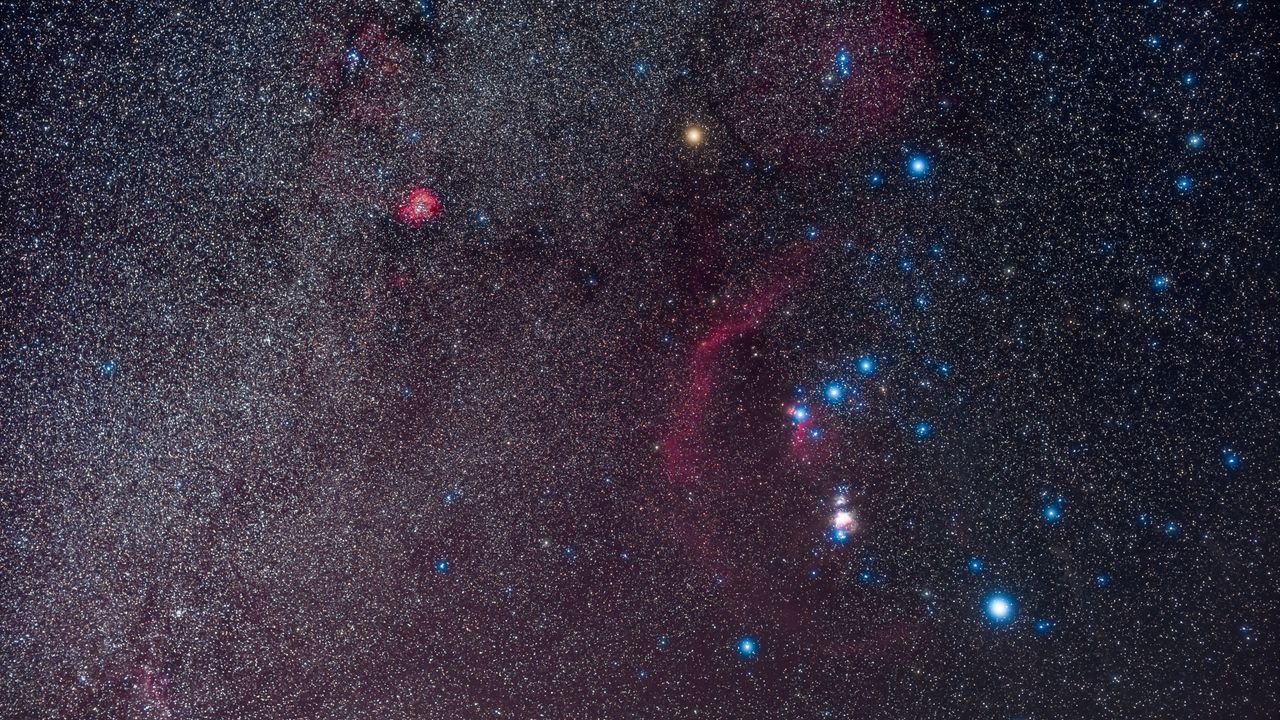
The Hunter’s Iconic Signature (Image Credits: Cdn.mos.cms.futurecdn.net)
Clear winter nights transform the heavens into a showcase for Orion’s Belt, where three supergiant stars captivate observers with their unmatched brilliance.
The Hunter’s Iconic Signature
Orion strides across the southeastern sky as evening deepens, reaching its peak high in the south around 8 p.m. local time before descending westward by 2 a.m. This dramatic arc repeats nightly, making the constellation a winter staple for skywatchers. Central to the figure stands its belt – a precise line of three second-magnitude stars spanning 2.3 degrees.
From east to west, the trio consists of Alnitak, Alnilam, and Mintaka. Their even spacing and similar glow create one of the sky’s most memorable patterns. Astronomers have long noted this alignment’s rarity among constellations.[1][2]
Supergiant Power in Blue Fire
These stars qualify as blue supergiants, among the Milky Way’s most luminous residents. Their distances vary from 900 to 2,000 light-years, yet they blaze with luminosities exceeding 200,000 times that of the Sun on average. Hot and youthful, they anchor Gould’s Belt, a striking band of blue giants tracing the galaxy’s disk.[1]
Short-lived by stellar standards, these giants fuse elements at a furious pace, surviving mere millions of years compared to the Sun’s billions. Nearby, Betelgeuse at 500 light-years glows up to 15,000 times brighter as a red supergiant, while Bellatrix lies just 250 light-years distant. Together, they complete Orion’s hunter silhouette against the winter backdrop.
Timeless Tales from Ancient Skies
Orion’s Belt has inspired stories across cultures for millennia. The Bible references it in Job 38:31, questioning if one could “loose the bands of Orion.” Greenlanders viewed the stars as lost seal hunters adrift at sea.
- Chinese observers saw a weighing beam in their alignment.
- Australian Aboriginal tales depicted three young men dancing to Pleiades music.
- Early translations explicitly named “the belt of Orion.”
Astronomer Robert H. Baker captured its enduring appeal: “The same drama will be repeated next winter, and the next. Each year it will be watched by vast and appreciative audiences as it has been watched since man first turned intelligent eyes to the heavens.”[2]
Winter’s Edge for Unrivaled Views
Cold air sharpens atmospheric clarity, revealing fainter stars amid Orion’s glow. The constellation appears opposite the galactic center toward Sagittarius, thinning the Milky Way’s band for a cleaner vista of individual beacons. Summer skies, by contrast, crowd with stars near the core.
Observers in the Northern Hemisphere catch Orion best from January evenings, when the belt hovers prominently around 9 p.m.[3]) Light pollution fades its impact less than dimmer patterns.
Glimpsing the Cosmic Giants
Locate Orion by its “shoulders” Betelgeuse and Bellatrix, then trace downward to the belt. No telescope needed – the naked eye suffices on moonless nights. Follow the line to Sirius, the sky’s brightest star, or upward to Aldebaran in Taurus.
| Star | Distance (light-years) | Notable Trait |
|---|---|---|
| Alnitak | 1,260 | Eastern anchor, multiple system |
| Alnilam | ~2,000 | Brightest at 375,000 Sun luminosities |
| Mintaka | 1,200 | Western end, ~250,000 Sun luminosities combined |
Key Takeaways
- Orion’s Belt stars outshine the Sun by over 200,000 times collectively, dominating winter views.
- Blue supergiants burn briefly but fiercely in our galaxy’s spiral arms.
- Step outside this winter – scan south after dusk for a timeless spectacle.
Orion’s Belt reminds us of the universe’s raw power, visible yet profoundly distant. What catches your eye under these winter stars? Share in the comments.