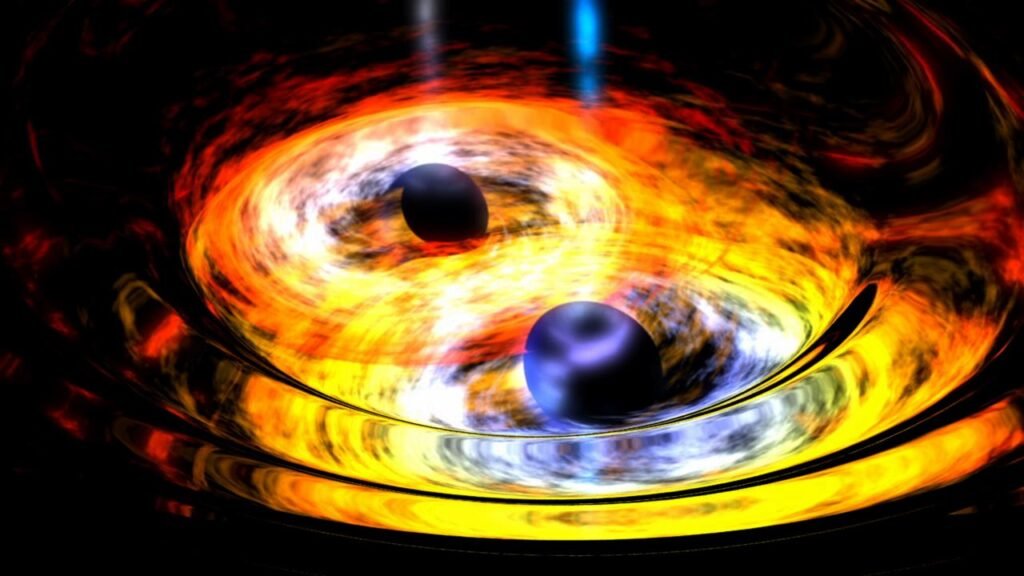
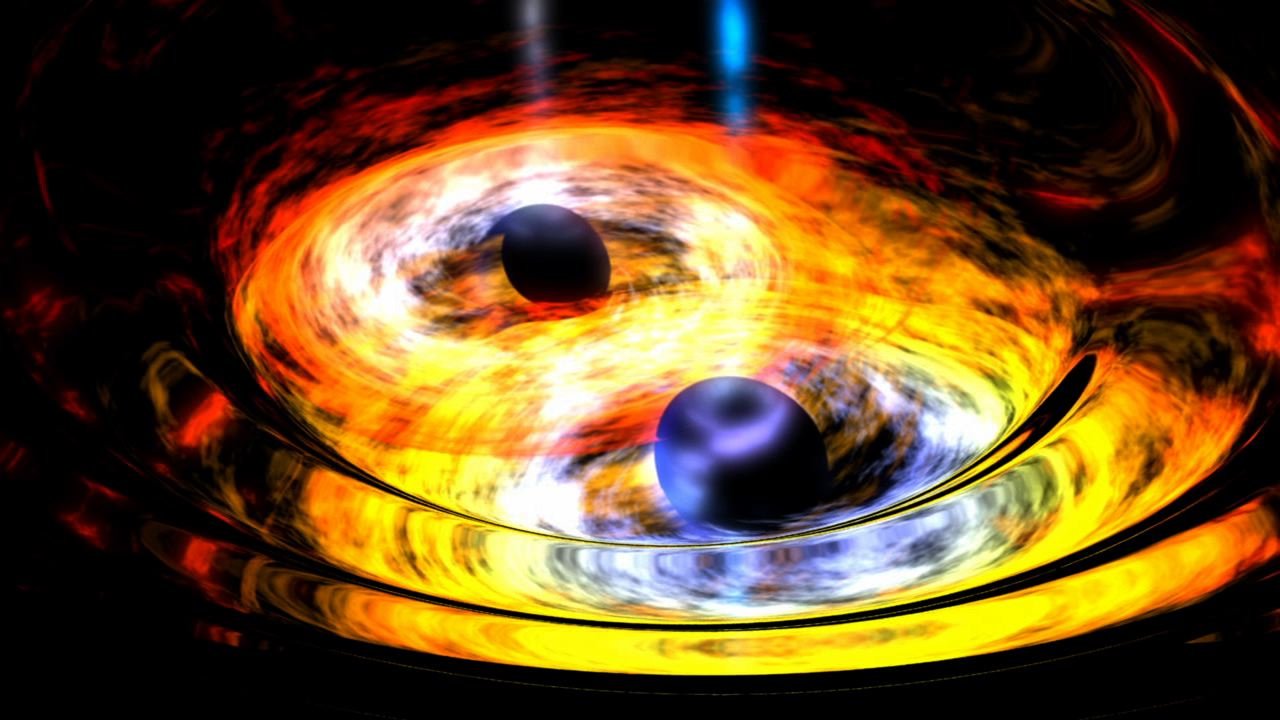
Shifting from Background Noise to Individual Sources (Image Credits: Upload.wikimedia.org)
New Haven, Connecticut – An international team including Yale University researchers has engineered a detection framework that harnesses gravitational waves to identify and chart the positions of supermassive black hole binaries across the cosmos.[1][2]
Shifting from Background Noise to Individual Sources
The North American Nanohertz Observatory for Gravitational Waves (NANOGrav) announced in 2023 the first direct evidence of a low-frequency gravitational wave background, a cosmic hum generated by countless merging supermassive black hole pairs.[1] Scientists now seek to isolate signals from specific binaries amid this din, much like distinguishing individual voices in a crowd.
This advance builds on pulsar timing arrays, networks of precisely monitored millisecond pulsars that serve as galactic clocks. Distortions in their timing signals reveal passing gravitational waves. The new protocol marks the first targeted searches for continuous waves from individual sources, offering concrete benchmarks for future efforts.[3]
Harnessing Pulsars to Probe Cosmic Collisions
Pulsars, the dense remnants of exploded massive stars, spin rapidly and beam radio pulses with clockwork precision. NANOGrav tracks dozens of these across the sky, using timing residuals—minuscule deviations in pulse arrival—to detect spacetime ripples from distant mergers.
The team combined this with electromagnetic data from quasars, bright beacons powered by infalling gas around black holes. Prior research showed mergers occur five times more often in quasar-hosting galaxies. This insight guided an end-to-end search framework, prioritizing active galactic nuclei where binaries likely lurk.[1]
Spotlighting Two Prime Candidates
Researchers scoured 114 active galactic nuclei, mostly flagged by the Catalina Real-Time Transient Survey for periodic light variations hinting at orbiting black holes. Two stood out: SDSS J1536+0411, dubbed “Rohan” after Yale undergraduate Rohan Shivakumar who first analyzed it, and SDSS J0729+4008, named “Gondor” in a nod to J.R.R. Tolkien’s tales where beacons summon allies.
Chiara Mingarelli, Yale assistant professor of physics and NANOGrav member, explained the naming: “Rohan was first, for Rohan Shivakumar, the Yale student who first analyzed it, and Gondor was next, because, well—the beacons were lit!”[1] Though tests confirmed these signals as noise-consistent, they sharpened upper limits on gravitational strain by a median factor of 2.2 compared to all-sky scans.[3]
- Rohan (SDSS J1536+0411): Gravitational wave frequency around 21 nanohertz, redshift 0.38.
- Gondor (SDSS J0729+4008): Frequency near 14 nanohertz, closer at redshift 0.074.
- Search involved NANOGrav’s 15-year dataset from 68 pulsars.
- Bayesian analysis yielded modest Bayes factors, disfavoring signals after corrections.
Charting a Path for Multimessenger Astronomy
The framework, detailed in a study published in The Astrophysical Journal Letters, sets rigorous protocols including coherence checks and trials accounting.[3] Yale contributors included Priyamvada Natarajan, chair of astronomy; Paolo Coppi; and students Forrest Hutchison, Bjorn Larsen, Qinyuan Zheng, Ellis Eisenberg, and Yu-Ting Chang.
Mingarelli noted, “Our work has laid out a roadmap for a systemic supermassive black hole binary detection framework.”[2] Confirmed detections could anchor maps of the wave background, linking mergers to galaxy evolution and testing general relativity on cosmic scales. NANOGrav plans ongoing hunts with extended data.
Such maps promise insights akin to how X-rays unveiled hot plasmas and radio waves traced jets, revolutionizing black hole astrophysics. Even modest binaries will illuminate galaxy merger histories and gravitational wave theory.
Key Takeaways
- First benchmarks for pulsar timing searches targeting individual continuous gravitational waves.
- Two candidates emerged from 114 galaxies, guiding follow-up protocols despite noise consistency.
- Strain limits improved up to 15-fold for nearby sources, constraining binary parameters.
This beacon-like system heralds precise cosmic cartography. What potential discoveries excite you most? Share in the comments.