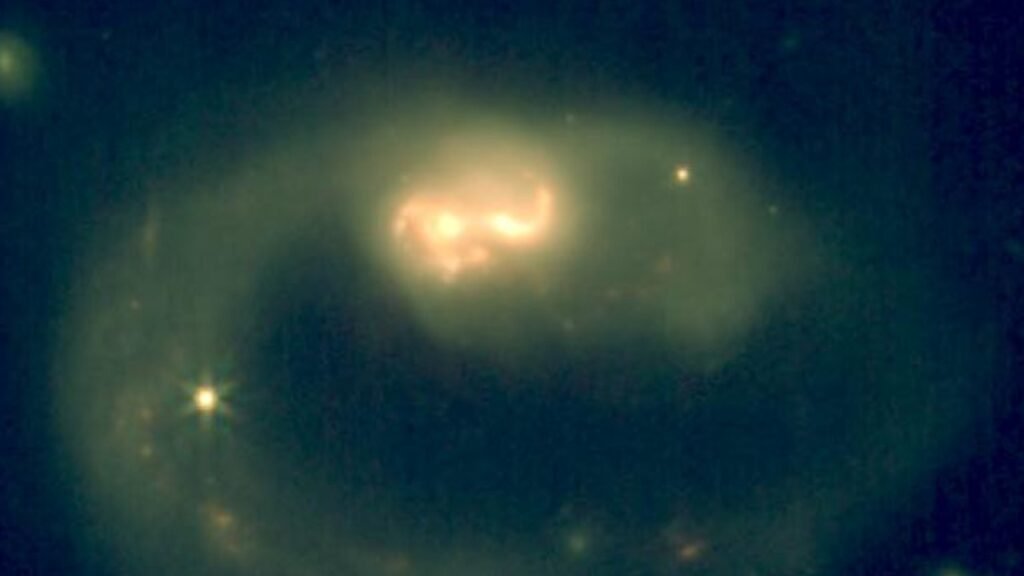
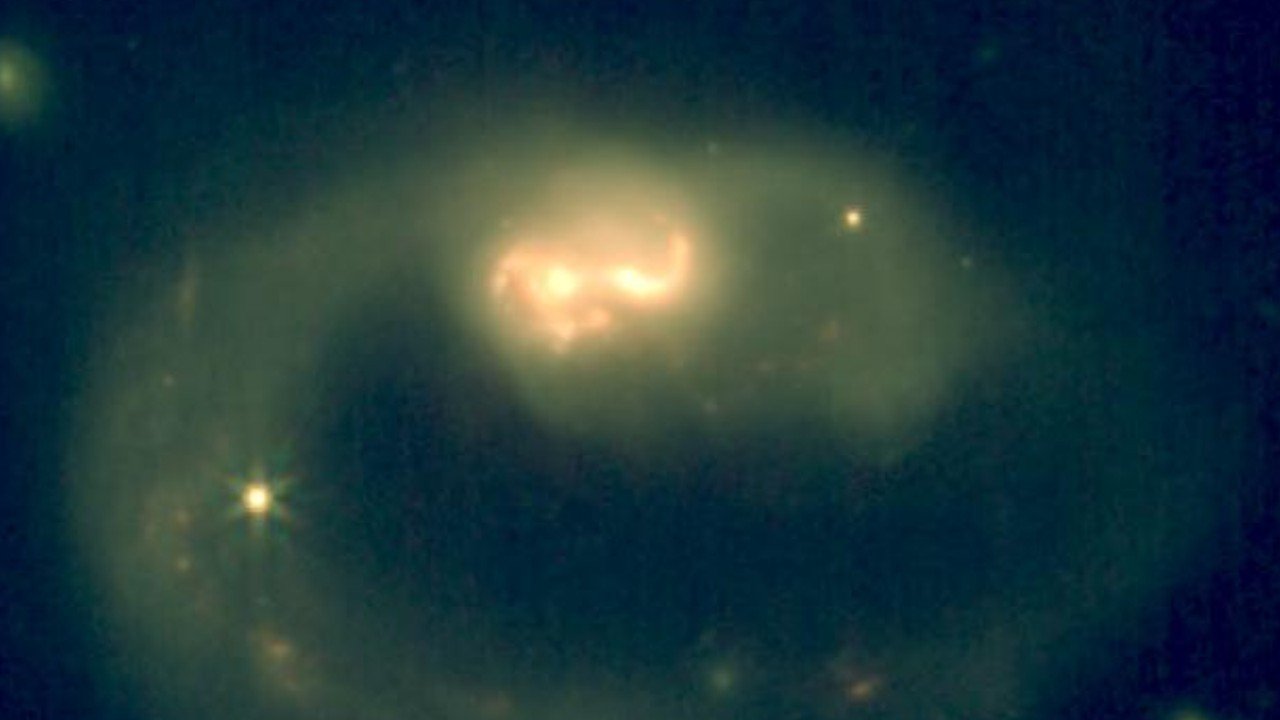
Unexpected Complexity Emerges (Image Credits: Cdn.mos.cms.futurecdn.net)
The James Webb Space Telescope pierced the thick veil of gas and dust shrouding the core of the nearby ultra-luminous infrared galaxy IRAS 07251–0248 to reveal an astonishingly rich collection of small organic molecules.[1][2]
Unexpected Complexity Emerges
Astronomers anticipated a relatively straightforward chemical makeup in such extreme environments, yet the observations delivered a shock: far more organic compounds than any model predicted.
Researchers analyzed spectra from JWST’s NIRSpec and MIRI instruments across 3 to 28 microns, capturing signatures of gas-phase molecules alongside ices and dust grains. The data exposed a bustling chemical factory powered by the galaxy’s buried supermassive black hole.[3]
This ultra-luminous infrared galaxy, one of the brightest in infrared light within the local universe, had long defied study due to its obscuration. JWST’s infrared prowess finally unlocked its secrets.
Hydrocarbons Dominate the Inventory
The spectrum brimmed with small hydrocarbons, many at elevated levels. Lead author Dr. Ismael García Bernete, now at Spain’s Center for Astrobiology, noted the surprise in abundances.
Key detections included:
- Benzene (C6H6)
- Methane (CH4)
- Acetylene (C2H2)
- Diacetylene (C4H2)
- Triacetylene (C6H2)
- Methyl radical (CH3), spotted for the first time beyond the Milky Way
Solid materials abounded too, with carbonaceous grains and water ices contributing to the layered structure: a hot core, warm molecular zone, and cold outer envelope.[4]
Cosmic Rays Fuel the Reaction
Standard explanations like intense heat or gas turbulence fell short. Instead, evidence pointed to cosmic rays as the driver.
These high-energy particles, prevalent near active black holes, shattered polycyclic aromatic hydrocarbons (PAHs) and carbon-rich dust, injecting small organics into the gas. A correlation emerged between hydrocarbon levels and cosmic-ray ionization rates across similar galaxies.[1]
“We found an unexpected chemical complexity, with abundances far higher than predicted by current theoretical models,” Dr. García Bernete stated. “This indicates that there must be a continuous source of carbon in these galactic nuclei fueling this rich chemical network.”[2]
Steps Toward Prebiotic Building Blocks
Though not life’s direct components, these molecules represent crucial precursors in organic synthesis. They hint at pathways to amino acids and nucleotides.
Co-author Professor Dimitra Rigopoulou of the University of Oxford emphasized their potential: “Although small organic molecules are not found in living cells, they could play a vital role in prebiotic chemistry, representing an important step towards the formation of amino acids and nucleotides.”[3]
The findings, detailed in Nature Astronomy, suggest obscured nuclei serve as cosmic organic factories, advancing galactic chemical evolution.
Key Takeaways
- JWST unveiled unprecedented organic richness in IRAS 07251–0248’s nucleus.
- Cosmic rays drive PAH and grain destruction, boosting gas-phase hydrocarbons.
- These precursors illuminate prebiotic chemistry in extreme settings.
This breakthrough underscores JWST’s power to probe hidden cosmic realms and reshape views on interstellar chemistry. How might such factories influence life’s spread across the universe? Share your thoughts in the comments.