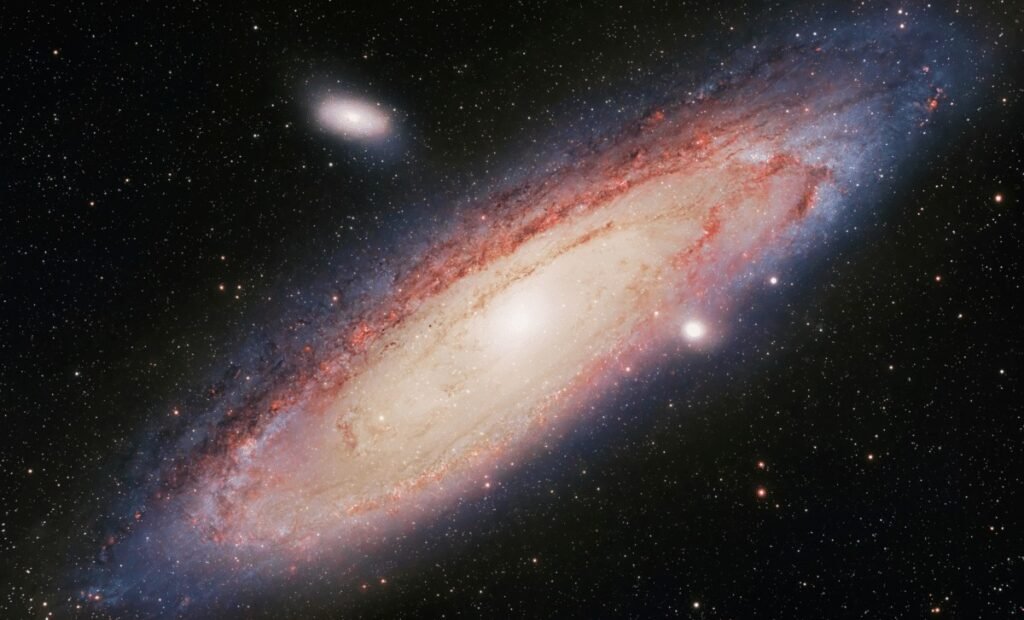
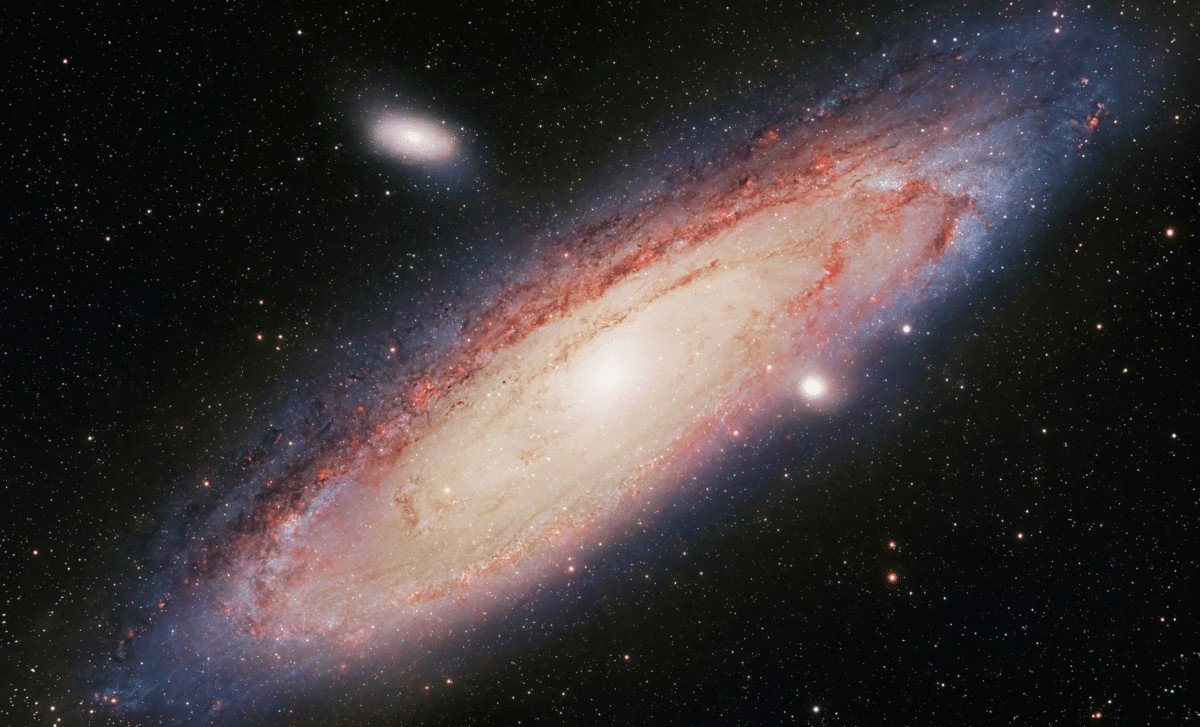
Andromeda Defies the Cosmic Flow (Image Credits: Dailygalaxy.com)
Astronomers have uncovered a striking explanation for why the Andromeda galaxy barrels toward our Milky Way while neighboring galaxies drift outward.[1][2]
Andromeda Defies the Cosmic Flow
Researchers revealed a perplexing pattern in galactic motions. Andromeda hurtles toward the Milky Way at 110 kilometers per second, defying the universal expansion described by Hubble’s law.[1]
This law states that galaxies recede from each other at speeds proportional to their distance. Yet Andromeda, just 2.5 million light-years away, shows a blueshift indicating approach. Other nearby galaxies, however, resist the Local Group’s gravity and move away faster than expected.[2]
Simon White, co-author of the study and director emeritus at the Max Planck Institute for Astrophysics, noted that galaxies within about 8 million light-years recede slower than predicted, while those farther out speed away quicker.[1]
A Flattened Realm of Invisible Mass
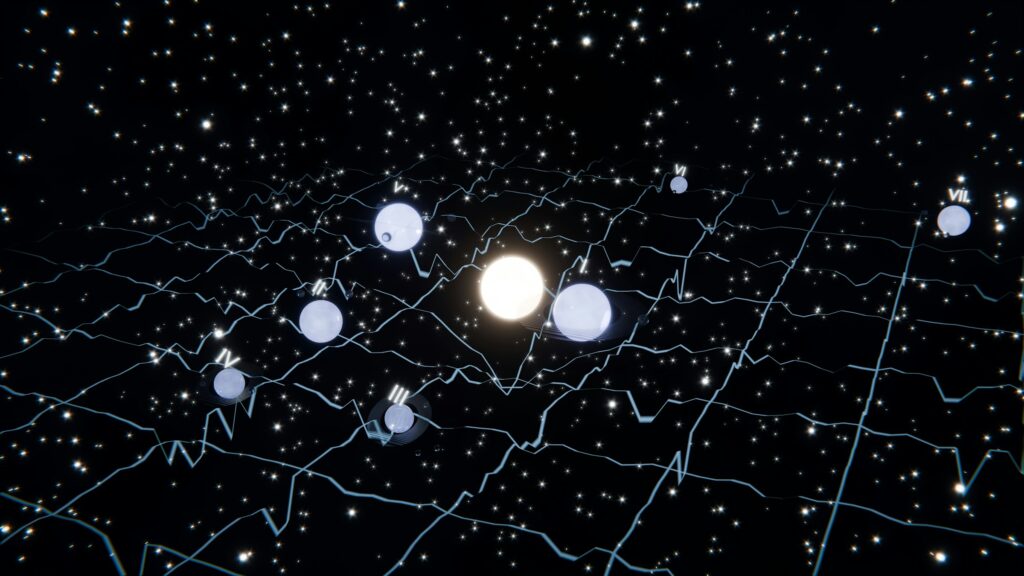
The solution emerged from detailed simulations of the local universe. A vast, flat sheet of dark matter and ordinary matter envelops the Local Group, spanning tens of millions of light-years.[1]
This sheet counteracts the gravitational tug of the Milky Way and Andromeda on external galaxies. Instead of slowing their recession, the flattened distribution pulls them outward, balancing the inward force precisely.[2]
White explained that a spherical mass distribution would decelerate nearby galaxies, but the sheet’s geometry creates the observed acceleration. Above and below this plane lie immense voids, regions of lower initial density that expanded rapidly, shoving matter into these walls.[1]
No galaxies occupy those voids, so none else plunge toward us like Andromeda.
Simulations Reconstruct Cosmic History
Lead author Ewoud Wempe and colleagues at the University of Groningen modeled the universe from its infancy. They started with mass distributions in the cosmic microwave background, light from when the universe was 380,000 years old.[1]
The simulations incorporated positions, masses, and velocities of the Milky Way, Andromeda, and 31 nearby galaxies up to 32 million light-years distant. Results matched observations perfectly, validating the lambda cold dark matter model.[2]
- Dark matter halos bind Milky Way and Andromeda, driving their mutual approach.
- The sheet embeds external galaxies, repelling them from the Local Group.
- Voids explain the absence of other inbound galaxies.
- High-latitude galaxies fall toward the sheet at hundreds of kilometers per hour.
Reshaping Views of Local Cosmology
This discovery reconciles long-standing tensions between observations and theory. Earlier work hinted at extra mass around Andromeda and the Milky Way, as noted in 1959 by Franz Kahn and Lodewijk Woltjer.[1]
The study appeared in Nature Astronomy, affirming dark matter’s pivotal role in sculpting our cosmic neighborhood. Future models may probe how gravity forges such structures.
Key Takeaways
- A flat dark matter sheet resolves Andromeda’s anomalous motion amid expansion.
- Simulations align local dynamics with Big Bang-era data.
- Voids and walls highlight uneven matter distribution in the nearby universe.
This flat cosmic canvas not only clarifies Andromeda’s path but also underscores the intricate gravitational dance governing our galactic home. What implications might this hold for the predicted merger billions of years hence? Share your thoughts in the comments.