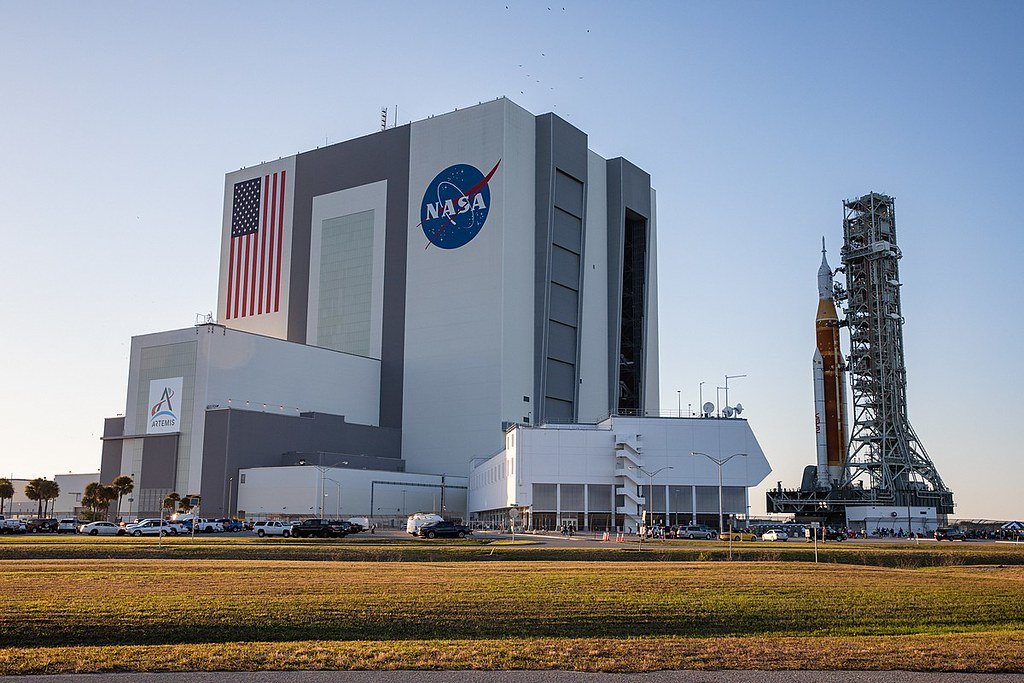
A Dress Rehearsal Like No Other (Image Credits: Flickr)
Teams at NASA’s Kennedy Space Center in Florida conducted a comprehensive wet dress rehearsal for the Artemis II mission, simulating the full spectrum of launch operations ahead of the first crewed flight of the Space Launch System rocket and Orion spacecraft.[1][2]
A Dress Rehearsal Like No Other
The wet dress rehearsal represented the final major test mimicking launch day, where engineers loaded cryogenic propellants into the SLS core stage and interim cryogenic propulsion stage while practicing countdown sequences and scrub procedures.[1] Secured atop the mobile launcher at Launch Pad 39B, the towering SLS rocket and Orion capsule underwent scrutiny from integrated teams across NASA centers, ensuring every system aligned for the crewed lunar orbit flight.[1]
This exercise verified ground and vehicle performance under real conditions, from chilling propellant lines to sealing hatches. Controllers at Kennedy coordinated with mission control in Houston and other sites, pausing at precise holds to replicate potential delays. The countdown clock started at 8:13 p.m. EST on February 2, targeting a simulated launch window shortly after.[1]
Navigating the Countdown Timeline
Early phases focused on powering up the core stage and ICPS between L-39 and L-38 hours, followed by preparations for the four RS-25 engines. Technicians filled the sound suppression water tank and prepped liquid oxygen and hydrogen systems around L-48 to L-39 hours.[1] A 2-hour-15-minute hold at L-11 hours 40 minutes allowed weather and tanking polls before initiating chills and fills.
Here are key milestones in the sequence:
- L-49 hours 15 minutes: Launch team arrives on console, countdown begins.
- L-15 hours: Non-essential personnel clear Launch Complex 39B; Ground Launch Sequencer activates.
- L-4 hours 40 minutes: 40-minute hold for closeout crew to access the white room.
- L-40 minutes: 30-minute hold for final configurations.
- T-10 minutes: Terminal count starts via Ground Launch Sequencer.
The rehearsal included two terminal counts, pausing at T-1 minute 30 seconds, resuming to T-33 seconds, then recycling for a second run.[1]
Propellant Ops and Crew Module Closeouts
Tanking operations mirrored launch day: slow fill, fast fill, topping, and replenish for LOX and LH2 in the core stage and ICPS. Lines chilled, vents tested, and Orion underwent cold soak to handle the cryogenic environment.[1] Closeout crews rehearsed sealing the Orion crew module hatch and Launch Abort System hatch, performing leak checks and pressure verifications.
In the terminal phase, the crew access arm retracted at T-8 minutes, core stage tanks pressurized at T-6 minutes, and auxiliary power units spun up at T-4 minutes. Power shifted to internal sources as the clock ticked toward T-33 seconds, where teams practiced cutoffs and recycles.[3] Though the Artemis II crew – Commander Reid Wiseman, Pilot Victor Glover, Mission Specialists Christina Koch and Jeremy Hansen – did not participate directly, these steps honed procedures for their flight.[1]
Toward a Lunar Orbit Milestone
The mission will send the four astronauts on a 10-day journey around the Moon and back, validating systems for future landings. No later than April 2026, Artemis II builds on uncrewed tests, paving the way for sustained lunar presence.[1]
Live streams captured tanking and updates via NASA’s Artemis page, engaging global audiences in this engineering feat.[1]
Key Takeaways
- Wet dress rehearsal confirmed propellant loading and countdown readiness for SLS and Orion.
- Teams practiced dual terminal counts and hatch closeouts critical for crew safety.
- Exercise positions Artemis II for launch no later than April 2026.
This rehearsal solidified NASA’s path to returning humans to the Moon’s vicinity, demonstrating precision amid complexity. What aspects of the Artemis program excite you most? Share in the comments.