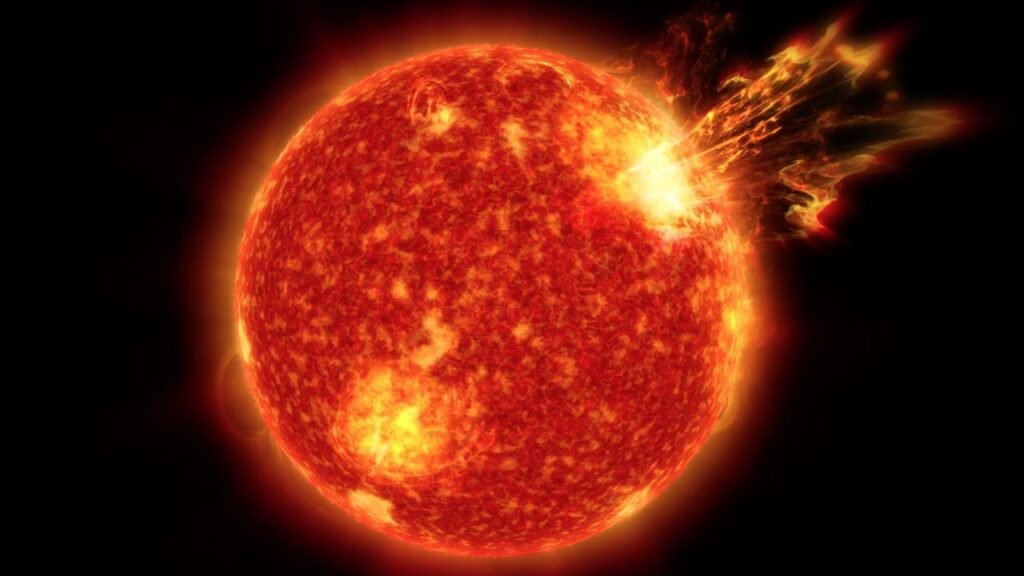
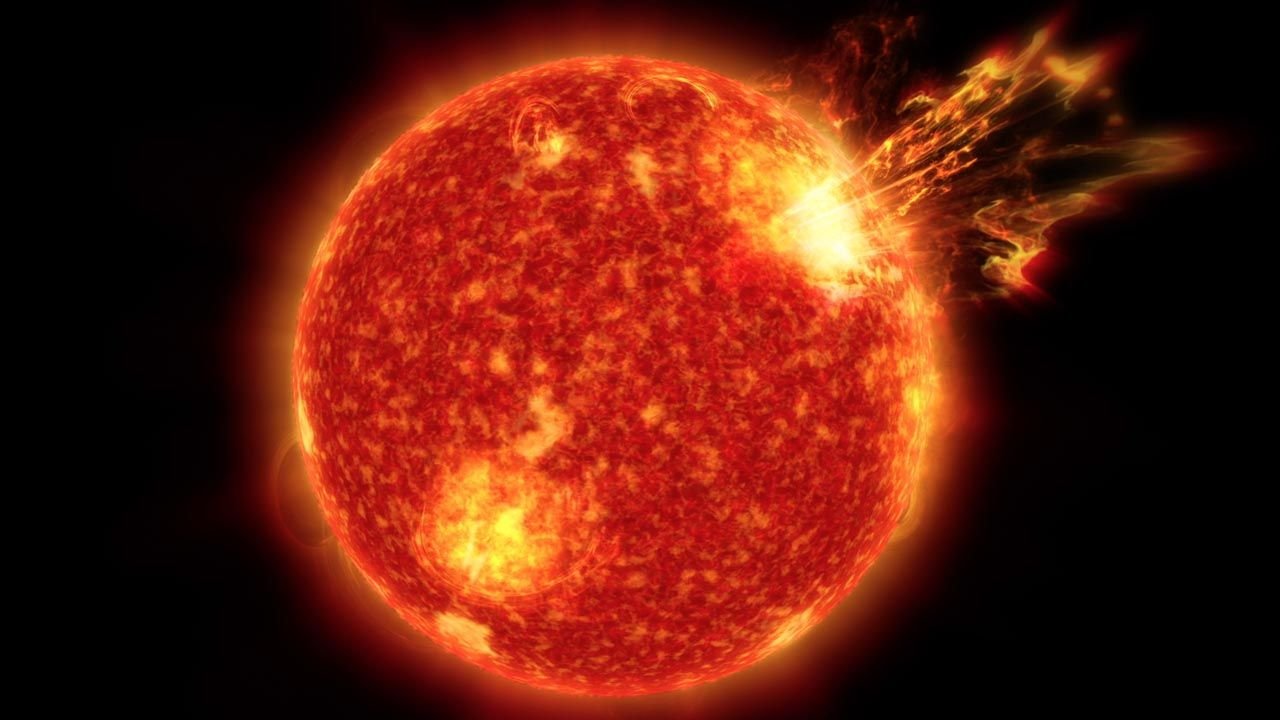
A Spectacular Stellar Explosion Unfolds (Image Credits: Cdn.mos.cms.futurecdn.net)
Astronomers recently documented a colossal plasma eruption from a nearby sun-like star, providing vital clues to the mechanisms powering rare and powerful superflares.[1][2]
A Spectacular Stellar Explosion Unfolds
Researchers turned their telescopes toward EK Draconis, a youthful G-type star roughly 60 light-years away, and caught a dramatic event in action. The star unleashed a superflare accompanied by a massive prominence eruption, hurling vast amounts of plasma into space.[3][4]
This outburst dwarfed anything observed on the sun. The prominence, a towering filament of cool plasma suspended in the star’s hot corona, erupted at speeds exceeding 1,000 kilometers per second – far surpassing the star’s escape velocity.[5]
Such events challenge existing models of stellar activity. EK Draconis, aged between 50 and 120 million years, mirrors the sun’s early vigorous phase, when rapid rotation fueled intense magnetic fields.[6]
Precision Observations Crack the Case
A multiwavelength campaign targeted the star over 12 days, combining data from space telescopes and ground-based instruments. Telescopes like the Transiting Exoplanet Survey Satellite (TESS) and the Seimei Telescope in Japan captured the flare’s evolution from optical to X-ray wavelengths.[6]
Scientists detected multi-temperature signatures of a coronal mass ejection (CME), confirming the link between superflares and planet-scale ejections on young stars. This marked one of the clearest views yet of such a process on a solar analog.[7]
- The superflare released energy up to 5 × 1034 ergs, thousands of times a typical solar flare.
- Prominence mass equaled trillions of tons, rivaling the largest solar events.
- High-velocity ejecta suggested instability in the star’s magnetic field lines.
- Observations spanned five years, revealing frequent activity on EK Draconis and similar stars like V889 Hercules.[3]
- Spectroscopic data showed blue-shifted emissions indicative of outward motion.
Bridging Solar Flares to Cosmic Giants
Superflares puzzled astronomers for years because sun-like stars rarely produce them today. Yet surveys of thousands of stars revealed they occur roughly once per century on solar twins.[8]
The EK Draconis event clarified the role of prominences: these structures store magnetic energy until they destabilize, triggering explosive releases. On the modern sun, smaller versions contribute to CMEs that drive space weather.[9]
This discovery refined theories. Young stars’ faster rotation amplifies dynamos, breeding giant spots and tangled fields prone to reconnection.[2]
| Feature | Sun Today | EK Draconis |
|---|---|---|
| Age | 4.6 billion years | 50-120 million years |
| Rotation Period | ~25 days | ~2-5 days |
| Flare Energy | Up to 1032 ergs | Up to 1034 ergs |
| CME Frequency | Occasional | Frequent and massive |
What It Means for Exoplanets and Earth
These insights extend to exoplanet habitability. Planets orbiting young sun-like stars face relentless bombardment from superflares and CMEs, potentially stripping atmospheres or sterilizing surfaces.[10]
Earth’s early history likely endured similar assaults, shaping life’s resilience. Modern space weather forecasts benefit too, as models incorporating stellar analogs improve predictions.[7]
Key Takeaways:
- EK Draconis’ eruption confirmed CMEs accompany superflares on young stars.
- Multi-year monitoring shows frequent massive events, unlike the quiescent sun.
- Findings enhance understanding of stellar evolution and space weather risks.
Observations like this propel stellar physics forward, revealing how stars transition from turbulent youth to stable maturity. As telescopes advance, more such events promise deeper revelations. What implications do these cosmic tantrums hold for life beyond Earth? Share your thoughts in the comments.