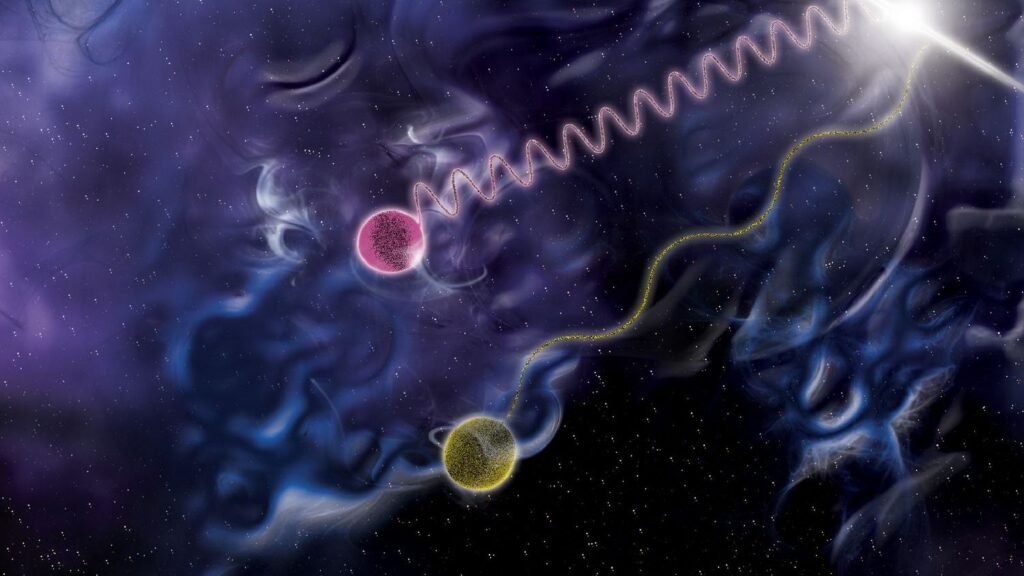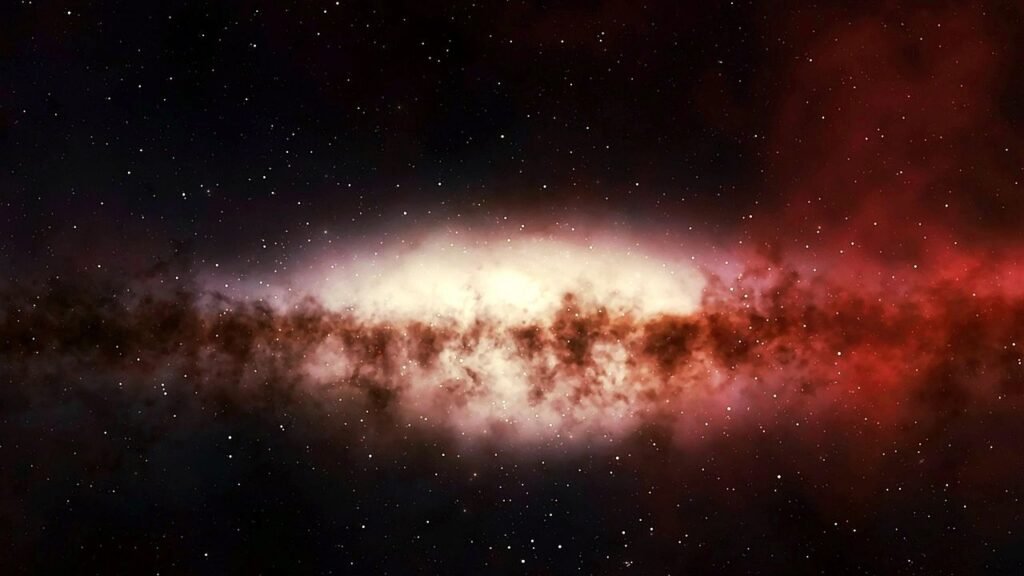

If you’ve ever stared up at the night sky and felt that quiet tug of unease, that sense that something huge is going on and we barely understand any of it, dark matter is that feeling turned into physics. Our best measurements keep shouting the same strange message: most of the universe is made of something we can’t see, can’t touch, and haven’t directly detected, yet it shapes everything.
That sounds like science fiction, but it’s the most grounded conclusion astronomers can reach from mountains of data. Over the past decades, every time we build better telescopes or more precise detectors, the universe leans in closer and whispers the same unnerving secret: the visible cosmos is just the tip of a very dark iceberg.
The Shocking Revelation: Most of the Universe Is Invisible
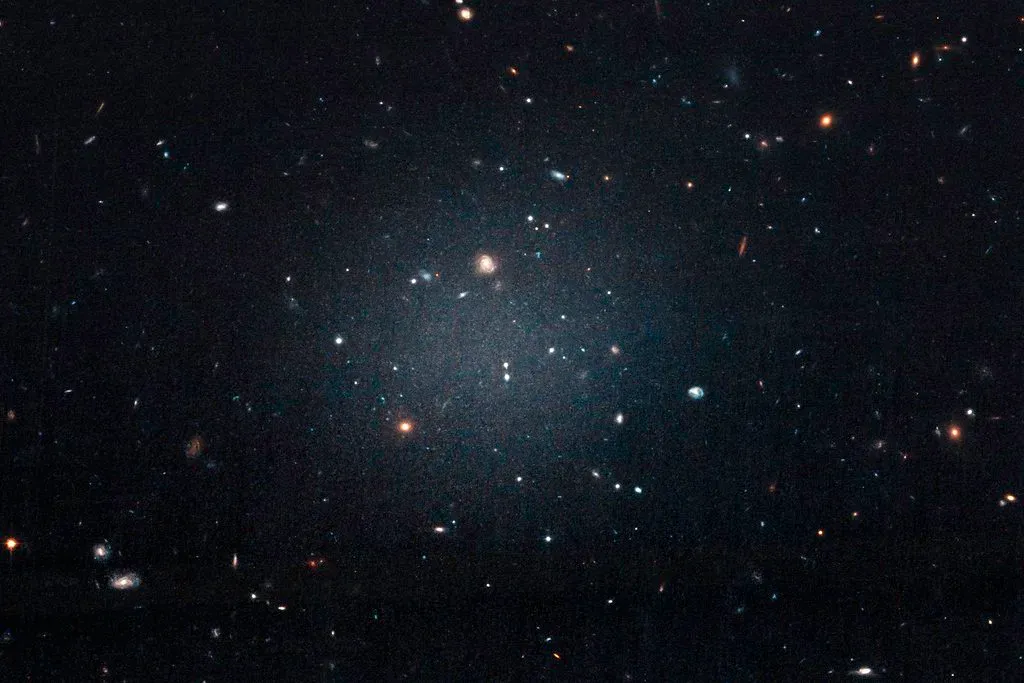
Imagine opening your bank app and realizing that the balance you see is only a small fraction of your real account, but the rest is locked in some mysterious, inaccessible vault. That’s roughly how cosmologists feel about dark matter. All the stars, planets, glowing gas, galaxies, you, me, everything we can see and measure directly – that’s only a minority of the cosmic “budget.” The rest is hidden, yet its gravitational pull is obvious everywhere we look.
Observations of the universe suggest that ordinary matter – the stuff made of atoms – explains only a modest portion of the total. A much larger share is this unseen dark matter, plus an even bigger slice of an even stranger thing called dark energy. The wild part is that dark matter does not glow, does not absorb light, and does not behave like any familiar substance. It mostly reveals itself by how it tugs on stars and galaxies, as if a ghostly scaffolding is propping up the architecture of the cosmos.
Galaxy Rotation: The First Clue Something Was Terribly Off
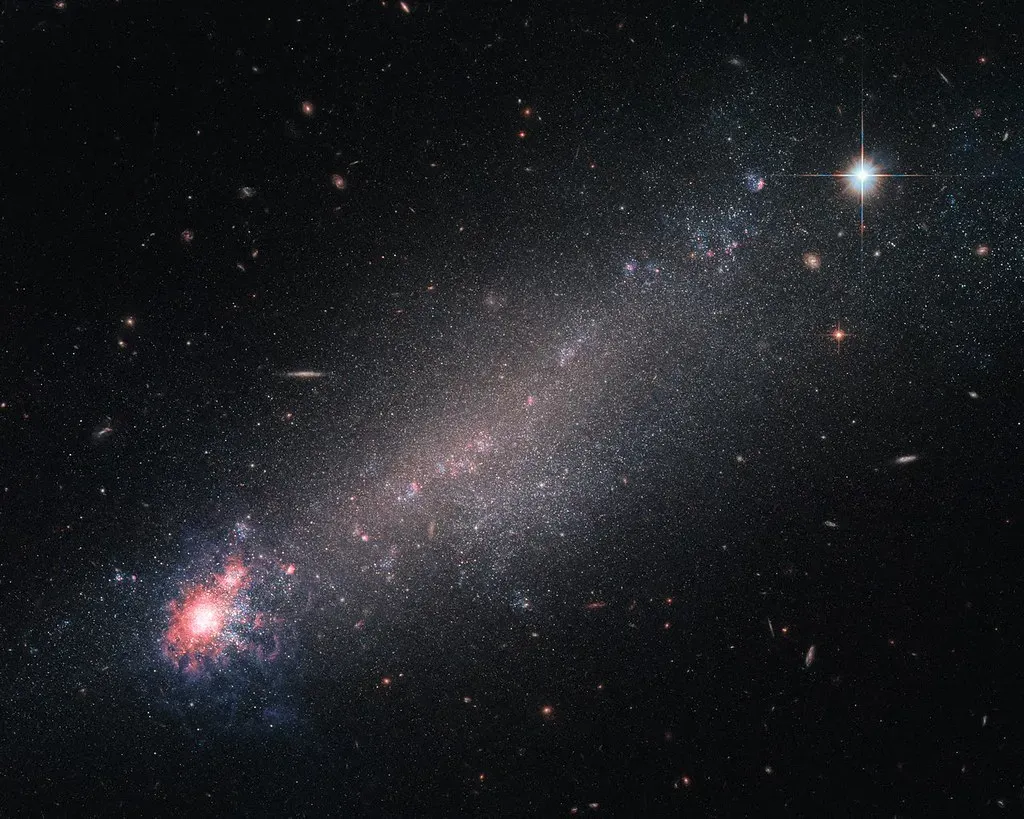
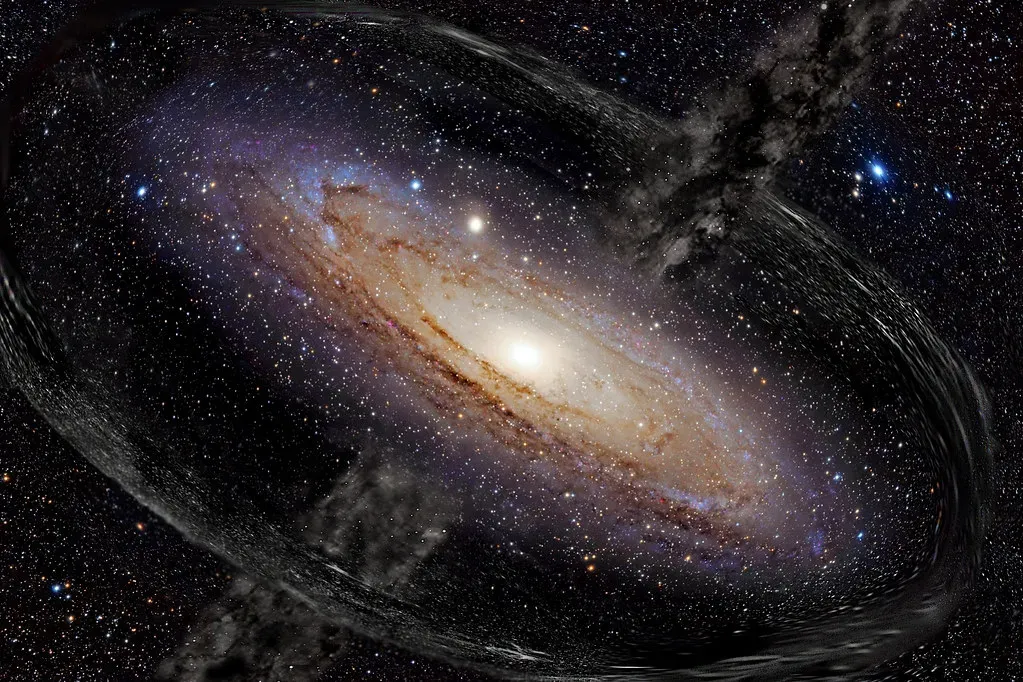
In the twentieth century, astronomers mapping how quickly stars orbit around galaxies stumbled on something that simply should not happen if only visible matter existed. Far from the galactic center, where there are fewer stars and less gas, stars should orbit more slowly, just like planets farther from the Sun move at more leisurely speeds. Instead, they found that stars in the outer regions of galaxies were whipping around far too fast to be held in place by the visible material alone.
If these galaxies contained only the matter we can see, they should have flown apart long ago. The fact that they are still intact strongly hints at something massive, invisible, and spread out like a halo, wrapping galaxies in a dark cocoon of extra gravity. Over time, this pattern has been measured in galaxy after galaxy, across different telescopes and surveys, turning what started as a weird anomaly into one of the most stubborn facts in modern astronomy.
Cosmic Webs and Gravitational Lensing: Dark Matter Shapes the Large-Scale Universe
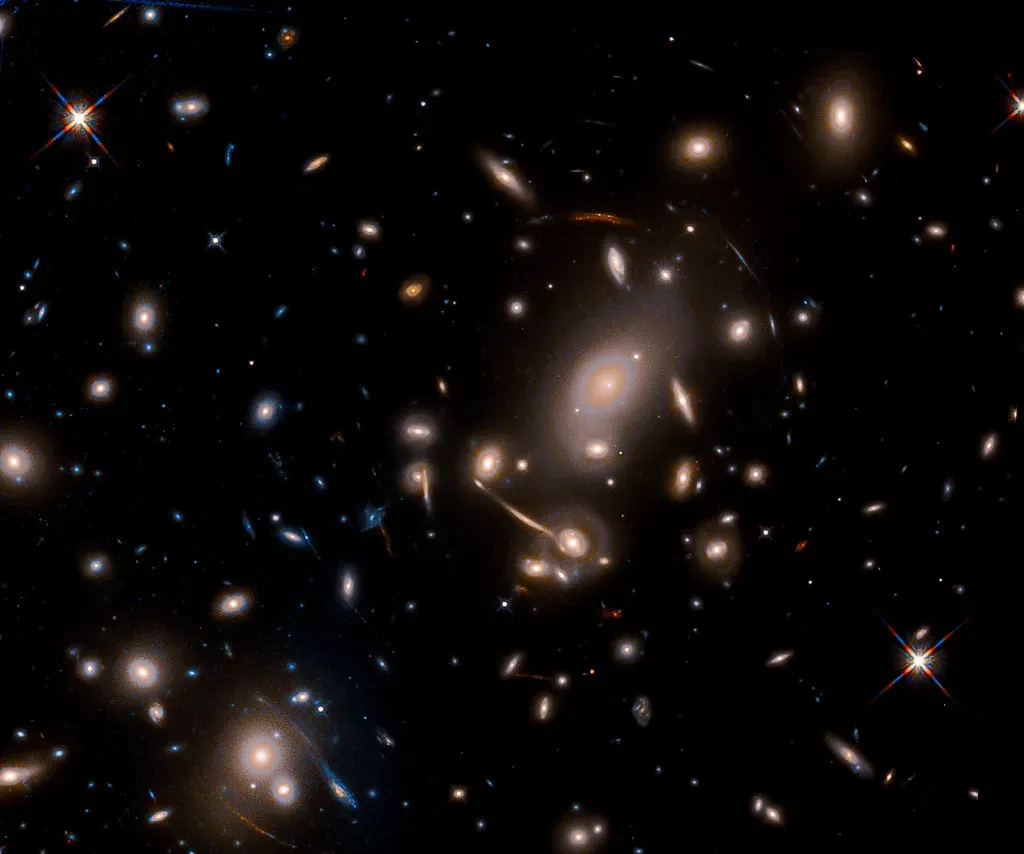
On the grandest scales, the universe doesn’t look like a random scatter of galaxies. It appears more like a three-dimensional spiderweb: filaments of galaxies and clusters stretching across cosmic space, with vast, nearly empty voids between them. Computer simulations that recreate the universe from just after the Big Bang suggest that dark matter acts as the invisible backbone of this structure, clumping first and pulling normal matter into its gravitational wells.
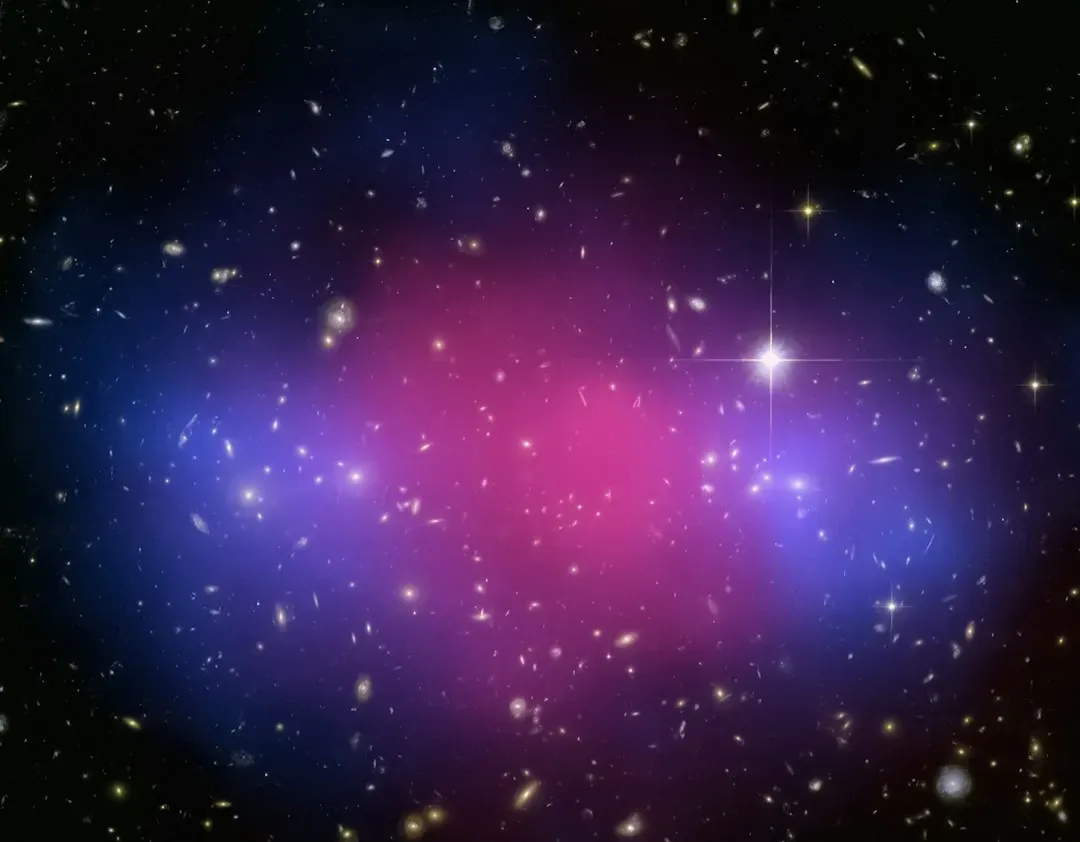
Another striking line of evidence comes from gravitational lensing, where massive objects bend the path of light passing near them. Astronomers observe background galaxies appearing smeared, stretched, or multiplied because something massive is warping space between us and them. When they calculate how much matter would be needed to cause that warping, they repeatedly find far more mass than the visible stars and gas can account for. The lensing patterns draw maps of invisible clumps and filaments, like fingerprints of a hidden skeleton holding the universe together.
What Dark Matter Is Not: Ruling Out the Obvious Suspects
When scientists first realized something invisible was adding gravity, the obvious guess was that it might just be faint, hard-to-see objects: cold stars, dead stellar remnants, black holes, or drifting planets. But detailed surveys and careful counts of such objects showed that, while they exist, they cannot possibly make up the huge missing mass. Their numbers and distribution simply do not add up to the observed gravitational effects.
Other ideas, like tweaking the laws of gravity themselves, have been proposed and seriously explored. A few modified gravity theories can explain some galaxy-scale phenomena, but they struggle badly when confronted with the full, messy range of evidence, especially galaxy clusters and the cosmic microwave background. One stubborn lesson keeps emerging: no simple fix to our existing physics neatly replaces the role dark matter seems to play across scales from galaxies to the entire observable universe.
The Hunt in the Lab: Why We Still Haven’t Caught a Dark Matter Particle
If dark matter is made of some new type of particle, you’d think that after decades of searching we’d have caught one by now. Huge detectors embedded deep underground, shielded from cosmic rays and everyday radiation, have been watching incredibly patiently for tiny, rare interactions between dark matter and ordinary atoms. So far, they’ve seen at most ambiguous hints, but no result strong enough that the community can agree they’ve finally snagged a dark matter particle.
Particle accelerators like the Large Hadron Collider have also been hunting for signs of new physics that could explain dark matter: new particles, new forces, or small cracks in the Standard Model of particle physics. Although some subtle anomalies have sparked intrigue, nothing has decisively shouted “dark matter lives here” yet. The silence from these experiments is becoming almost as interesting as a discovery, forcing theorists to rethink their favorite candidates and expand their imaginations beyond the ideas that dominated the early two thousands.
Radical Possibilities: Dark Sectors, Primordial Black Holes, and Exotic Physics
As each round of experiments narrows the options, theories about dark matter are getting both more creative and more extreme. Some physicists now entertain the idea that dark matter might live in an entire “dark sector” with its own particles and forces, interacting with our familiar world only through gravity and perhaps the faintest of other channels. In that picture, our ordinary matter could be just one small neighborhood in a much larger, more complicated cosmic city.
Others revisit wilder possibilities, such as some fraction of dark matter being made of small, ancient black holes formed shortly after the Big Bang, or of ultralight fields that behave more like waves than particles on galactic scales. Each of these ideas comes with its own predictions and experimental tests. None has yet won the race, but together they underline a sobering idea: to truly understand dark matter, we may need to accept that the universe’s fundamental ingredients and rules are stranger than the physics we have grown comfortable with.
Why Dark Matter Changes How We See Ourselves in the Cosmos
It’s tempting to think of dark matter as just a technical quirk, a niche problem for cosmologists, safely detached from daily life. But there’s a quiet, unsettling philosophical punch behind it: everything we’ve ever known, every story humanity has told under the night sky, has unfolded in a universe where the dominant form of matter is something we did not even know existed until recently. We are late arrivals, fumbling with the light switch in a house whose foundations are mostly hidden.
There’s also a strange kind of humility in realizing that our familiar atoms are more like decorative details than the main structural beams of reality. Dark matter likely dictated where galaxies could form, how they grew, and where stars – and eventually planets and people – could appear. In that sense, our existence is written on the canvas that dark matter stretched across space long before life arose. The more we learn, the more it feels as if we’ve only just opened the first page of a much longer, darker book.
Living with the Unknown in a Darker, Deeper Universe
Dark matter sits at a haunting crossroads between what we know and what we can barely guess. Its fingerprints are pressed into galaxy rotations, cosmic webs, and bent starlight, yet its true nature stays stubbornly beyond our grasp. Every failed detection and every new constraint does not erase the mystery; it sharpens it, like a sketch slowly gaining detail while the main figure remains in shadow.
For now, we live in a universe where the dominant matter is invisible, untouchable, and still unnamed in any everyday sense. That is not just a puzzle for specialists; it is a reminder that reality is far less tame than our intuition suggests. If most of the cosmos is made of something we have not yet seen, what else might we be missing?