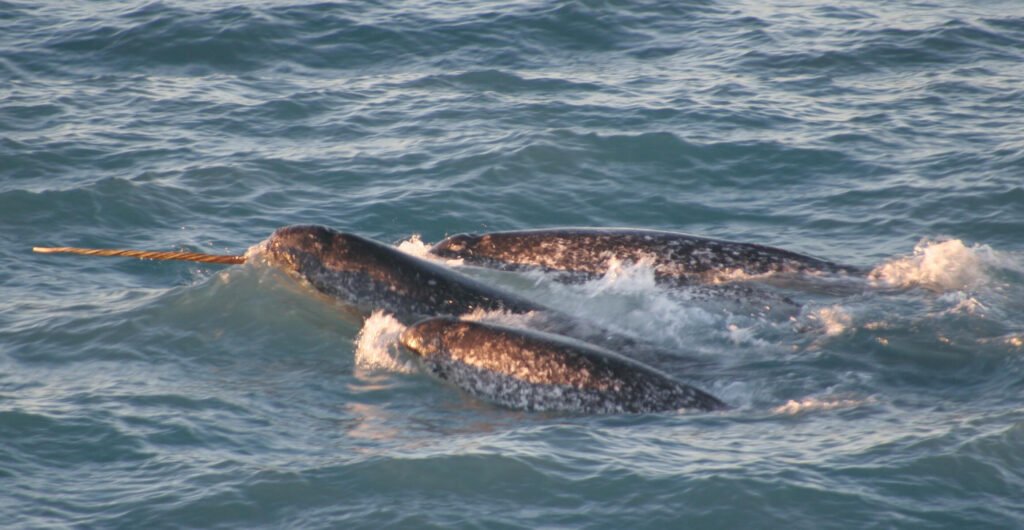
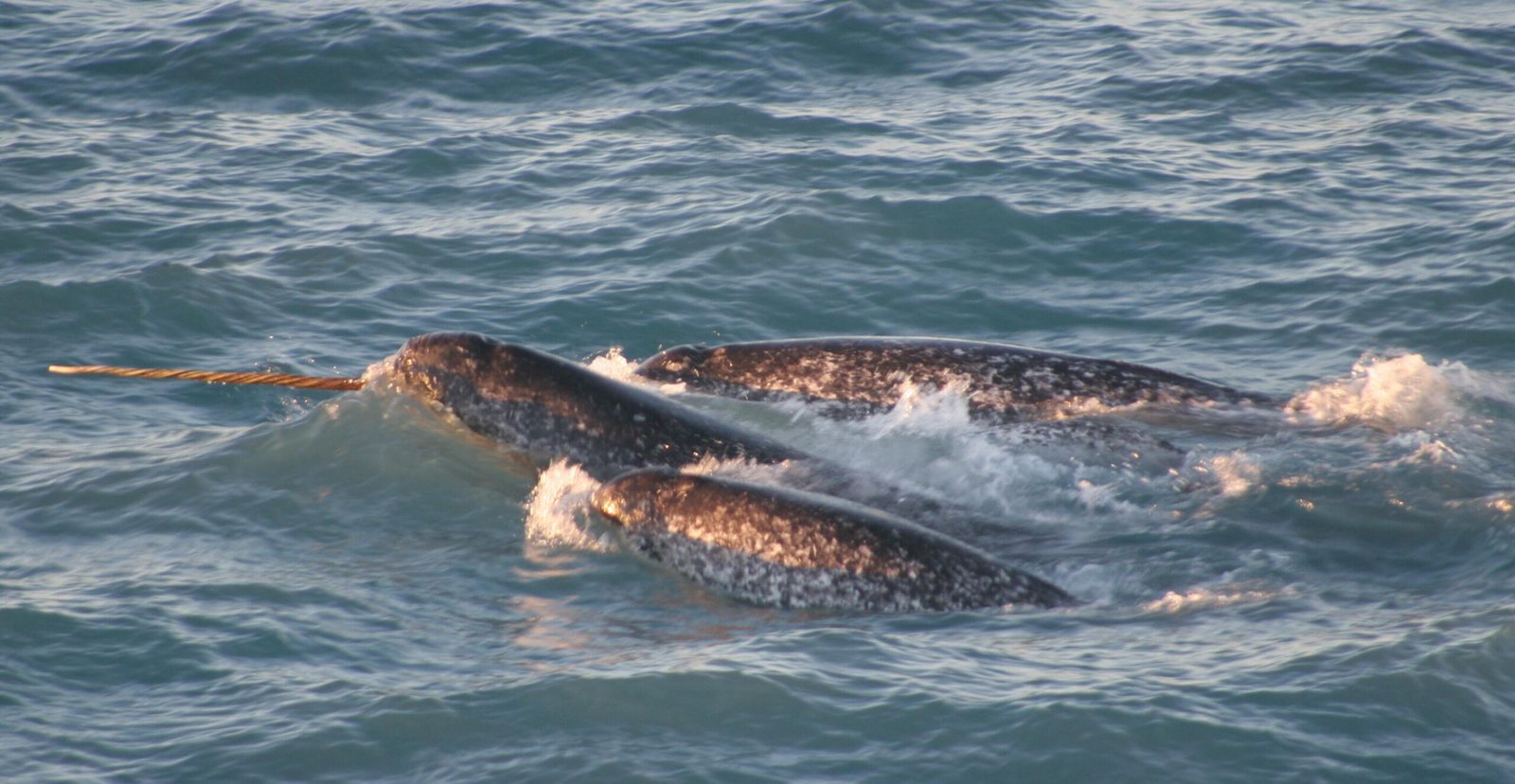
Narwhals’ Acoustic Lifeline Under Threat (Image Credits: Upload.wikimedia.org)
Eclipse Sound, Nunavut – The Arctic’s mysterious narwhals, long dependent on acoustic signals for survival, have begun emitting fewer sounds as vessel traffic disrupts their underwater world.[1][2]
Narwhals’ Acoustic Lifeline Under Threat
These speckled whales, often dubbed the unicorns of the sea for the males’ spiraling tusks, evolved in the Arctic’s dim, ice-covered depths where vision plays a minor role. They emit thousands of high-frequency clicks, whistles, and calls per second to echolocate prey buried hundreds of feet below, detect breathing holes in ice, and coordinate with pod members.[1]
Belugas and bowhead whales share this vulnerability, but narwhals stand out for their acute sensitivity. Researchers noted that even modest noise levels interfere with these vital echoes, forcing adaptations that strain their energy reserves during migrations and calving seasons.[3]
Explosion of Human Activity Amplifies the Din
Climate change accelerated Arctic warming – three times faster than global averages – shrank sea ice and unlocked new shipping lanes. Cargo ships, fishing fleets, cruise liners, oil tankers, and liquefied natural gas carriers now traverse waters once muffled by ice.[1]
A World Wildlife Fund analysis revealed crude oil and gas tankers doubled in Arctic waters over the past decade, while LNG carriers jumped from 44 vessels in 2014 to around 120 in 2024. In Eclipse Sound, a prime summer nursery near Pond Inlet, industrial hauls from the Mary River Mine and roughly 30 annual cruise ships spiked vessel numbers by 384 percent between 2015 and 2019.[3][1]
Propeller cavitation and engine rumbles create low-frequency barrages that drown out narwhal signals for tens of kilometers.
From Clicks to Quiet: Documented Shifts in Behavior
Hydrophone recordings and satellite tags captured narwhals halting echolocation and deep foraging dives when ships approached within 20 kilometers – far beyond earlier estimates of 3 kilometers.[1][2]
Pods fled areas, ceased feeding, and altered migration paths, potentially abandoning traditional calving fjords. Local populations in Eclipse Sound plummeted 90 percent from over 20,000 in 2004 to about 2,000 by 2021, though multiple factors contributed.[3]
- Stopped calling or relocated upon detecting vessels.
- Reduced deep dives essential for hunting Arctic cod and halibut.
- Shifted directions mid-migration, risking exhaustion.
- Broader ecosystem ripple: disrupted fish and plankton chains.
- Threat to Inuit hunters reliant on narwhals for sustenance.
Insights from Science and Indigenous Knowledge
A multi-year study by Scripps Institution of Oceanography, Oceans North, and Pond Inlet’s Mittimatalik Hunters and Trappers Organization confirmed these reactions. “These animals are hearing and responding to ships from distances much further than we would have predicted,” said Joshua Jones, a Scripps researcher.[1]
Inuk hunter Alex Ootoowak, who aided the fieldwork, observed: “They stopped doing their deep dives to the bottom to feed during a ship transit.”[1] Inuit reports first flagged the issue, now backed by data.
“Narwhals stop calling or move away from approaching vessels when they hear them,” Ootoowak added.[2]
Urgent Calls for Regulatory Action
Conservationists press the International Maritime Organization to mandate noise cuts, evolving from voluntary guidelines adopted in January 2025. WWF charted “blue corridors” along whale routes to steer ships clear during vulnerable seasons.[1]
| Solution | Benefit |
|---|---|
| Slower speeds (e.g., 9 knots) | Less cavitation, fewer emissions |
| Quieter propellers and hulls | Reduced radiated noise |
| Route planning via migration maps | Avoids calving/feeding grounds |
Without intervention, experts warn shipping noise could quadruple by 2030, endangering Arctic marine life.[1]
Key Takeaways
- Narwhals detect and flee ships up to 20 km away, halting essential activities.
- Shipping traffic in Eclipse Sound rose 384% recently, correlating with population drops.
- Mandatory IMO rules for quieter vessels offer a feasible path forward.
As Arctic waters transform, protecting narwhals demands swift, enforceable steps to restore acoustic balance. What measures would you prioritize for ocean conservation? Tell us in the comments.