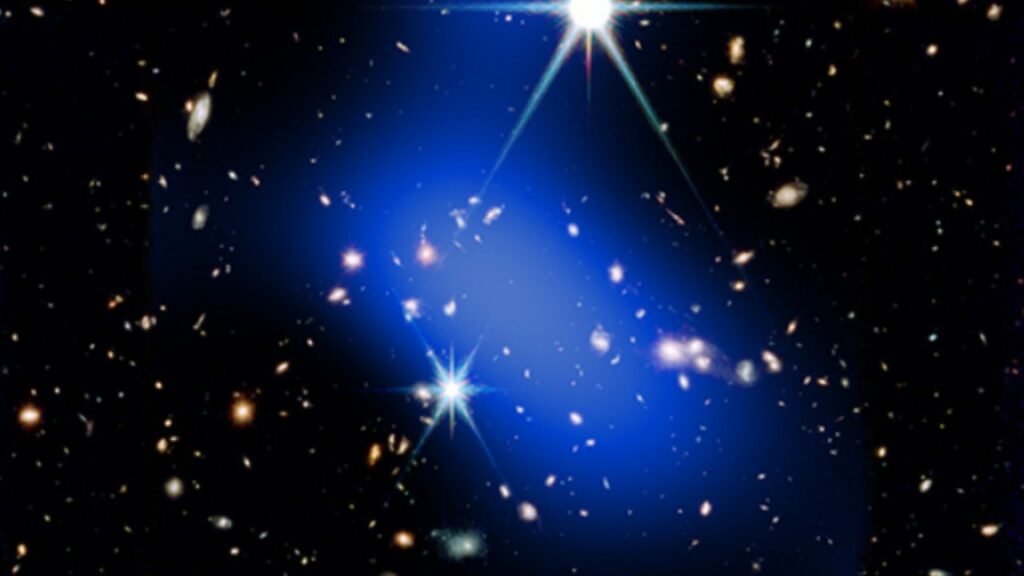
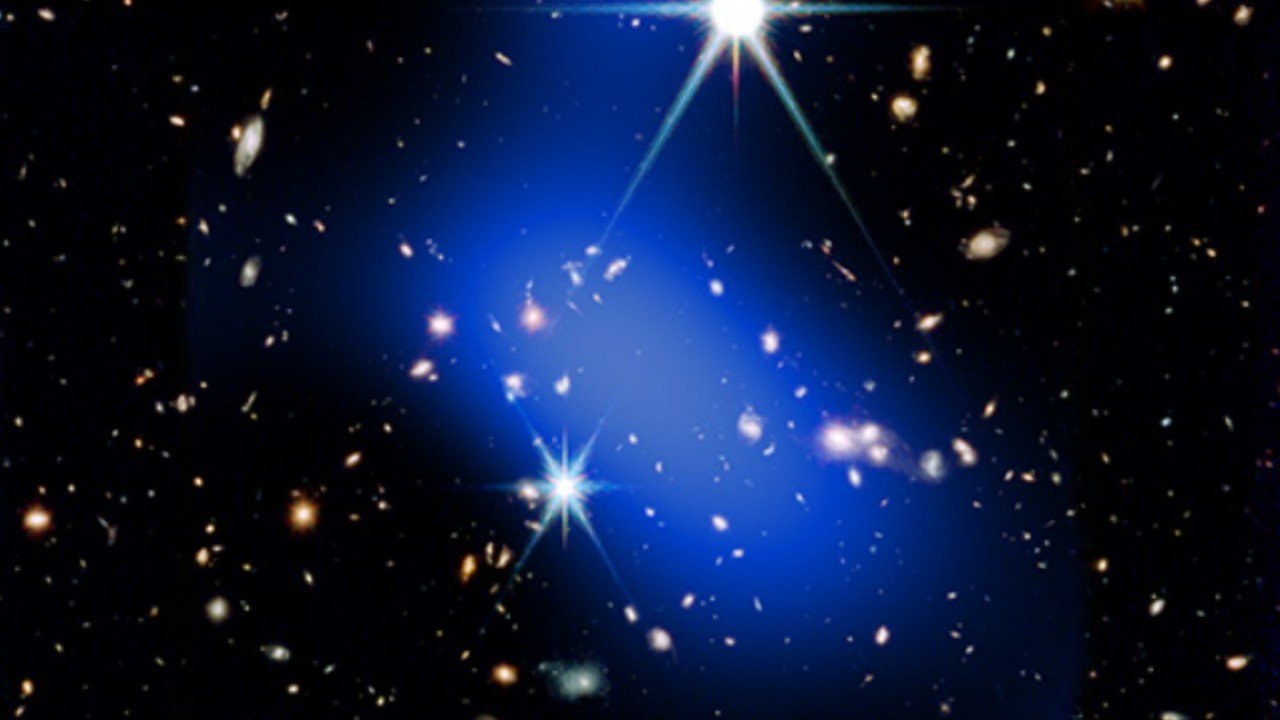
Spotting the Infant Cluster in Action (Image Credits: Cdn.mos.cms.futurecdn.net)
Astronomers captured a pivotal moment in cosmic evolution when galaxies began coalescing into one of the largest structures known, far earlier than models predicted.[1][2]
Spotting the Infant Cluster in Action
Researchers identified JADES-ID1, the most distant confirmed protocluster, assembling just one billion years after the Big Bang. This structure, observed at a redshift of approximately 5.7, shattered previous records by appearing one to two billion years sooner than expected.[1]
The discovery relied on overlapping deep fields from NASA’s James Webb Space Telescope (JWST) and Chandra X-ray Observatory. JWST revealed at least 66 potential member galaxies in the JADES survey area, while Chandra detected a vast cloud of hot gas heated to millions of degrees by shock waves.[1] Team leader Akos Bogdan of the Center for Astrophysics | Harvard & Smithsonian noted, “This may be the most distant confirmed protocluster ever seen. JADES-ID1 is giving us new evidence that the universe was in a huge hurry to grow up.”[1]
Prior detections of X-ray-emitting protoclusters dated to about three billion years post-Big Bang. JADES-ID1’s mass reaches roughly 20 trillion solar masses, embedding hundreds of future galaxies within superheated gas and dark matter.[1]
Combined Power of Two Telescopes
The JADES field, a prime JWST target, aligned perfectly with Chandra’s Deep Field South, enabling unprecedented depth. Infrared imaging from JWST pinpointed galaxy overdensities, and Chandra’s X-rays confirmed gravitational collapse through the intracluster medium.[1]
University of Manchester astronomer Qiong Li, who led an earlier JWST study identifying JADES-ID1, remarked, “We thought we’d find a protocluster like this two or three billion years after the big bang – not just one billion.”[1] Co-author Gerrit Schellenberger added, “It’s very important to actually see when and how galaxy clusters grow. It’s like watching an assembly line make a car, rather than just trying to figure out how a car works by looking at the finished product.”[1]
- Redshift: z ≈ 5.7
- Lookback time: ~12.8 billion years
- Gas signature: X-ray emission from shocked plasma
- Galaxy count: At least 66 candidates
- Mass estimate: 2 × 10¹³ solar masses
Implications for Cosmic Structure Formation
Galaxy clusters rank among the universe’s grandest architectures, comprising thousands of galaxies bound by gravity, hot gas, and dark matter. They serve as cosmic laboratories for probing dark energy and expansion rates. JADES-ID1’s early emergence challenges simulations, which assumed slower buildup due to limited time and galaxy density.[1]
Professor Christopher Conselice of the University of Manchester highlighted the breakthrough: “Unique discoveries like this are made when two powerful telescopes like the Chandra and James Webb Space Telescopes stare at the same patch of sky at the limit of their observing capabilities.”[1] Over billions of years, JADES-ID1 will mature into a massive cluster akin to local giants.
This finding aligns with JWST’s pattern of revealing oversized early galaxies and black holes, signaling accelerated growth in the universe’s youth.[1]
Future Horizons in Deep Space
The Nature study, published January 28, underscores the need for refined models of large-scale structure assembly.[1] Deeper surveys may uncover more such outliers, refining our grasp of dark matter’s influence.
Key Takeaways
- JADES-ID1 formed 1–2 billion years earlier than prior protocluster records.
- Combines JWST galaxy counts with Chandra’s hot gas detection for confirmation.
- Urges revisions to theories on rapid cosmic maturation.
Galaxy clusters like JADES-ID1 offer windows into the universe’s foundational dynamics, prompting a reevaluation of its growth timeline. What surprises await in the next deep-field stare? Share your thoughts in the comments.