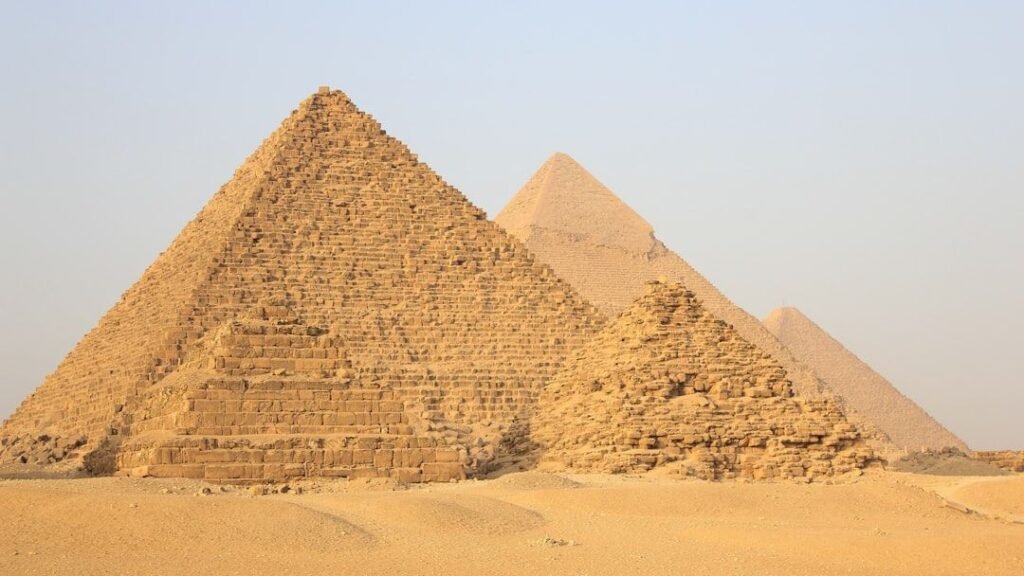

Stand in front of the Great Pyramid of Giza and you’re not just looking at a pile of stones – you’re staring at a monument that encodes surprising layers of mathematics, geometry, and cosmic alignment. Built more than four thousand years ago, without steel cranes, computer models, or even the wheel for heavy transport in everyday use, it somehow lands astonishingly close to true cardinal directions, maintains precise proportions, and uses geometry in ways that still make engineers raise an eyebrow. The more closely modern researchers measure it, the more numerical patterns they seem to find – some convincing, some probably coincidence, but together they paint a picture of a culture that clearly took numbers and order very seriously.
So what could actually explain this apparent “mathematical genius”? Were the builders secret masters of advanced geometry, or simply very persistent craftsmen with good rules of thumb? The answer is probably a mix of both: smart practical math, clever surveying techniques, and a worldview where harmony and proportion really mattered. Let’s unpack how the Egyptians could pull off this level of precision long before algebra textbooks and laser levels existed, and what that says about the way they understood their world.
Cosmic Alignment: Why The Pyramid Sides Face Almost True North
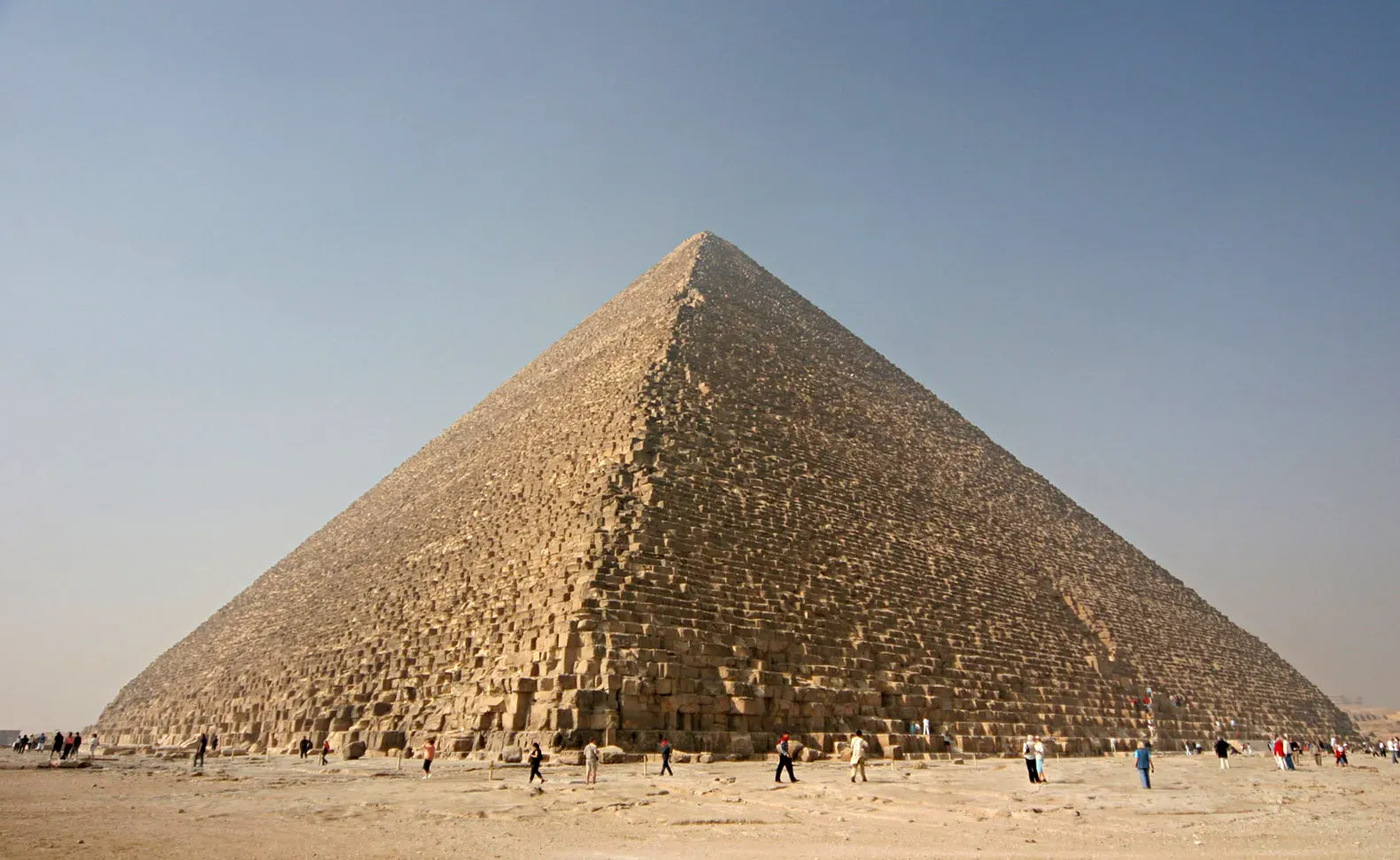
One of the most surprising facts about the Great Pyramid is how accurately it is aligned to the four cardinal directions: north, south, east, and west. The deviation from true north is tiny, on the order of a fraction of a degree, which is remarkable for a structure started around the mid-third millennium BCE. This isn’t the kind of thing that happens by accident; it means the Egyptians had reliable ways to track direction using the sky and repeat that measurement over a large building site.
Most researchers think they used the stars, not compasses, to get this right. A leading idea is that they tracked a pair of circumpolar stars that circle near the north celestial pole and marked the line exactly between them as they crossed the meridian. Another possibility is that they used the rising and setting positions of the sun at specific times of the year with a shadow-casting rod. In both cases, they’d be combining careful repeated observation, simple tools like plumb lines and sighting rods, and a deep respect for the idea that a building dedicated to the king and the gods had to be in proper cosmic alignment.
Geometry In Stone: The Slope, Triangles, And Ratios

When you look at a pyramid, you’re basically looking at a geometry problem you could draw on a school notebook: a square base, four isosceles triangles, height, slope, and edges. The builders had to choose a specific steepness for those triangular faces, and they didn’t do it randomly. Measurements of the Great Pyramid suggest its faces have a slope close to what modern math would describe using a ratio of roughly seven to eleven in vertical to horizontal rise when expressed in ancient units. There’s also a long-standing debate about whether the pyramid’s proportions deliberately encode the value of pi through the relationship between its height and the perimeter of its base.
Whether or not they consciously “knew” pi the way we define it today, the Egyptians clearly had strong geometric instincts. Ancient mathematical texts like the Rhind Mathematical Papyrus show they knew how to approximate areas, slopes, and volumes with rules that work surprisingly well. Instead of abstract formulas, they might have used step-by-step procedures, like “for every so many cubits of horizontal run, raise this many cubits of height,” turning geometry into a construction recipe. In practice, that’s enough to generate a consistent slope across a huge structure and lock in harmonious proportions that modern mathematicians later describe with neat formulas.
Measurement Systems: Cubits, Palms, And The Art Of Consistency

Behind the beauty of the pyramids sits something less glamorous but just as important: a solid measurement system. Egyptian builders used the royal cubit, divided into smaller units like palms and fingers, to keep dimensions consistent across thousands of stones and long distances on the construction site. Archaeologists have found cubit rods with carefully marked divisions, which suggests that standardization mattered a lot to them. Without that consistency, you simply don’t get four sides that meet, courses that line up, or chambers that sit exactly where they’re supposed to.
What looks like “genius” often boils down to very careful repetition and discipline. Imagine a team of surveyors walking the base outline, measuring and re-measuring, checking diagonals like a modern carpenter squaring a frame. That habit of double-checking, combined with a shared unit system everyone respected, would naturally reduce errors. When you scale that attitude up over years of work, you get the impression of a mathematically gifted culture, when in reality it might be a combination of decent arithmetic, consistent tools, and relentless quality control.
Practical Mathematics: Builders, Not Theorists

It’s tempting to imagine some lone Egyptian genius drawing complex equations in the sand, but what we actually see from surviving papyri is more down-to-earth. Egyptian math was heavily practical: calculating grain rations, dividing land, estimating the volume of granaries, or figuring out how many stone blocks would be needed. Their arithmetic relied on addition, doubling, and fractions expressed as sums of unit fractions. On the surface, it looks simple, even clunky, but it worked very well for planning large projects.
That practicality spilled directly into architecture. If you know how to split an area into equal parts to pay taxes, you can adapt the same thinking to laying out a symmetrical base or dividing a ramp into equal steps. The builders didn’t need abstract algebra; they needed methods that gave them the same answer every time. So when we see the pyramid’s clean lines and right angles, what we’re really seeing is a culture that turned everyday number skills into a giant, stone-scale application. In that sense, the pyramids are less a miracle of theoretical mathematics and more a masterpiece of organized, applied calculation.
Surveying And Layout: Turning Desert Into Graph Paper
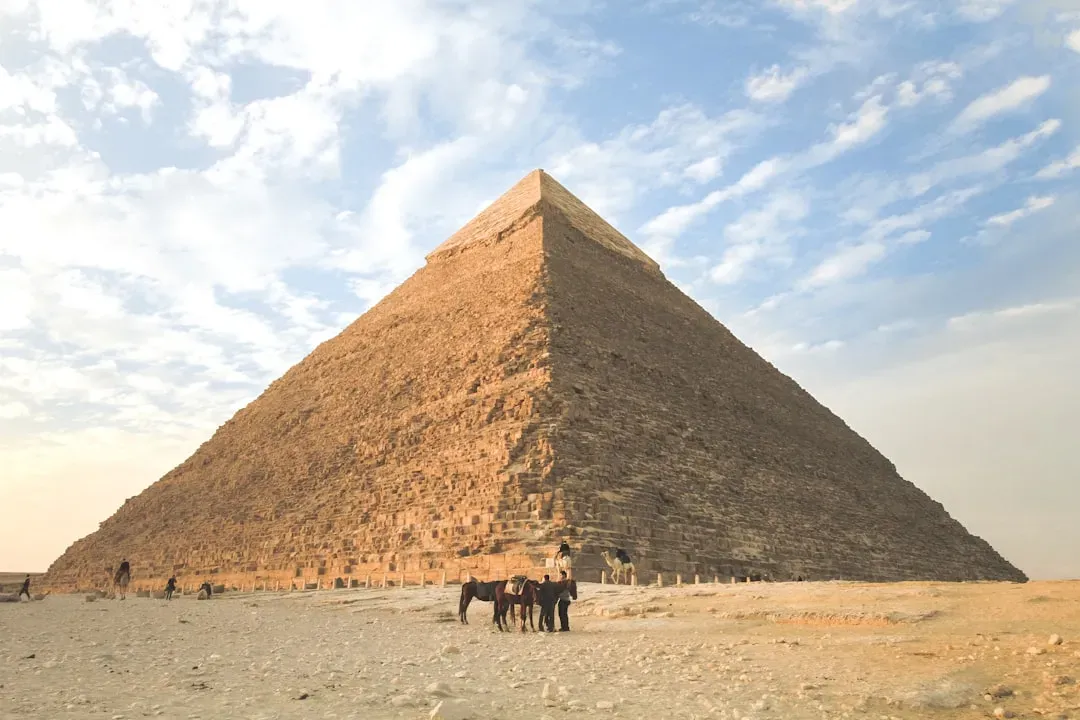
Before a single block was dragged into place, the architects had to turn a piece of rough ground into a precise layout. Evidence from other Egyptian construction projects suggests they were very good at surveying: stretching cords to create straight lines, using right-angle tools, and checking squareness by measuring diagonals. Some researchers think they used a clever rule that essentially mimics our concept of a right triangle, allowing them to create accurate corners without ever writing down a theorem.
Leveling the site was another quiet mathematical feat. The ground under the Great Pyramid is astonishingly flat, within a small fraction of a meter over a huge area. To do that, workers may have used water-filled trenches as a reference level or repeated measurements with plumb bobs and sighting bars. Once the base and corners were fixed, the rest of the geometry could grow upward, layer by layer, following those original lines. It’s like they laid an invisible grid over the sand, then spent years patiently turning that invisible math into something you can walk around and touch.
Symbolism, Sacred Proportion, And Motivation

Numbers weren’t just tools for the Egyptians; they were tied to ideas of order, balance, and the divine. The pyramid itself symbolized a sacred mound rising from the primordial waters and a stairway or ramp to the heavens. Aligning it to the cardinal directions, using clean ratios, and keeping everything symmetrical wasn’t only about engineering pride. It expressed a belief that the king’s eternal resting place should reflect cosmic order, not chaos. That kind of motivation has a way of sharpening people’s focus on getting things right.
When a whole culture agrees that harmony and proportion matter to their afterlife and their relationship with the gods, small mistakes stop being “good enough.” That mindset can push architects to develop more refined rules, surveyors to refine their methods, and workers to correct misaligned stones instead of ignoring them. In other words, the mathematical discipline we see in the pyramids may come as much from religious and symbolic pressure as from intellectual curiosity. The genius is not only in what they could calculate, but in how seriously they took the idea that the numbers had to line up with the universe itself.
Organization, Iteration, And The Power Of Time

No culture wakes up one morning and just builds the Great Pyramid on its first try. The Egyptians had already been constructing mastabas and smaller step pyramids for generations, learning from mistakes as they went. Earlier pyramids show structural problems, steepness experiments, and even mid-project angle changes when things started to crack. By the time the Great Pyramid was planned, they had a long track record of what worked and what didn’t, plus an organized state system capable of mobilizing a massive workforce over decades.
That combination of time, repetition, and centralized control acts like a slow-motion research and development program. Each project refines the rules of thumb, the surveying tricks, and the organizational methods. When we finally see the Great Pyramid standing there with its tight alignments and neat geometry, we’re looking at the polished result of many iterations, not a single leap. In that sense, its mathematical “genius” is really the visible tip of a long, mostly invisible process of trial, error, and stubborn persistence.
Modern Eyes On Ancient Brains

Today, we tend to project our own mathematical language onto the pyramids, talking about pi, golden ratios, and complex constants. Some of those patterns are probably real reflections of Egyptian choices, and others might be coincidences that our pattern-hungry brains latch onto. What we can say with confidence is that the builders had a practical command of geometry, measurement, and alignment good enough to satisfy very demanding goals, both architectural and spiritual. They didn’t need our symbols to think clearly about shape, distance, and direction.
Seen that way, is less mysterious and more human. It comes from patient observation of the sky, consistent units, clever surveying, generational learning, and a belief system that demanded precision. Put those pieces together over many years with thousands of determined workers, and the result is a stone textbook of applied mathematics that still humbles modern visitors. Would you have guessed that so much quiet number work was hiding behind those ancient blocks of limestone?