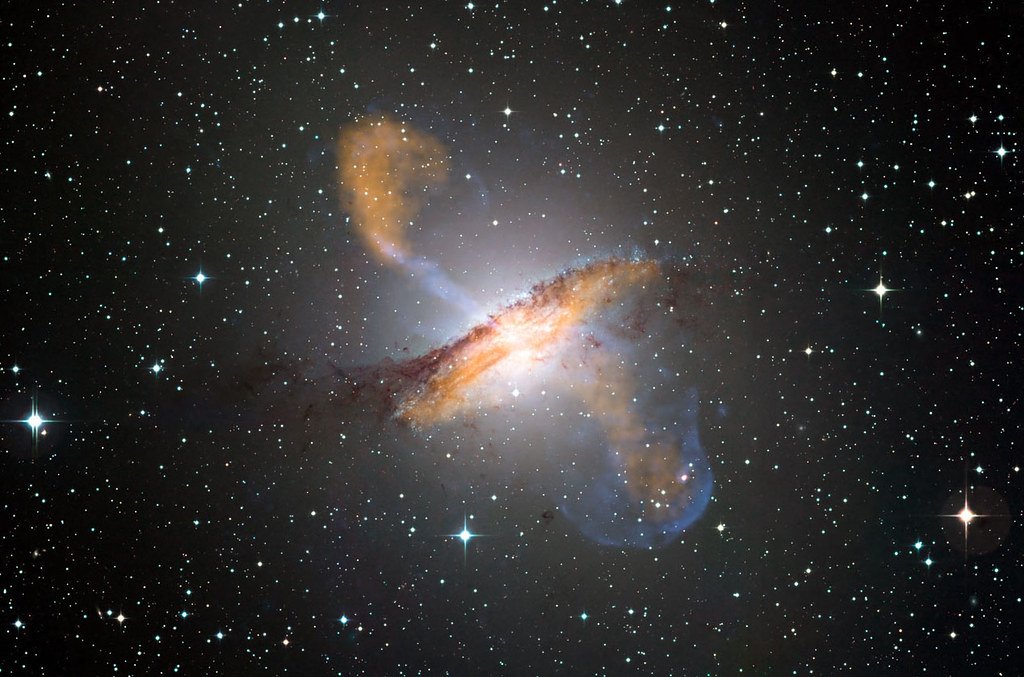
A Cosmic Blowtorch Powered by a Monster Black Hole (Image Credits: Flickr)
Astronomers have connected the iconic glowing ring around the M87 supermassive black hole to the base of its enormous relativistic jet through new Event Horizon Telescope analysis.[1][2]
A Cosmic Blowtorch Powered by a Monster Black Hole
The supermassive black hole at the heart of galaxy M87 blasts out a narrow jet of particles that stretches roughly 3,000 light-years across space.[3] This outflow, racing near the speed of light, originates from a region powered by M87*, a behemoth with a mass equivalent to six billion suns. Located 55 million light-years away in the Virgo cluster, M87 has long fascinated researchers for its vivid displays of extreme physics.
Previous images from 2019 captured the black hole’s shadow encircled by a bright ring of superheated gas. Yet the jet’s precise starting point remained elusive. Researchers now report that 2021 observations fill this gap, revealing a compact emission source just 0.09 light-years from the black hole.[1]
Event Horizon Telescope’s Expanded Reach
The Event Horizon Telescope combines radio observatories worldwide into a virtual telescope the size of Earth, achieving unprecedented resolution at 230 GHz wavelengths. The 2021 campaign marked a leap forward with added stations, including the 12-m Kitt Peak Telescope in the U.S., NOEMA in France, the Submillimeter Telescope in Arizona, and the IRAM 30-m in Spain.
These enhancements provided critical intermediate baselines – spanning hundreds to thousands of kilometers – that proved sensitive to structures between the black hole’s immediate vicinity and the broader jet. Earlier efforts in 2017 and 2018 lacked such connections, limiting detection of faint jet features at this frequency.[4]
- Long baselines resolved the glowing ring and shadow.
- Short baselines captured extended jet emission.
- Intermediate baselines detected the missing link: jet base emission.
Key Evidence from Multi-Scale Analysis
Teams compared radio brightness across scales and found the ring alone could not explain all observed light. Higher intensity on shorter baselines pointed to additional compact emission. Computer models pinpointed this to a region aligning with the jet’s southern arm, as seen in 2018 observations at 86 GHz.[5]
The discovery bridges vast distances: from the black hole’s event horizon to thousands of light-years outward. Saurabh from the Max Planck Institute for Radio Astronomy noted, “Identifying where the jet may originate and how it connects to the black hole’s shadow adds a key piece to the puzzle.”[1]
This work, detailed in a January 2026 Astronomy & Astrophysics paper, advances tests of jet-launching theories.[5]
Toward Sharper Views of Jet Formation
Hendrik Müller of the National Radio Astronomy Observatory highlighted the progress: “We are gradually moving towards combining these breakthrough observations across multiple frequencies to complete the picture of the jet launching region.”[4] Future data from sites like Mexico’s Large Millimeter Telescope promise direct imaging of the jet base.
Such insights could illuminate how black holes channel matter into powerful outflows, influencing galaxy evolution. The findings build on EHT’s legacy, from the first black hole image to probing fundamental cosmic engines.
Key Takeaways
- EHT 2021 data localized M87 jet base at 0.09 light-years from the black hole.
- Intermediate baselines enabled detection of faint emission linking ring to jet.
- Results test models of relativistic jet formation near supermassive black holes.
This milestone underscores black holes’ role as universe-shaping dynamos. How might future images reshape our view of these cosmic phenomena? Share your thoughts in the comments.