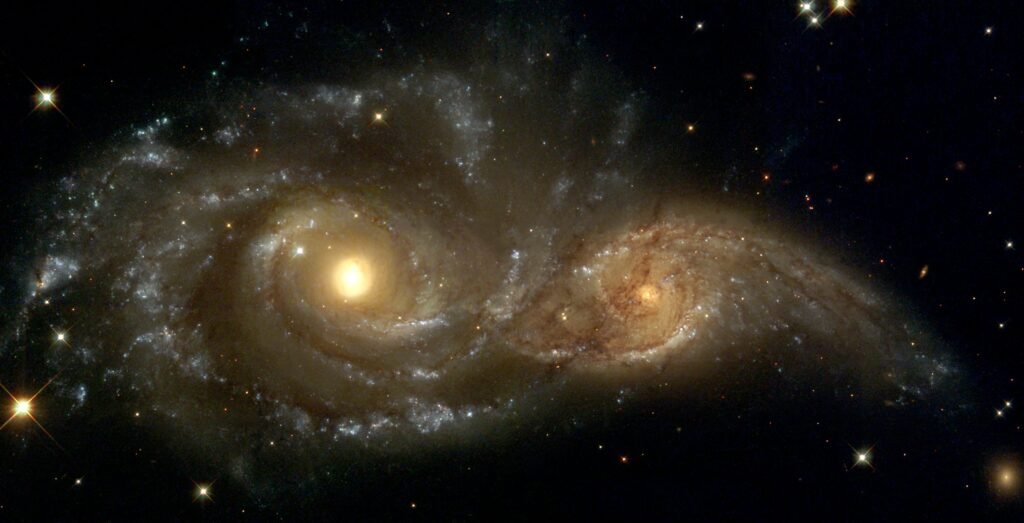
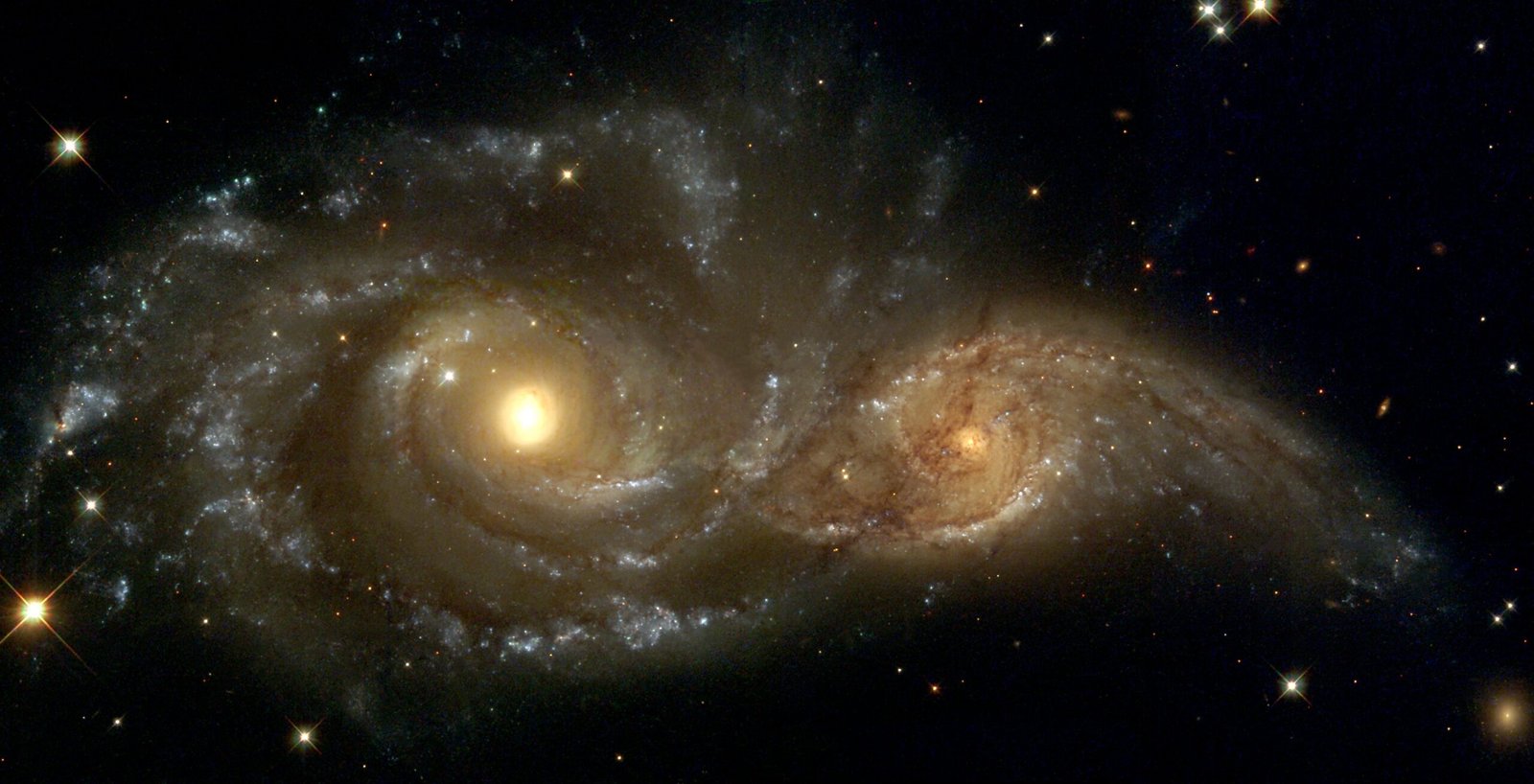
Arp 220 Emerges as a Starburst Powerhouse (Image Credits: Upload.wikimedia.org)
Astronomers recently uncovered a structured magnetic pathway guiding ferocious cosmic outflows at speeds exceeding 1.1 million miles per hour within the turbulent merger known as Arp 220.[1]
Arp 220 Emerges as a Starburst Powerhouse
The galaxy system Arp 220 stands out as the nearest ultraluminous infrared galaxy, located about 250 million light-years away. This merger involved two spiral galaxies that collided, triggering intense star formation rates hundreds of times greater than in the Milky Way. Researchers observed dense concentrations of gas and dust fueling this frenzy in the system’s twin nuclei.[2]
Powerful outflows erupted from these cores, expelling material at velocities reaching 500 kilometers per second. Such events highlighted Arp 220’s role as a prototype for distant, dusty starbursts from the early universe. The collision compressed interstellar medium, igniting supernovae and black hole activity that drove these galactic winds.[3]
Magnetic Fields Take Center Stage
Observations revealed strong, ordered magnetic fields aligned with the bipolar outflows in Arp 220’s western nucleus. These fields formed a nearly vertical channel, dubbed a “magnetic superhighway,” that funneled magnetized gas outward. The structure acted like invisible guardrails, shaping the direction and acceleration of the winds.[1][4]
The winds carried gas, dust, metals, and cosmic rays far beyond the galaxy, contributing to a surrounding cocoon of enriched material. Magnetic forces emerged as a primary driver, complementing stellar feedback and active galactic nuclei. This discovery underscored how magnetism influences outflow dynamics in extreme environments.[2]
ALMA Provides Unprecedented Insights
The Atacama Large Millimeter/submillimeter Array (ALMA) enabled the mapping through polarized light from aligned dust grains and gas molecules. Data from the western core showed magnetic fields parallel to both red- and blueshifted outflows in dust and emission line polarization. Polarization fractions reached notable levels, indicating ordered field configurations.[4][5]
These measurements marked the first detailed magnetic map of such outflows in a starburst merger. Earlier studies had hinted at field presence, but ALMA’s resolution captured their alignment and strength. The team published findings in The Astrophysical Journal Letters, detailing the observations.[3]
- Outflow speeds: Up to 500 km/s (1.1 million mph).
- Magnetic alignment: Vertical in west nucleus, parallel to bipolar flows.
- Key tracer: Polarized dust emission and molecular lines.
- Telescope: ALMA’s high-resolution submillimeter capabilities.
- Imaged region: Twin nuclei and surrounding outflows.
Shaping the Cosmos Through Feedback
Galactic winds like those in Arp 220 regulate star formation by ejecting fuel, preventing runaway growth. Magnetized outflows efficiently disperse metals and dust, seeding future star-forming regions across intergalactic space. This process links local mergers to large-scale cosmic evolution.[6]
Similar structures likely operate in high-redshift galaxies, influencing the universe’s star formation history. Future observations with advanced telescopes will probe these fields in more distant systems. The findings elevated magnetic fields from supporting players to key architects of galactic feedback.[7]
Key Takeaways:
- Magnetic superhighways channel ultra-fast winds, driving material expulsion.
- Arp 220 serves as a nearby model for early universe starbursts.
- ALMA polarization maps reveal ordered fields’ critical role in outflows.
This revelation transforms our view of galaxy mergers, showing magnetism’s pivotal influence on cosmic recycling. What do you think about these magnetic forces shaping the universe? Tell us in the comments.