
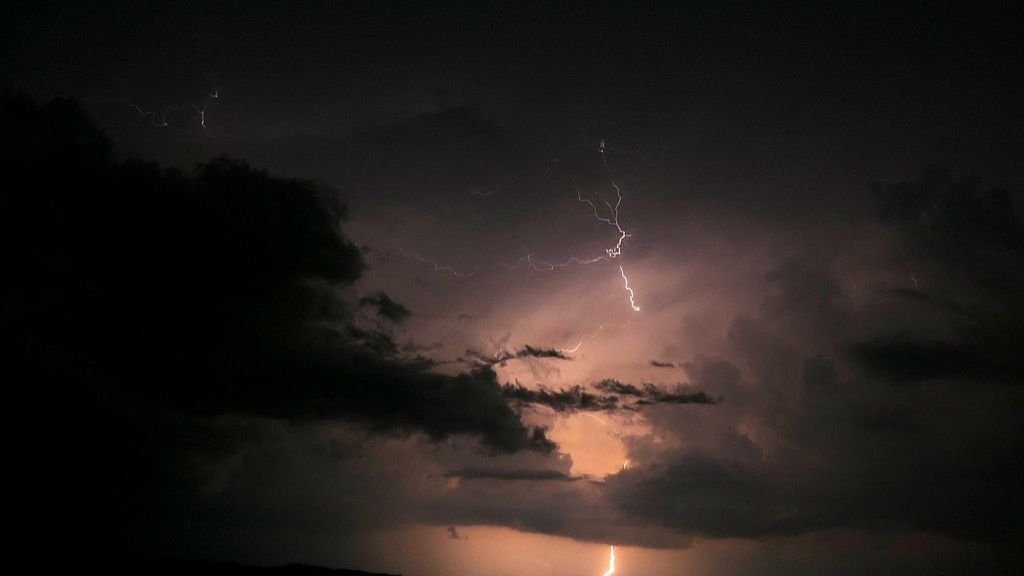

Every time we look up, we assume we understand what we’re seeing: blue sky, white clouds, maybe a storm rolling in. But hidden in that familiar backdrop are strange, rare events that even in 2026 still leave scientists shrugging more than they’d probably like to admit. Some have been caught on high-speed cameras, some only in grainy photos, and a few mostly in panicked eyewitness reports that sound almost too weird to be real.
What makes these phenomena so gripping isn’t just that they’re mysterious; it’s that many of them hint at physics operating on the edge of what we can explain. They appear for a second, vanish without a trace, and leave behind nothing but puzzled researchers and a lot of data that doesn’t quite add up. Let’s dive into ten of the strangest atmospheric puzzles that continue to defy complete explanation.
1. Ball Lightning: Glowing Orbs in the Storm
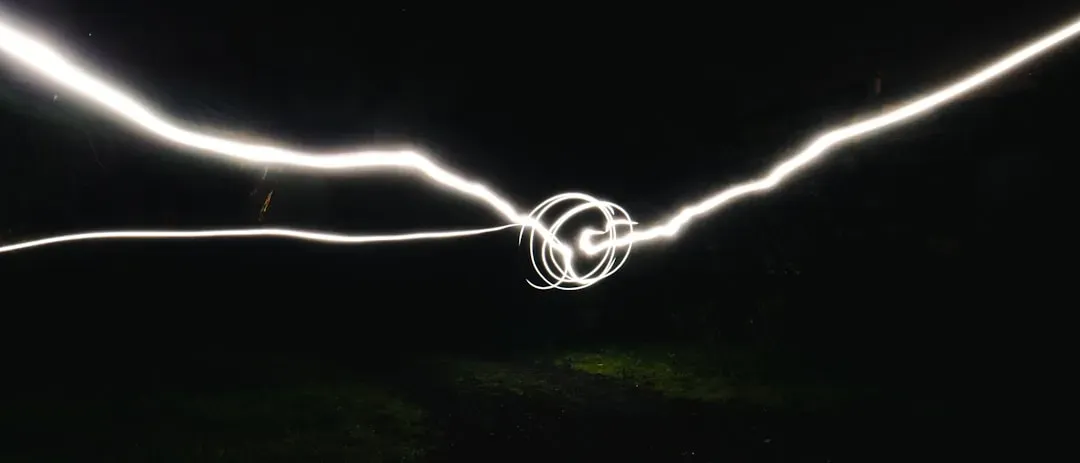
Imagine a thunderstorm outside your window and suddenly a glowing, floating ball of light drifts through the room, silently hovering before vanishing in an instant. That’s ball lightning as many people describe it: a luminous sphere, usually the size of a grapefruit or larger, moving unpredictably in the air. Reports go back centuries, including accounts from soldiers, sailors, and pilots, yet scientists still can’t fully agree on what it actually is.
In the last couple of decades, there have been a few promising lab experiments that created ball-lightning-like glows using high-voltage discharges and vaporized materials, but those results don’t completely match the real-world sightings. Some theories suggest plasma, others point to chemical reactions in vaporized soil, and a few argue it might be a kind of electromagnetic knot in the air. The honest answer today is that ball lightning remains mostly a mystery – especially how it sometimes seems to drift through solid walls like a ghost in a storm. If anything, it’s a reminder that even something as “basic” as lightning can still surprise us.
2. Sprites and Elves: Ghostly Flashes Above Thunderstorms
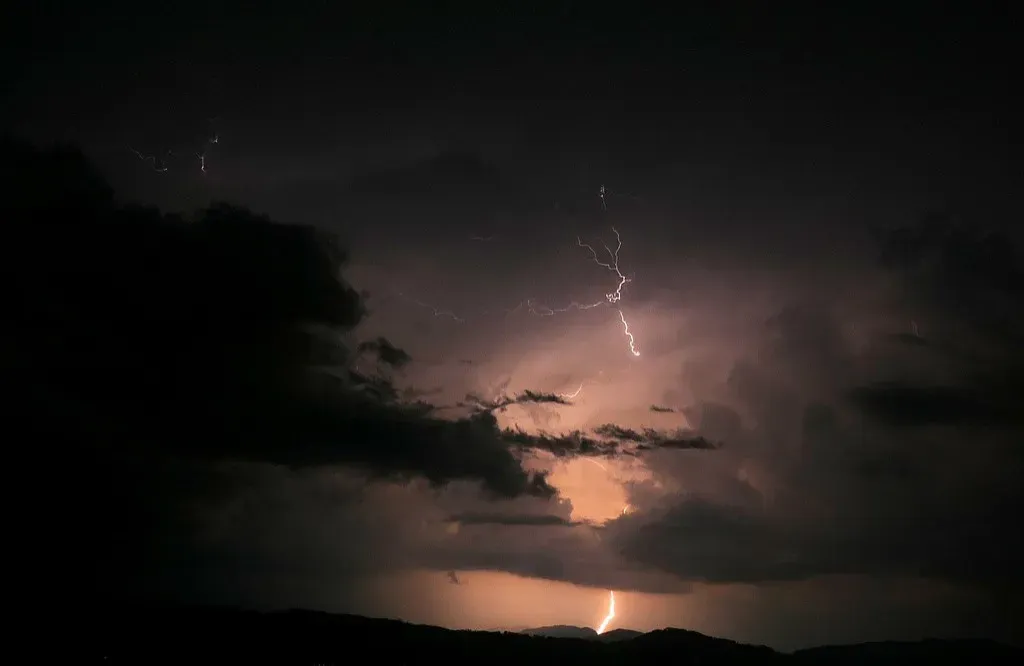
High above a thunderstorm, far above the lightning you see from the ground, something spectacular can happen in the thin, cold upper atmosphere. Sprites – huge, red, jellyfish-shaped flashes – can burst into existence for just a few thousandths of a second. Even higher, faint expanding rings of light called elves can appear, spreading horizontally like a glowing shockwave. Pilots used to report eerie lights above storms and were often dismissed, until high-speed cameras finally captured sprites in the late twentieth century.
We now know these events are linked to powerful lightning strikes, but the exact details of how and why they form are still being worked out. The atmosphere at those altitudes is extremely thin, and the electric fields are complex and hard to measure without specialized equipment. Scientists can model some aspects of these “transient luminous events,” but matching real-world observations has proven difficult. The fact that they are so brief and so high up means most people will never see one with their own eyes, which adds to their ghostly reputation.
3. The Morning Glory Cloud: A Rolling Sky Tube
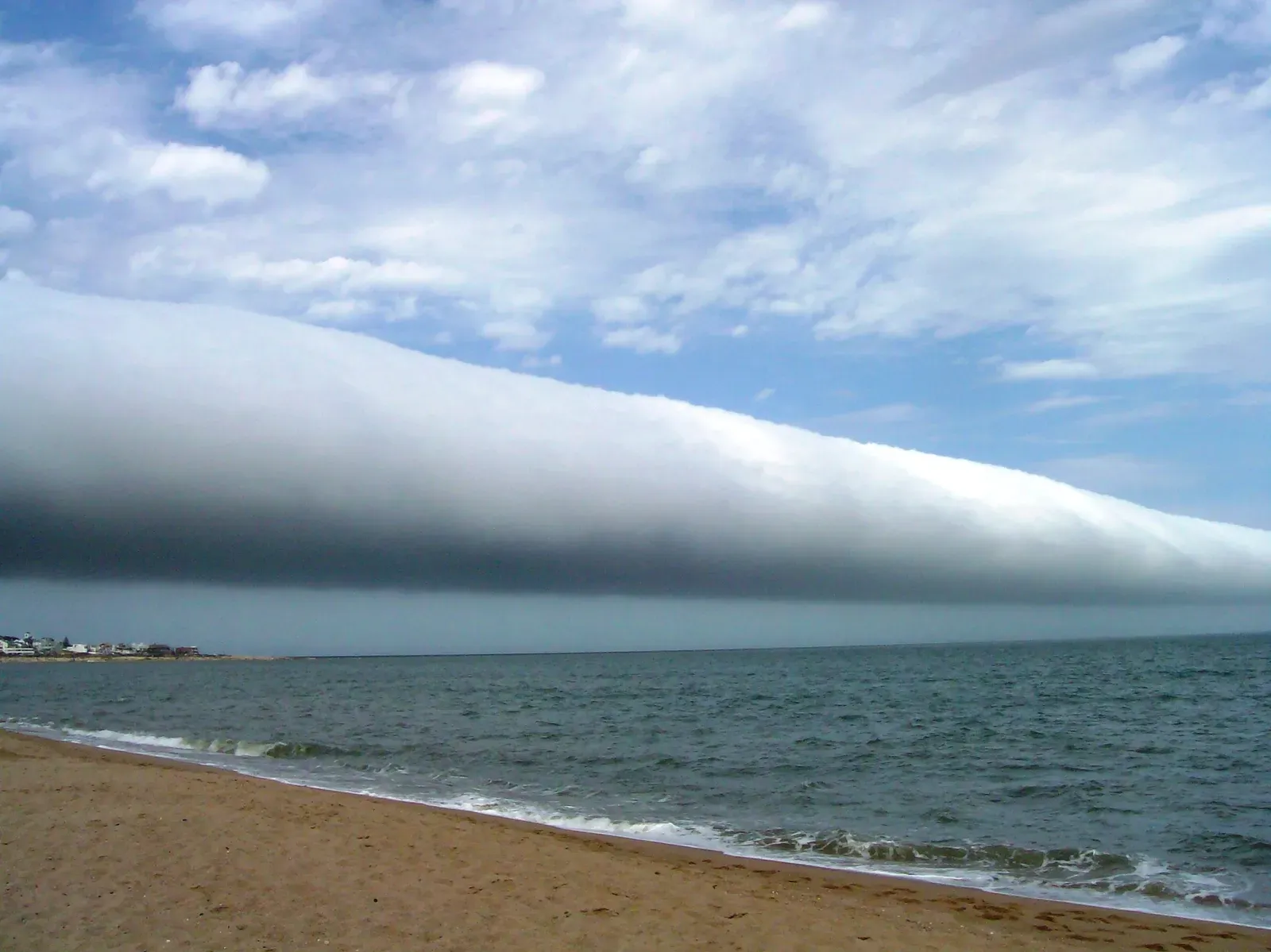
In a remote region of northern Australia, usually around spring, the sky sometimes transforms into something that looks like a massive, rolling tube stretching from horizon to horizon. This is the Morning Glory cloud, a long, cylindrical cloud that can extend hundreds of kilometers and move like a giant airborne wave. Glider pilots travel there just to ride the updraft along this cloud, surfing the atmosphere like a slow, silent roller coaster.
Meteorologists have tried to explain it using concepts from fluid dynamics and sea-breeze interactions, and computer models can reproduce something similar under very specific conditions. Yet, the Morning Glory’s regular appearance in that particular region – and its occasional appearance in a few other places – still isn’t fully understood. Why that spot, and why such a perfectly shaped, rolling structure? It’s as if the sky there has learned a party trick that it refuses to perform anywhere else on command.
4. Noctilucent Clouds: Night-Shining Ghosts of the Upper Atmosphere

On some summer nights at high latitudes, just after sunset, you can spot delicate, electric-blue clouds glowing high above the darkening horizon. These are noctilucent clouds, made of tiny ice crystals hanging at the edge of space, in a region of the atmosphere called the mesosphere. They are so high that they are lit by sunlight long after the ground has slipped into night, giving them an otherworldly shimmer.
What puzzles scientists is not just how they form, but why they seem to be becoming more common and brighter in recent decades. They need extremely cold temperatures and just the right amount of water vapor, conditions that are influenced by both natural cycles and human activities like methane emissions. Researchers suspect they may be a subtle sign of broader changes in the upper atmosphere, but the exact balance of causes is still under debate. In a way, these night-shining clouds might be a kind of cosmic mood ring, hinting at changes in our planet we’re only beginning to grasp.
5. The Great Red Sprites of Gigantic Jets
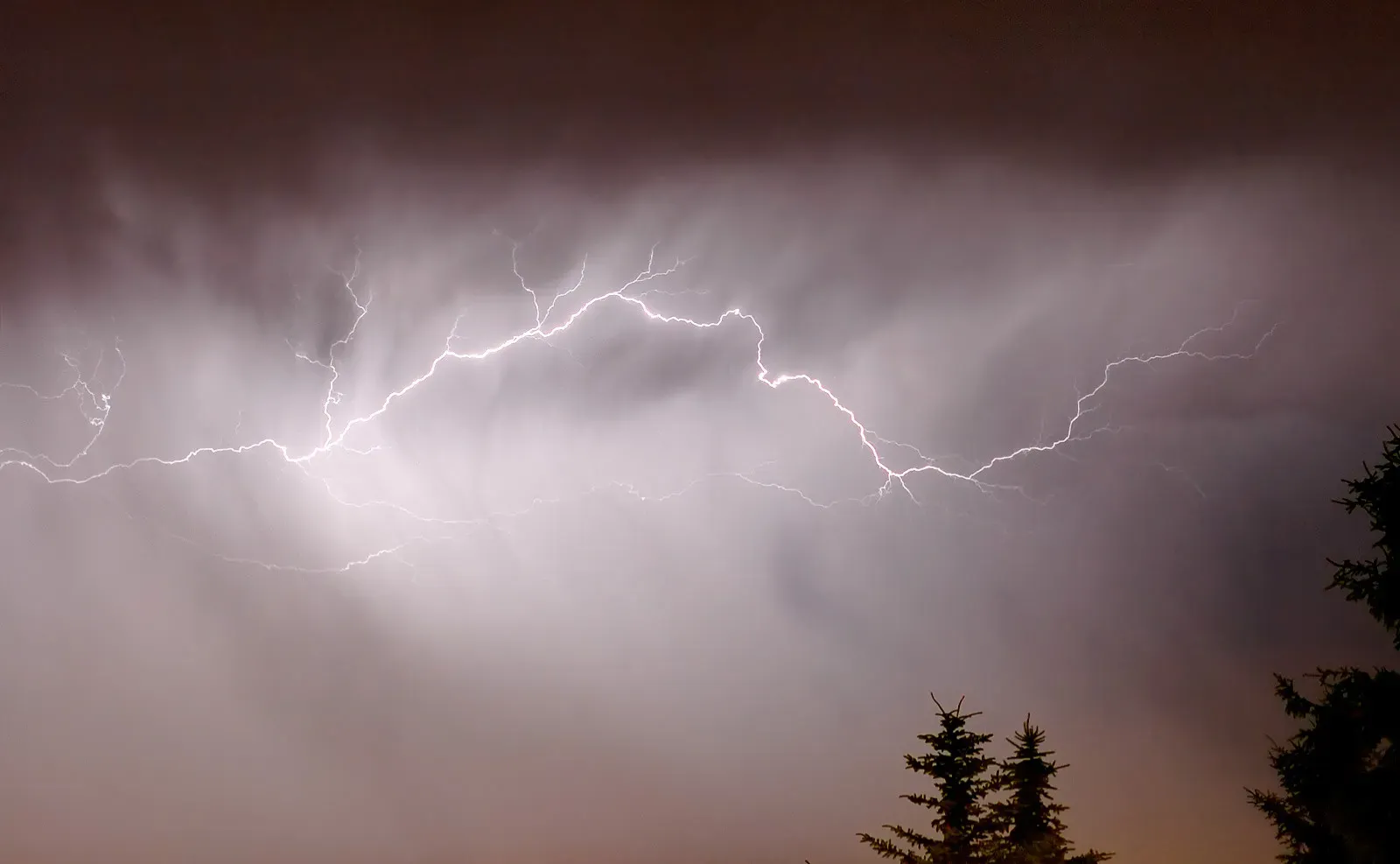
While sprites and elves are already weird enough, an even more dramatic phenomenon has joined the list: gigantic jets. These are enormous lightning-like discharges that shoot upward from storm clouds directly into the ionosphere, sometimes reaching heights of more than eighty kilometers. To the eye, they can look like enormous trees or fountains of light erupting from the top of storms, turning our usual idea of lightning upside down – literally.
Despite better satellite and ground-based observations over the last several years, gigantic jets are still poorly understood. They seem to happen only in certain types of storms, and not all intense storms produce them. Why do some lightning discharges choose to go up instead of down? How do they influence the electrical balance between the atmosphere and space? There are working theories, but not enough data to settle the arguments, which leaves gigantic jets in that frustrating zone where we know they exist, can sometimes predict where to look, and still can’t fully explain their behavior.
6. St. Elmo’s Fire: Eerie Glow on Ships, Planes, and Spires
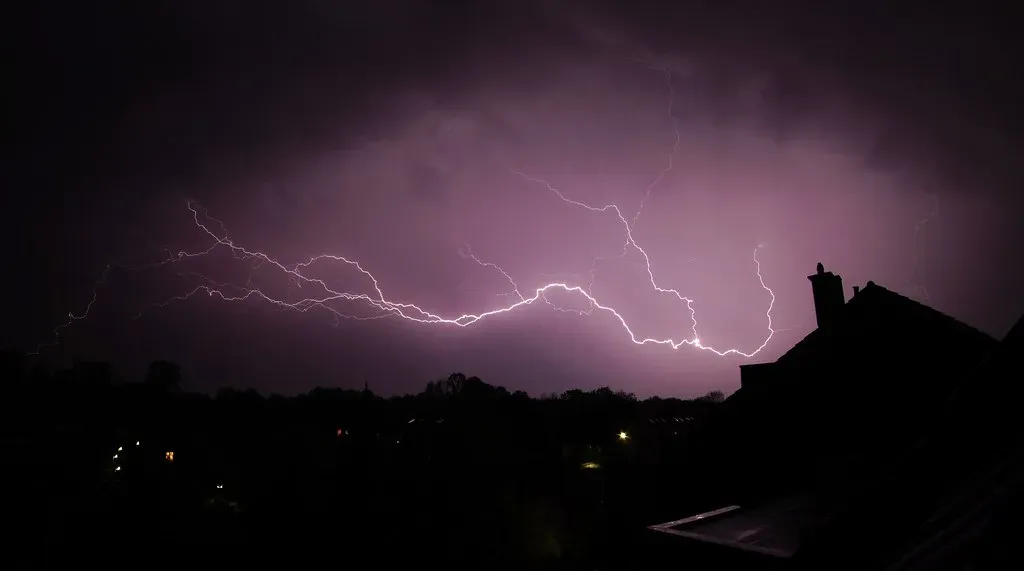
Sailors in past centuries reported strange, bluish or violet glows clinging to the tips of ship masts during storms, and pilots have seen similar lights on cockpit windows or wing edges. This is St. Elmo’s fire, a phenomenon where strong electric fields around pointed objects cause the air to glow faintly. On paper, it’s often explained as a corona discharge – a fairly standard bit of physics when voltage builds up around sharp points.
Yet the exact conditions that make it visible, stable, and sometimes long-lasting are trickier than the textbook description suggests. The atmosphere is a messy place, filled with variations in humidity, dust, and ionization that are hard to model precisely. Witnesses describe different colors, different sounds, and different behaviors that are not fully captured by simple lab experiments. St. Elmo’s fire sits in a strange middle ground: the basic principle is known, but the lived, dramatic versions at sea or in the air still feel stubbornly unpredictable.
7. Mysterious Sky Trumpets and Hum Sounds
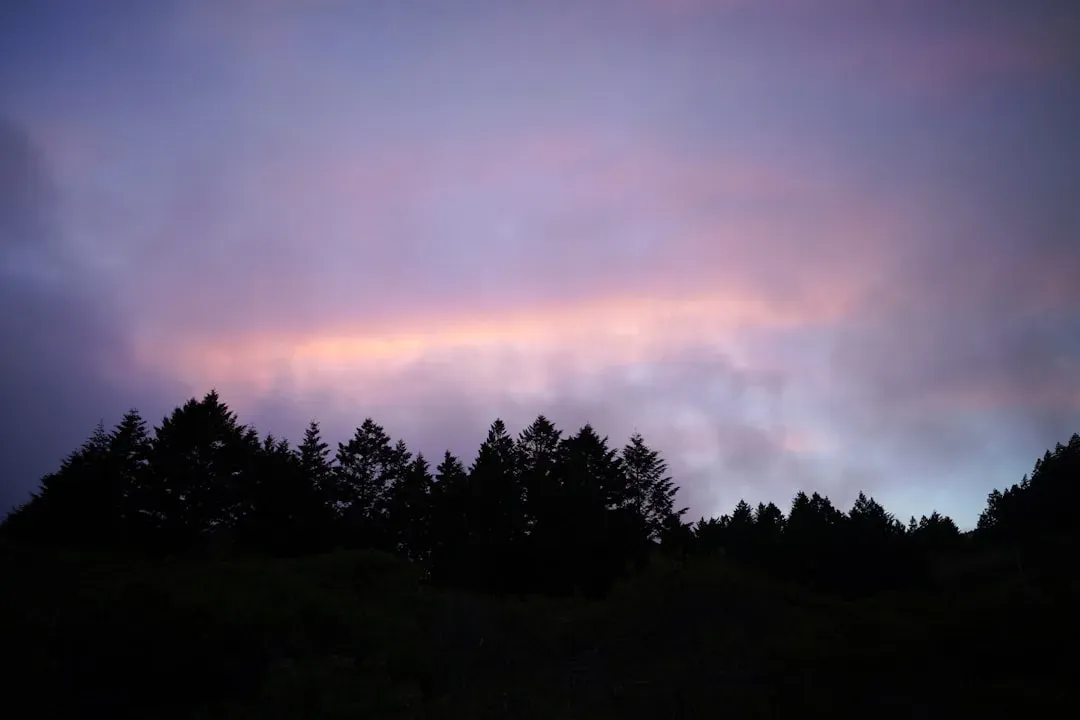
Every so often, videos surface online of people recording deep, metallic, trumpet-like sounds echoing from the sky. In other places, residents complain of a persistent, low-frequency hum that seems to have no clear source and can drive sensitive listeners to distraction. Some of these events have likely mundane explanations – distant industrial activity, trains, wind interacting with structures – but in many documented cases, no definitive source is ever nailed down.
Atmospheric acoustics is surprisingly complex: sound can bend, bounce, and travel great distances under the right conditions, like a whisper carried down a long hallway. Changes in temperature, wind layers, and humidity can all shape where sound goes and who hears it. Scientists have offered various possibilities, from microseisms (tiny vibrations in the Earth) to distant thunder being channeled oddly, but a single neat explanation doesn’t fit every case. That lingering uncertainty keeps the mystery alive and fuels everything from sober research to wild speculation.
8. Rare Green Flashes at Sunset and Sunrise
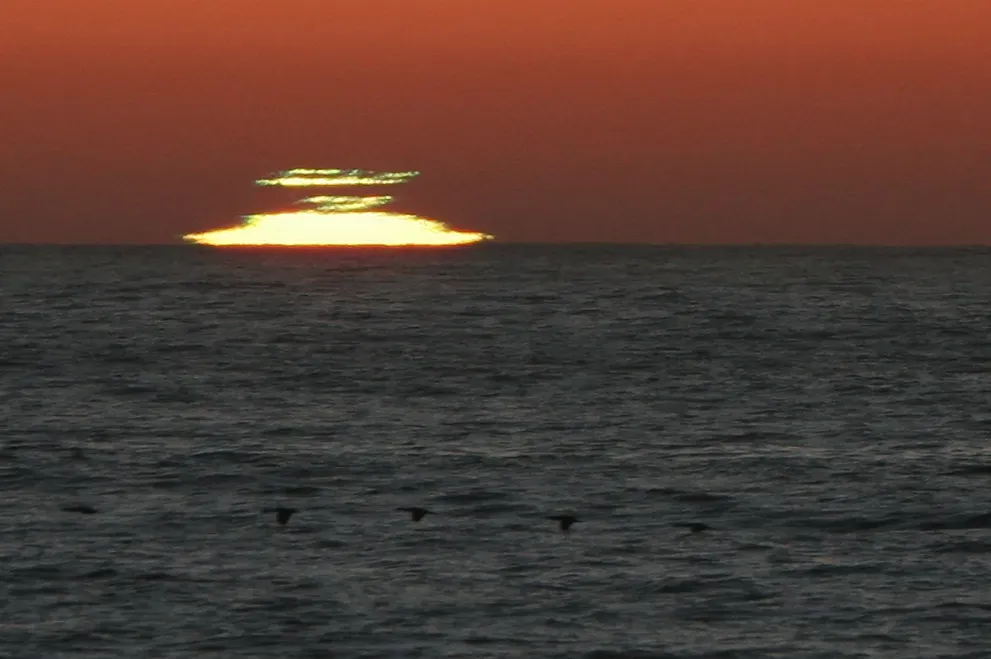
It sounds like a sailor’s tall tale: as the sun sinks below the horizon, a brief, emerald-green wink appears at the very top of the disk. Yet the green flash is very real, photographed and filmed many times from oceans, deserts, and mountaintops. It happens because the atmosphere acts like a lens and a prism, bending and splitting sunlight into colors; under the right conditions, the green component can linger last, just long enough to be seen.
While the underlying physics of refraction and dispersion are well known, the exact mix of conditions that make a vivid, long-lasting green flash are still a bit elusive. Most sunsets don’t show it, even when the air seems clear and the horizon is sharp. Slight, barely noticeable layers in temperature and density can make or break the effect, and our models are not good enough to predict it like a weather forecast. The result is a phenomenon that sits awkwardly between “totally explainable” and “annoyingly unpredictable,” which, honestly, is part of its charm.
9. High-Altitude Luminous “UFO” Clouds from Rocket Launches
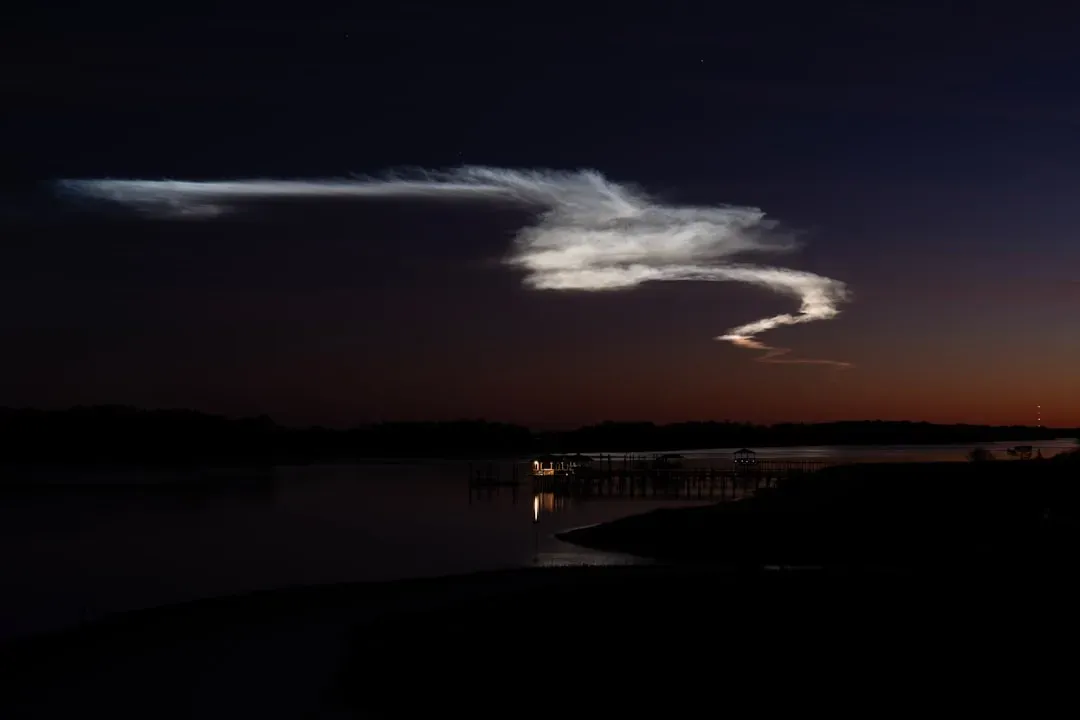
In recent years, especially with more frequent rocket launches, people across the world have looked up at twilight and seen strange, glowing swirls or jellyfish-like shapes spreading across the sky. Social media quickly fills with UFO theories before space agencies eventually confirm a launch. These are exhaust plumes from rockets or missiles interacting with the high, sunlit atmosphere, often at altitudes where the sky above is still bright even though the ground is dark.
The overall idea – rocket exhaust catching sunlight and spreading – is straightforward, but the actual shapes and colors of these clouds can be surprisingly bizarre and not entirely predictable. Interactions between different exhaust components, upper-level winds, and ionization can create complex, spiraling patterns that even seasoned scientists find hard to model in detail. Sometimes the plumes seem to twist, knot, or form sharp edges that defy simple explanations. The growing number of launches has turned the sky into an occasional experimental canvas, and we’re still learning how all the pieces fit together.
10. The Mysterious Quasi-Periodic Pulsations of Lightning
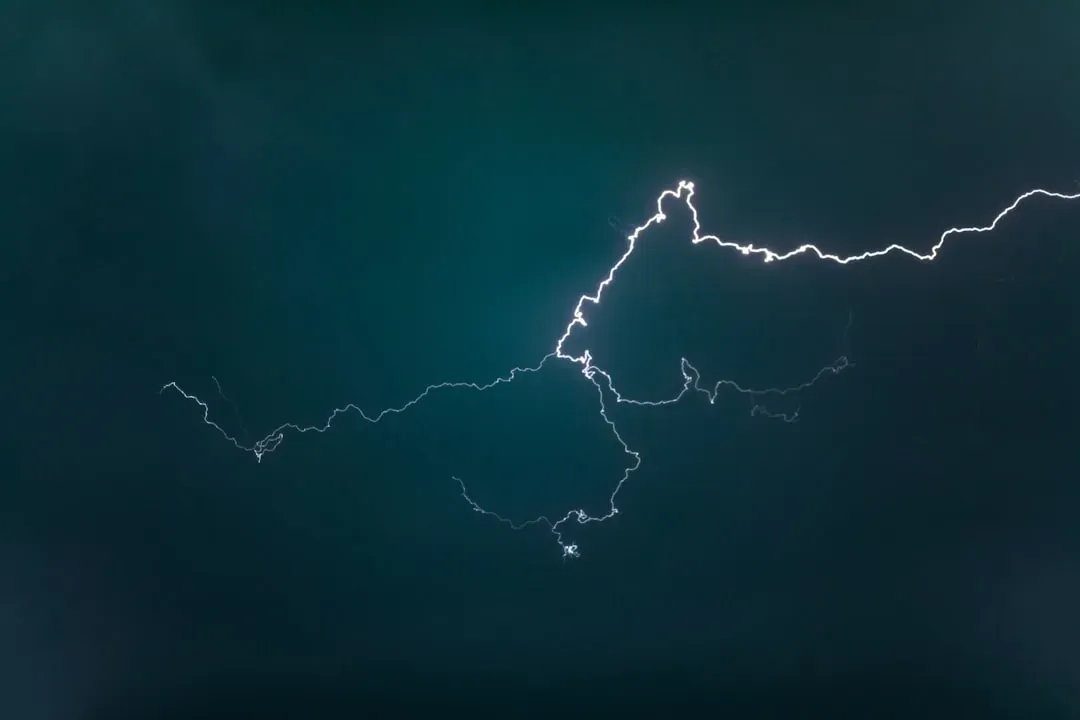
When we think of lightning, we imagine a single, blinding strike. But high-speed measurements reveal something far stranger: many lightning bolts flicker with intricate, quasi-periodic pulses and sub-pulses in radio waves, X-rays, and even gamma rays. In fact, thunderstorms can produce brief bursts of high-energy radiation – called terrestrial gamma-ray flashes – that momentarily rival processes in deep space. It’s as if a common thunderstorm secretly contains a miniature particle accelerator.
Researchers have proposed models involving runaway electrons, strong electric fields, and feedback loops between particles and radiation, but the exact sequence of events is still hotly debated. Instruments on satellites and on the ground keep finding more detailed structures inside these flashes, raising new questions faster than answers can be confirmed. Why do some storms generate intense high-energy pulses while others, just as powerful on radar, stay quiet? Until we can fully map and simulate the inner life of a storm at extremely fine scales, the deepest workings of lightning will stay partly hidden.
A Restless, Unfinished Sky
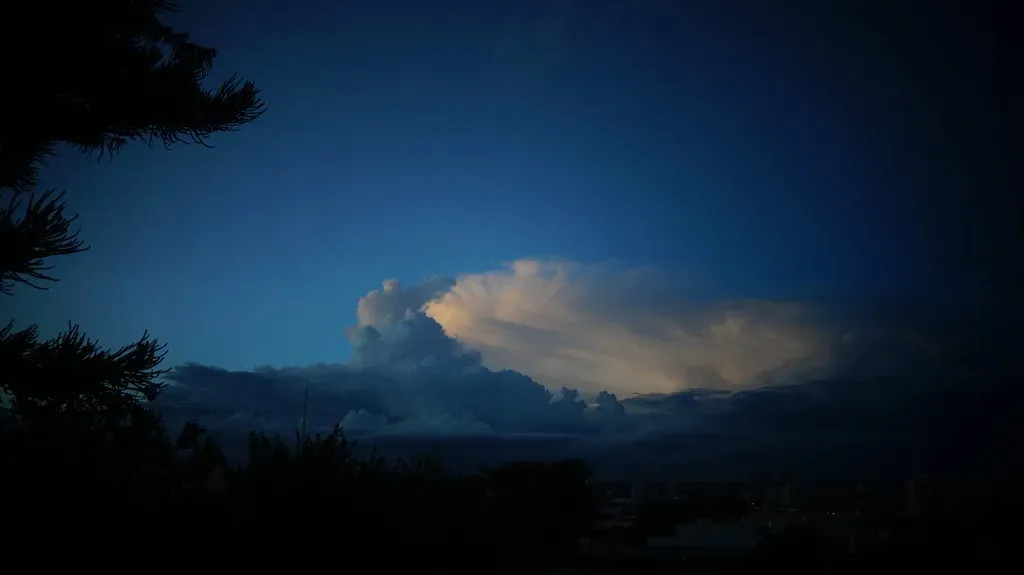
All these phenomena share something important: they expose the gaps between our big, confident theories and the messy, flickering reality of the atmosphere overhead. For every neat diagram in a textbook, there’s a strange glow, flash, sound, or cloud formation that refuses to behave exactly as predicted. Even with satellites, high-speed cameras, and powerful computers in 2026, the sky still knows how to keep secrets.
Personally, that mix of knowledge and mystery feels oddly comforting. It means there’s still room for wonder when you step outside at night, or glance up during a storm and notice something that doesn’t quite fit. Somewhere above you, a faint glow or fleeting flash might be playing out that no one will ever record or fully explain. The next time the sky looks ordinary, it might be hiding something extraordinary – would you notice it if it happened right over your head?


