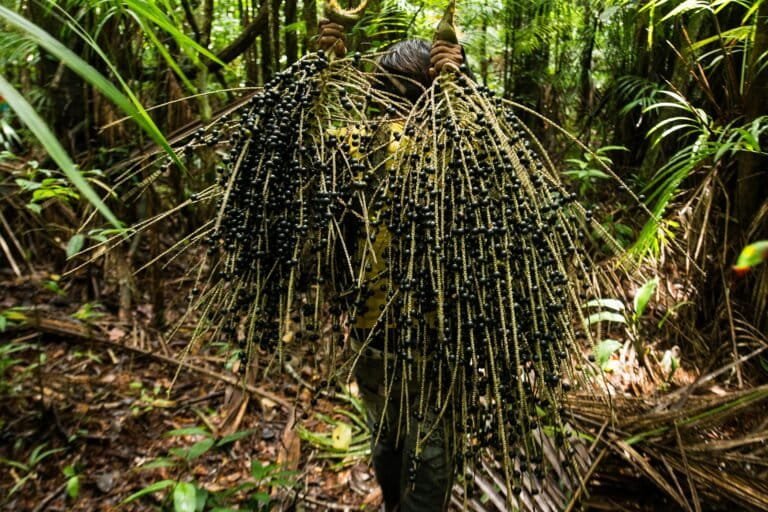
A Timeless Staple Faces Global Spotlight (Image Credits: Imgs.mongabay.com)
Brazil – Lawmakers recently enshrined the açaí berry as the nation’s official fruit through a new law, aiming to protect this Amazonian treasure from unauthorized foreign exploitation.[1][2]
A Timeless Staple Faces Global Spotlight
Communities in northern Brazil have relied on açaí for generations, consuming the dark purple berry from the Euterpe oleracea palm as a savory paste mixed with fish and manioc flour.[1] This traditional preparation underscores its deep cultural roots in the Amazon region.
Today, açaí commands worldwide attention as an antioxidant-packed superfood, blended into smoothies and featured in cosmetics. Production reached 1.7 million metric tons in 2024, fueling a booming export market that supports thousands of families.[1] The fruit’s rise highlights Brazil’s rich biodiversity but also exposes vulnerabilities.
Biopiracy Cases That Prompted Action
Foreign interests have repeatedly tested Brazil’s resolve. In 2003, Japanese firm K.K. Eyela Corporation registered a trademark on açaí, a claim canceled only in 2007 after government intervention.[1][2] A similar dispute over cupuaçu, another Amazon fruit, saw a Japanese company demand royalties in the late 1990s, leading to a two-decade legal battle.
Prosecutors accused U.S. exporter Sambazon of biopiracy in 2018 for using açaí without proper authorization, though the company denied wrongdoing.[1] Patents on açaí-derived ingredients abroad further alarmed officials. These incidents revealed gaps in protecting traditional knowledge and genetic resources.
- 2003 Japanese açaí trademark, revoked 2007.
- Late 1990s cupuaçu royalty demands, resolved after 20 years.
- 2018 Sambazon biopiracy accusation.
- Ongoing foreign patents on active compounds.
Building a Stronger Legal Framework
President Luiz Inácio Lula da Silva sanctioned Law 15.330 on January 8, 2026, amending a 2008 statute that recognized cupuaçu.[2] The bill, first proposed by Senator Flexa Ribeiro in 2011, passed the Senate that year and the Chamber of Deputies in late 2025.
“The legislative recognition of açaí as a national fruit will have a mostly symbolic value. It seeks to reinforce the identity of açaí as a Brazilian product,” said Sheila de Souza Corrêa de Melo, an intellectual property analyst at Embrapa’s Amazon branch.[1] Brazil’s Ministry of Foreign Affairs noted the law bolsters positions in disputes and shields harvesting communities.[1]
Complementing this are the 2015 biopiracy law, requiring 1% of profits from community knowledge in products like pharmaceuticals, and ratification of the Nagoya Protocol in 2021.[1]
Balancing Heritage, Economy, and Innovation
The designation spotlights açaí’s role in sustainable Amazon economies, from pulp exports to seed crafts and palm hearts. Experts urge Brazil to invest in local research to capture more value from raw exports.[3]
Ana Costa of Natura emphasized the need for rules ensuring fair benefit-sharing, while Bruno Kato of Horta da Terra viewed the law as elevating public awareness.[3] Brazil’s agriculture ministry described açaí as a genuinely Brazilian product sustaining Amazon livelihoods.
Key Takeaways
- Açaí’s national status symbolizes cultural pride and deters biopiracy.
- Production hit 1.7 million tons in 2024 amid surging global demand.
- Past disputes underscore the need for vigilant intellectual property protection.
This milestone reaffirms Brazil’s commitment to its natural wealth – what steps should follow to fully harness açaí’s potential? Share your thoughts in the comments.