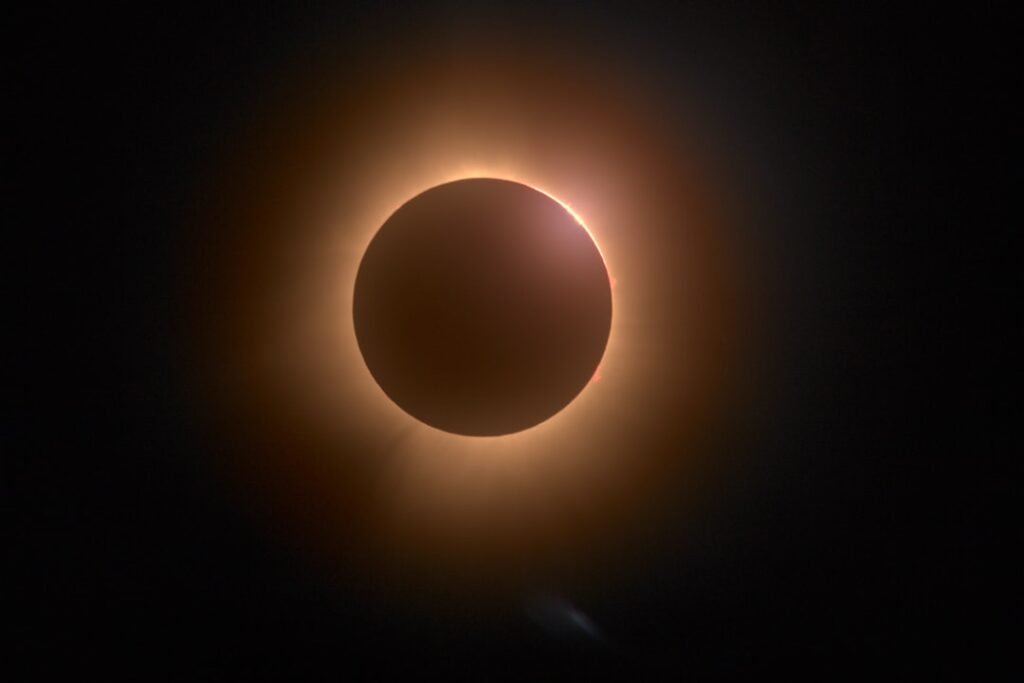

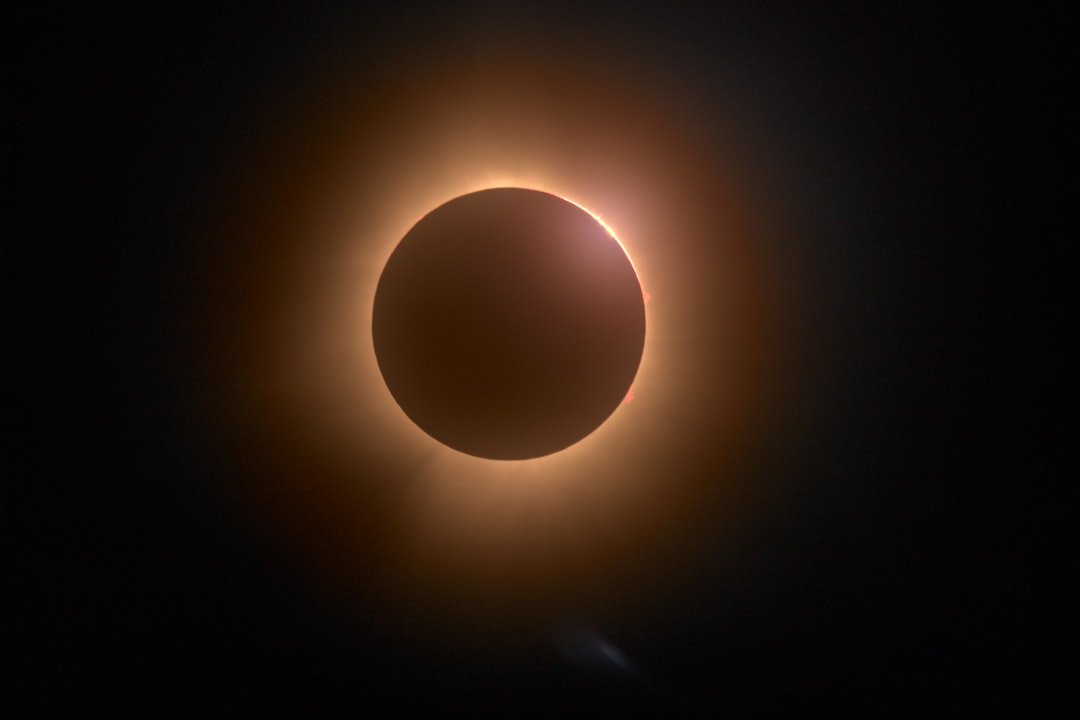
Solar Corona Observations Face Persistent Hurdles (Image Credits: Unsplash)
Scientists have unveiled plans for a spacecraft that positions itself in the Moon’s shadow to mimic total solar eclipses, offering clearer insights into the Sun’s atmosphere and enhancing space weather predictions.[1]
Solar Corona Observations Face Persistent Hurdles
The Sun’s corona, its outermost atmosphere, holds vital clues to solar storms but remains notoriously difficult to study. Traditional methods struggle with the overwhelming brightness of the solar disk. Ground-based total solar eclipses provide rare glimpses, yet they last mere minutes and suffer from Earth’s atmospheric interference.[1]
Space-based coronagraphs, such as the LASCO instrument on the SOHO satellite launched in 1995, block the Sun’s light with artificial disks. These tools produce unwanted artifacts like light streaks, limiting views to outer layers. Recent efforts like ESA’s Proba-3 mission, which launched in December 2024, use paired satellites to create eclipses but still fall short of imaging deeper regions like the chromosphere.[1]
Mesom Mission Leverages Natural Lunar Occultation
The Moon-Enabled Sun Occultation Mission, or Mesom, proposes a novel solution. A compact satellite would orbit within the Moon’s shadow, exploiting the celestial body’s perfect spherical shape and lack of atmosphere. This setup delivers artifact-free blockages of the Sun’s glare, enabling prolonged observations of the inner corona.[1]
Monthly windows lasting up to 48 minutes would occur, far exceeding the under-seven-minute durations of 21st-century ground eclipses. Over two years, the mission expects to gather at least 400 minutes of high-resolution data – equivalent to more than 80 years of eclipse chasing from Earth. Researchers at University College London’s Mullard Space Science Laboratory lead the effort, with partners from the Universities of Surrey and Aberystwyth, alongside teams in Spain, the US, and Australia.[1]
Strengthening Defenses Against Solar Disruptions
Solar storms pose growing risks to modern infrastructure. A coronal mass ejection in 1989 triggered a blackout in Quebec, costing tens of millions. More recently, eruptions in May 2024 disrupted satellite orbits and GPS signals, leading to an estimated $500 million loss for US farmers. The 1859 Carrington Event fried telegraph systems; a similar occurrence today could devastate power grids and communications.[1]
Mesom targets these threats by scrutinizing magnetic fields and plasma dynamics in the Sun’s atmosphere. Better data across wavelengths and timescales would refine forecasting models. The UK Space Agency funded the initial feasibility study, now expanded into an international proposal submitted to the European Space Agency for a potential 2030s launch.[1]
Key Advantages Over Current Approaches
The mission stands out through several innovations:
- Natural lunar occultation eliminates coronagraph artifacts for pristine imagery.
- Extended observation periods provide dynamic views of evolving solar phenomena.
- Access to chromosphere layers reveals plasma confinement and release mechanisms.
- Regular monthly sessions ensure consistent data collection unaffected by weather.
- Cost-effective mini-satellite design builds on proven orbital mechanics.
| Method | Observation Time | Frequency |
|---|---|---|
| Ground Eclipses | <7 minutes | Every 18 months |
| Proba-3 | Limited | Formation flying |
| Mesom | Up to 48 minutes | Monthly |
- Mesom uses the Moon for superior solar eclipse simulations in space.
- It promises 400+ minutes of corona data over two years.
- Enhanced forecasts could safeguard against costly solar disruptions.
This innovative approach could redefine solar research, turning the Moon into a cosmic shield for humanity’s protection. As launch plans advance, the mission highlights the power of international collaboration in tackling cosmic challenges. What are your thoughts on harnessing lunar shadows for science? Share in the comments.[1]