
A Pristine Comet Meets Intense Solar Heat (Image Credits: Cdn.mos.cms.futurecdn.net)
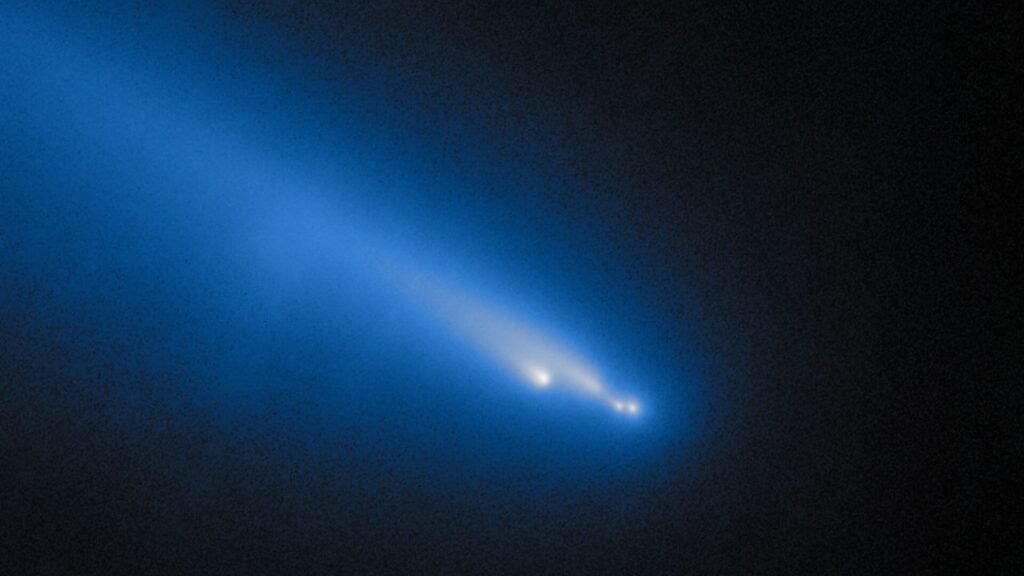
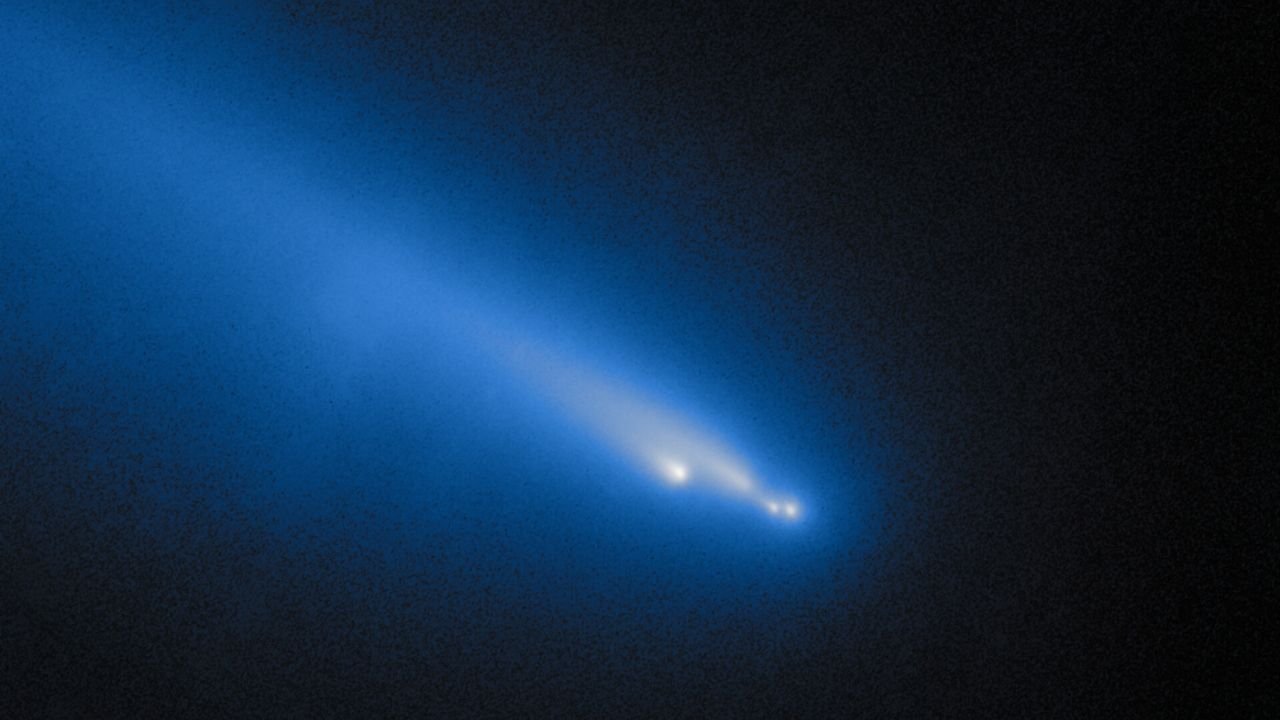
Recent observations from Hawaii’s Gemini North telescope captured the ongoing breakup of Comet C/2025 K1 (ATLAS), a visitor from the solar system’s distant fringes.[1][2])
A Pristine Comet Meets Intense Solar Heat
Astronomers first spotted Comet C/2025 K1 (ATLAS) on May 24, 2025, at the ATLAS facility in Rio Hurtado, Chile. The object appeared asteroid-like at 19th magnitude within the constellation Pegasus.[2])
Originating from the Oort Cloud, this dynamically new comet followed a hyperbolic trajectory toward the sun. It reached perihelion on October 8, 2025, at a distance of 0.334 astronomical units – close enough to raise doubts about its survival. Yet recovery efforts confirmed its presence on October 18.[2])
The intense solar radiation and tidal forces took their toll. Subsurface ices vaporized, building pressure within the nucleus estimated at 1 to 2 kilometers across. Fragmentation signs emerged as early as October 10, when French astronomer F. Kugel reported two components from Dauban Observatory.[2])
Fragmentation Accelerates in November
By November 11, Italian observers at Asiago Observatory’s 1.82-meter Copernicus telescope documented two distinct pieces separated by about 2,000 kilometers. A fainter third fragment trailed nearby.[3]
Gianluca Masi of the Virtual Telescope Project imaged the comet over multiple nights from November 11 to 18. His unfiltered exposures revealed three primary fragments labeled A, B, and C, plus a possible fourth, D. The images showed relative motion as the pieces drifted apart.[3]
Outbursts preceded the split, including a 0.9-magnitude brightening on November 4. Material arced away from the nucleus before dissipating, signaling internal instability.[2])
Advanced Telescopes Track the Crumbling Process
Gemini North on Maunakea observed the comet on November 11 and December 6, 2025. Three fragments appeared, each varying in brightness, density, and position night to night. The telescope’s high resolution highlighted the comet’s transformation into a debris cloud.[1]
James Webb Space Telescope observations in January 2026 confirmed secondary fragmentation on fragment C. The primary fragments passed closest to Earth on November 24, 2025, at 0.401 AU, visible to amateur telescopes in Leo and later Camelopardalis.[2])
- October 10: Initial two-component report.
- November 11: Three fragments confirmed.
- November 18: Possible fourth fragment.
- December 6: Fluctuating fragments via Gemini North.
- January 2026: JWST detects further breakup.
Insights From a Carbon-Poor Time Capsule
Spectroscopy from Asiago in August 2025 showed a coma depleted in carbon-chain molecules like C₂, with NH₂ dominant during fragmentation. This rare composition links it to comets like C/1988 Y1 (Yanaka) and 96P/Machholz.[2])
Low CN-to-OH and dust-to-gas ratios suggest origins in a distinct solar nebula region. As fragments potentially escape the solar system on hyperbolic paths, they offer clues to early solar system chemistry.[2])
| Fragment | Earth Approach (Nov 24, 2025) | Notes |
|---|---|---|
| A | 0.40128 AU | Brightened significantly |
| B | 0.40175 AU | Primary piece |
| C | 0.40120 AU | Secondary fragmentation |
Key Takeaways
- Comet C/2025 K1 survived perihelion but succumbed to thermal stress.
- Multiple telescopes documented a rare, multi-stage breakup.
- Its unusual chemistry provides data on Oort Cloud primitives.
Though now fading to 14th magnitude, the remnants of C/2025 K1 remind us of comets’ fragility and scientific value. What lessons will future fragments yield? Share your thoughts in the comments.