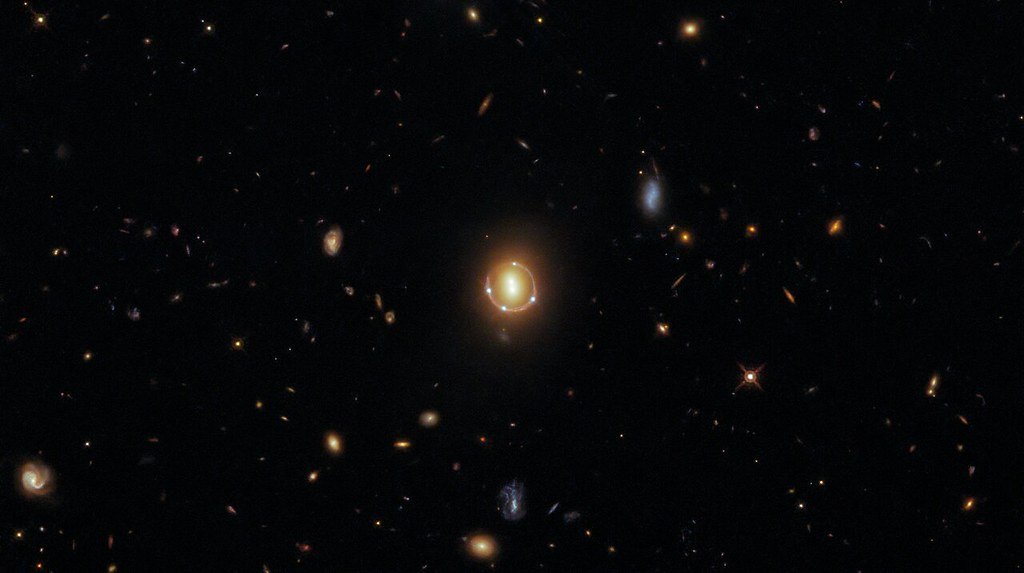
Breakthrough Speed in Sky Scanning (Image Credits: Flickr)
Los Angeles, CA – Astronomers deployed artificial intelligence to scour the Hubble Space Telescope’s extensive archive and uncovered more than 1,300 peculiarly shaped objects amid a sea of nearly 100 million image snippets.
Breakthrough Speed in Sky Scanning
The entire process unfolded in just two and a half days, a feat that highlighted AI’s potential to accelerate discoveries in astronomy. Traditional methods often demand months or years to review such volumes of data manually. Researchers focused on small cutouts, each spanning only a few dozen pixels, from the Hubble Legacy Archive. This approach allowed the AI to flag anomalies that might otherwise escape notice.
Team members marveled at the efficiency. The tool sifted through the dataset with precision, prioritizing shapes that deviated from typical celestial patterns. Such speed opens doors to revisiting old observations with fresh computational power.
Unveiling the Hubble Legacy Archive
NASA’s Hubble Legacy Archive serves as a treasure chest of astronomical data, compiled from decades of telescope observations. It contains vast arrays of images capturing distant galaxies, stars, and nebulae. The archive’s scale poses challenges for human analysts, who can review only a fraction of the material.
By automating the search, astronomers tapped into this underutilized resource. The 100 million cutouts represented a targeted subset optimized for AI processing. This method proved its worth by surfacing hidden gems within the digital stacks.
Characteristics of the Cosmic Curiosities
These 1,300 objects stood out due to their unusual forms, signaling potential rare phenomena. Astronomers noted shapes that defied common expectations in the Hubble imagery. Such outliers could represent gravitational lenses, merging galaxies, or other exotic events.
Further study now beckons for these finds. Initial reviews suggest they warrant deeper investigation with additional telescopes or simulations. The discoveries underscore how AI complements human intuition in pattern recognition.
Shifting Paradigms in Space Exploration
This project marks a pivotal step in blending machine learning with observational astronomy. Similar techniques could apply to upcoming telescopes like the James Webb Space Telescope. Researchers anticipate broader adoption to handle escalating data volumes from space missions.
Collaborations between AI specialists and astronomers will likely intensify. The success here demonstrates scalable solutions for legacy datasets across observatories worldwide.
- Nearly 100 million image cutouts analyzed.
- More than 1,300 unusual objects identified.
- Completion in 2.5 days.
- Focus on pixel-scale anomalies from Hubble.
- Potential for rare astronomical events.
Key Takeaways
- AI dramatically shortens analysis timelines for massive archives.
- Hubble data yields fresh insights years after capture.
- Future astronomy hinges on human-AI partnerships.
Astronomers now gear up to decode these cosmic puzzles, promising revelations about the universe’s quirks. What surprises might the next AI-assisted scan reveal? Share your thoughts in the comments.