
Imagine discovering that the stage on which the entire universe performs isn’t solid at all, but more like a strange cosmic liquid that can swirl, ripple, and boil. That’s the wild idea behind the notion that space-time itself might be a fluid, not a rigid, unchanging backdrop. It sounds like science fiction, but serious physicists are exploring this possibility to explain some of the biggest puzzles in modern cosmology.
I remember the first time I encountered this idea; it felt like someone had told me the floor under my feet was actually water, and I’d just never noticed. The more I dug into it, the more it made sense that what we call “space” could be made of something deeper and more fundamental. If this is true, then gravity, black holes, and even the Big Bang might look completely different than we’ve been taught. Let’s walk through what this fluid picture of space-time really means and why it could change everything.
Why Physicists Are Questioning the Old Picture of Space-Time
For over a century, Einstein’s general relativity has treated space-time as a smooth, continuous fabric that bends and curves in response to matter and energy. It’s an elegant idea: massive objects warp this fabric, and that curvature is what we experience as gravity. The theory has passed countless tests, from the bending of starlight around the sun to the recent detection of gravitational waves rippling across the cosmos. On everyday and even galactic scales, it works astonishingly well.
But when you push general relativity to extremes, especially inside black holes or back toward the first moments after the Big Bang, the math starts to break. It spits out infinities and singularities, places where the theory basically throws its hands up and says, “I don’t know.” At the same time, quantum mechanics, which rules the microscopic world, refuses to play nicely with relativity. Many physicists now suspect that treating space-time as perfectly smooth is like pretending water is perfectly continuous and ignoring that it’s made of molecules. At some deeper level, they think, space-time might be granular, emergent, and in a strange way, fluid-like.
The Mind-Bending Idea of Emergent Space-Time
The concept of emergent space-time says that space and time aren’t fundamental ingredients of reality, but byproducts of something more basic. It’s a bit like how temperature doesn’t exist at the level of one single particle but appears when you look at a huge crowd of particles together. According to this view, space-time could “emerge” from the collective behavior of some underlying degrees of freedom, the way a fluid’s smooth surface emerges from countless jostling molecules.
This sounds abstract, but the logic is simple: if relativity and quantum physics keep clashing, maybe it’s because we’re trying to quantize something that isn’t truly fundamental. Instead of forcing space-time into the quantum box, some researchers think we should treat it as a macroscopic manifestation of a deeper quantum system. In that case, just like a fluid can have waves, vortices, and turbulence, the universe might have gravitational waves, black holes, and cosmic expansion as emergent “flow patterns” in an invisible substrate. It’s a radical downgrade of space-time from “ultimate reality” to “collective illusion,” but one rooted in real physics.
How a Fluid Space-Time Could Explain Gravity
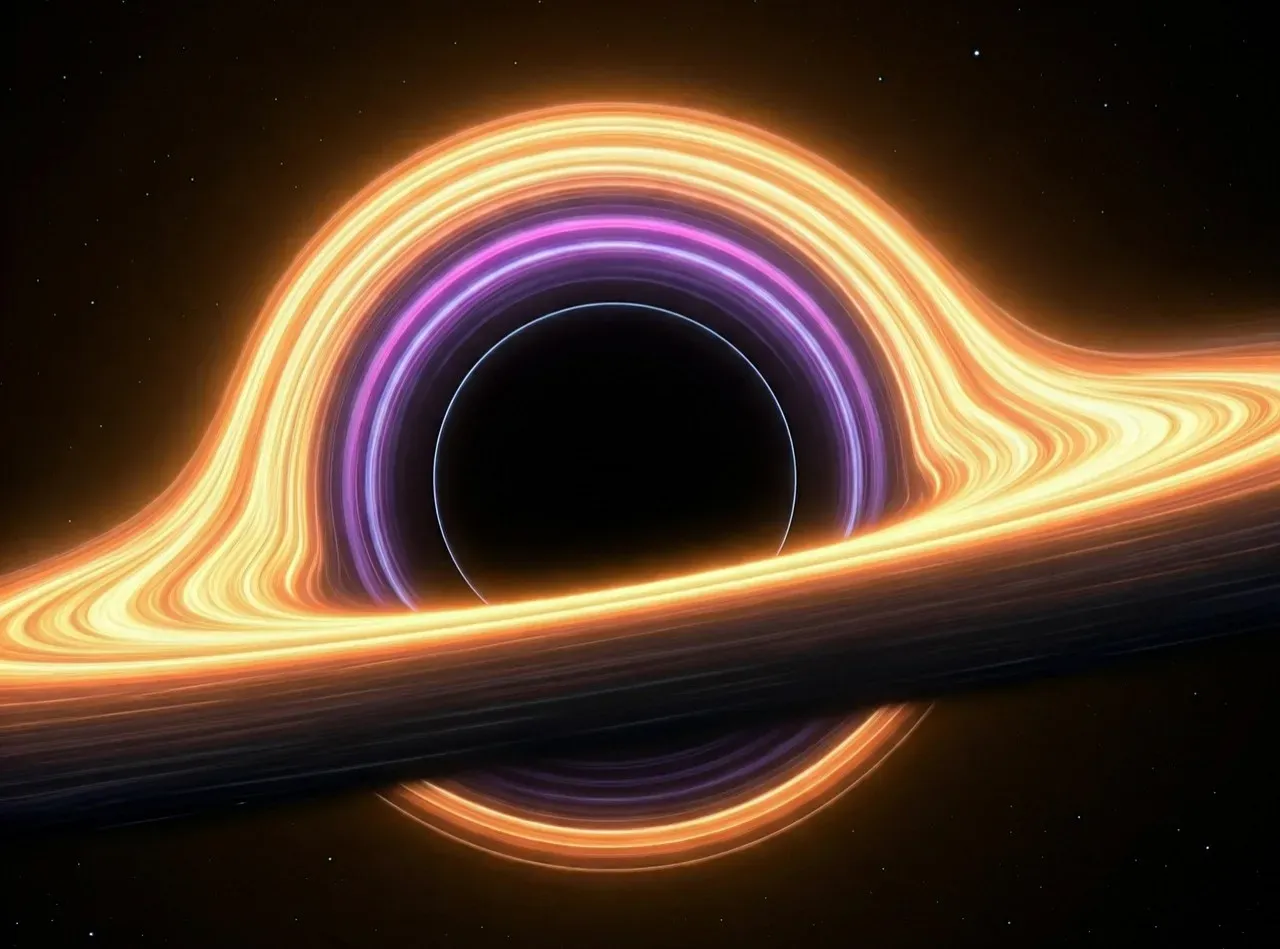
In the traditional view, gravity is geometry: matter tells space-time how to curve, and space-time tells matter how to move. In the fluid picture, gravity becomes more like a thermodynamic effect or a kind of elasticity of the underlying medium. Just as sound waves are pressure disturbances in air, gravitational effects could be excitations or distortions in the deeper “stuff” that makes up space-time. You don’t need to imagine particles of gravity floating around in empty space; you imagine the medium itself responding like a fluid under stress.
Some approaches even treat Einstein’s equations as similar to equations of fluid dynamics or thermodynamics, suggesting they are not fundamental laws but effective descriptions, like the laws of hydrodynamics that emerge from molecular physics. In this scenario, black holes might resemble droplets or whirlpools in this fluid, with their horizons acting like phase boundaries. I find this reinterpretation strangely satisfying, because it turns gravity from a mysterious curvature into something more familiar: the large-scale behavior of a deep, possibly quantum medium, whose microscopic details we haven’t yet resolved.
Quantum Foam and the Granular Texture of Reality
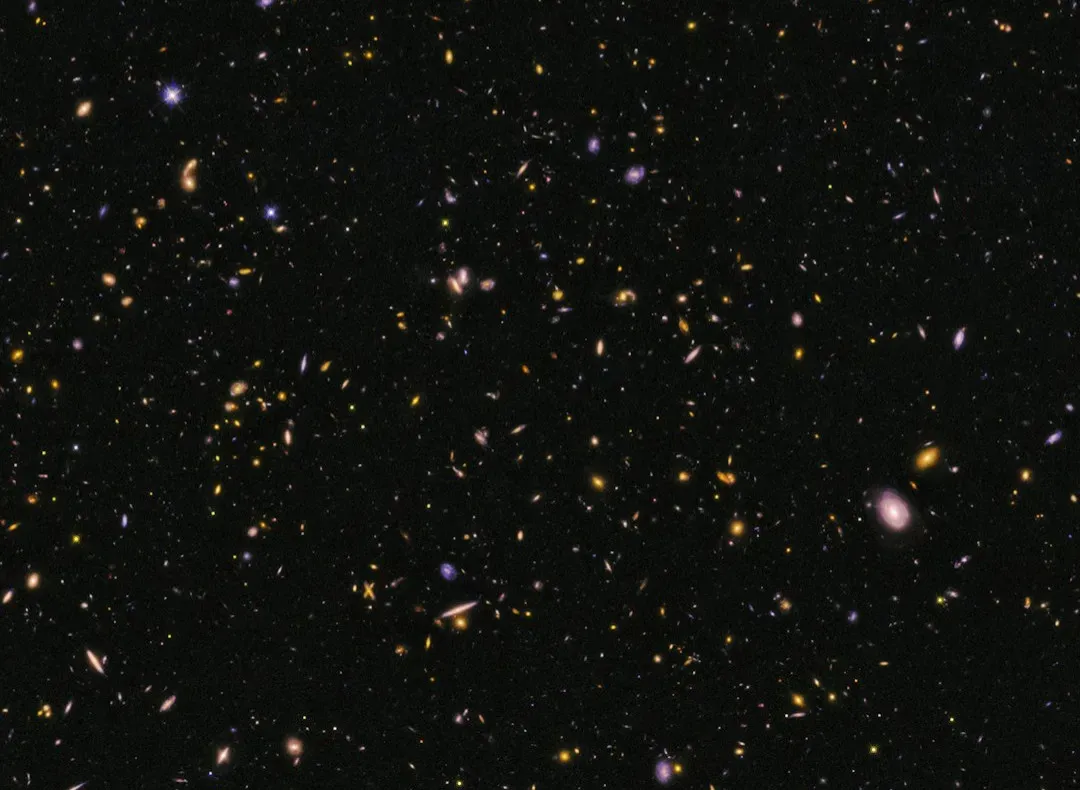
If space-time is a fluid, it probably isn’t perfectly smooth down to arbitrarily tiny scales. Quantum mechanics suggests that at unimaginably small distances, space-time might be jittery, frothy, and noisy, something often called quantum foam. Instead of a calm ocean surface, picture a boiling pot of water, where tiny bubbles are constantly forming and disappearing. At our human scale, that chaos averages out, and we see a relatively smooth surface; at the Planck scale, the bubbling might dominate everything.
This granular picture lines up with the idea that there could be a smallest meaningful distance or time interval beyond which our usual notions of space and time break down. Some researchers have tried to look for traces of this foam in the light from distant galaxies or gamma-ray bursts, searching for tiny delays or blurring that would hint at an underlying discreteness. So far, the universe has been surprisingly quiet and smooth, pushing any such effects to scales even smaller than we can currently probe. Still, the idea of a foamy, fluid-like microstructure of space-time continues to guide many attempts at a quantum theory of gravity.
Black Holes as Droplets in the Cosmic Fluid
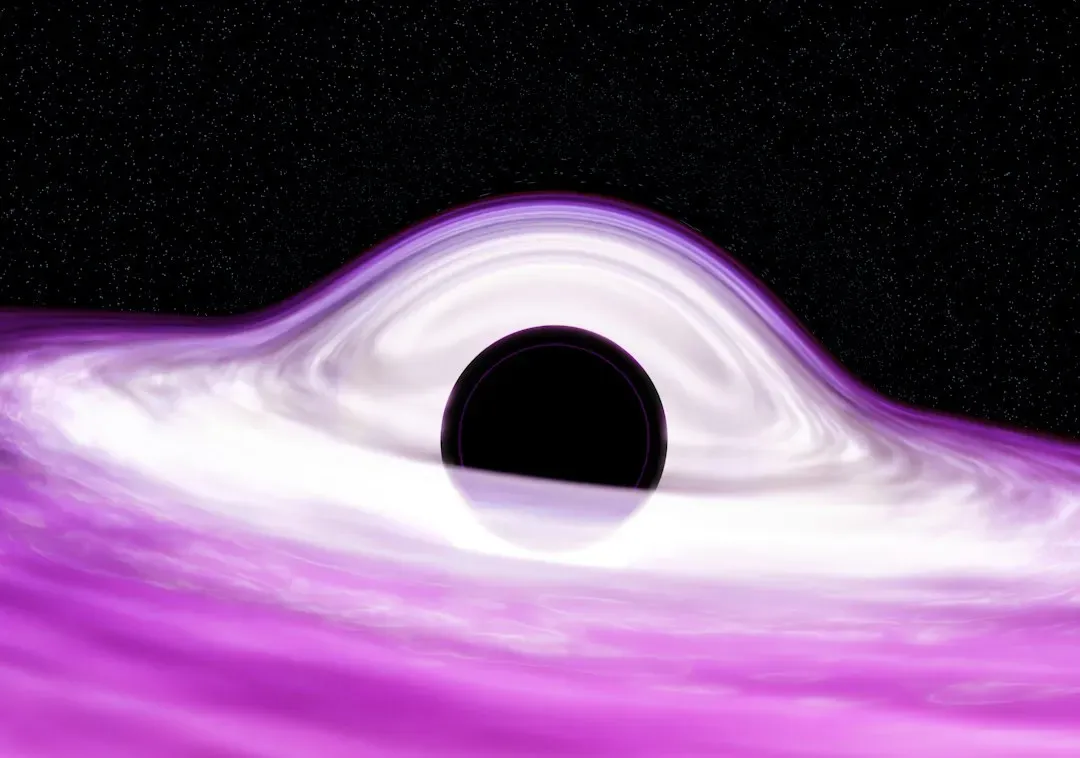
Black holes are where our current theories fail the loudest, which makes them perfect testing grounds for radical ideas. In a fluid-space-time picture, a black hole might be less like an infinitely dense point and more like a special state or “droplet” of the underlying medium. Its event horizon, the boundary beyond which nothing escapes, could act like a membrane or surface tension in the fluid, separating one phase of the medium from another. This perspective can change how we think about information falling into, and eventually escaping from, a black hole.
The long-standing black hole information paradox arises because classical relativity says information can be lost inside a black hole, while quantum mechanics insists it can’t. If space-time is emergent and fluid-like, the paradox might fade: information could be encoded in the microscopic degrees of freedom of the medium rather than destroyed. Some models even compare black holes to superfluids or quantum condensates, where strange behaviors like frictionless flow and quantized vortices appear. In that sense, black holes might not be cosmic monsters that break physics, but complex droplets that reveal the hidden microstructure of reality.
Clues from Condensed Matter: The Universe as a Strange Material
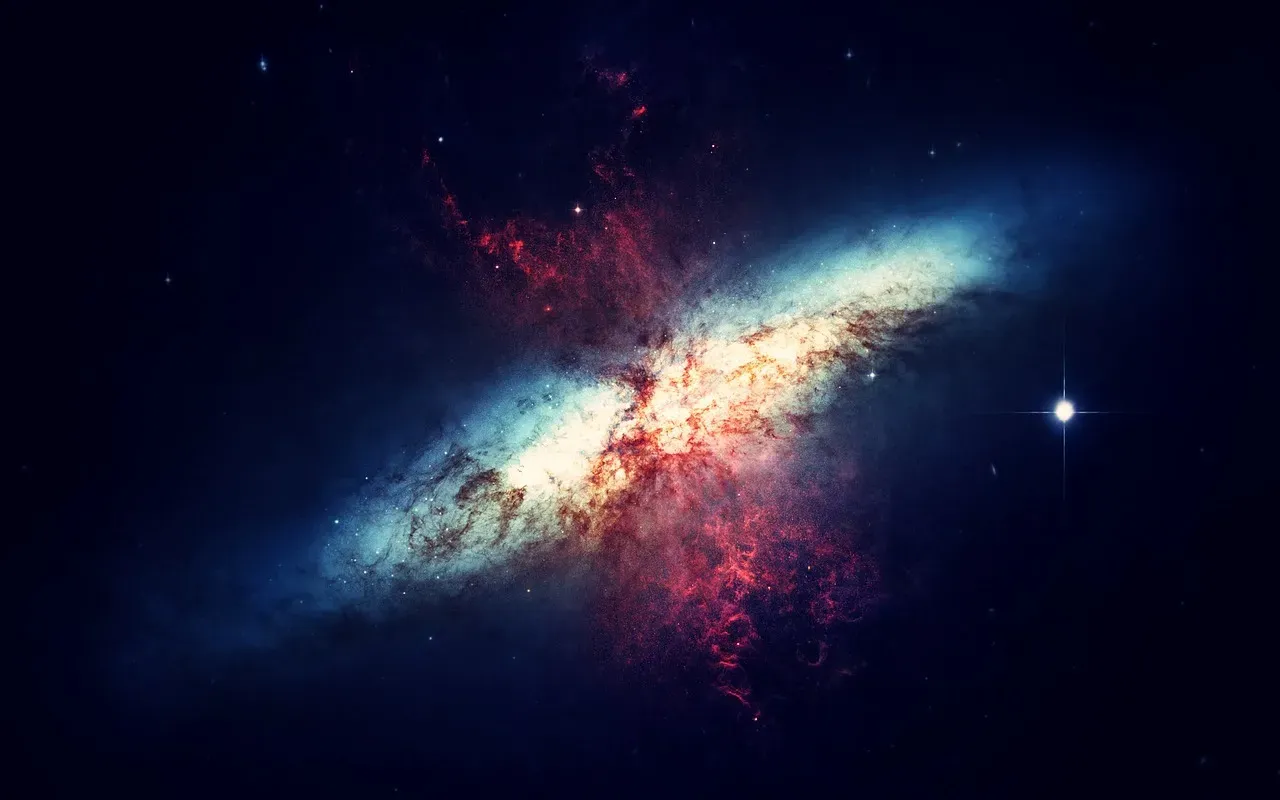
One of the most surprising developments over the last few decades is how often condensed matter physics, the study of materials like liquids, crystals, and superconductors, turns out to be useful for understanding the universe. Physicists have built laboratory systems where sound waves or light behave a bit like particles in curved space-time, creating “analogue gravity” experiments. In some of these setups, researchers have simulated horizons that mimic black holes using fluids, superfluids, or Bose–Einstein condensates, and then studied how excitations move near those horizons.
These experiments don’t prove that space-time is literally a fluid, but they show how gravity-like behavior can emerge from underlying microscopic systems that have nothing to do with geometry at the start. It’s like watching a miniature universe made from atoms behave as if it has its own space-time. I find it almost unsettling that a table-top experiment can echo features of the cosmos, as if the universe is hinting that its own structure might not be so different from a very exotic material. The boundary between cosmology and materials science has started to blur in a way that would have sounded absurd a few generations ago.
What This Means for the Beginning and Fate of the Universe
If space-time is a fluid-like emergent phenomenon, the Big Bang might not have been a literal “beginning of everything” as traditionally imagined. Instead of a singular starting point where laws break down, it could have been a kind of phase transition in the underlying medium, like water freezing into ice or boiling into steam. In that case, what we call the early universe might just be the era when this cosmic fluid settled into the form we now interpret as space and time. Our current cosmic expansion, dark energy, and large-scale structure could be reflections of how this medium relaxes, flows, and responds to whatever deeper rules it obeys.
This idea also changes how we think about the ultimate fate of the universe. Rather than asking whether space-time will expand forever, recollapse, or tear itself apart, we might instead ask what happens to the fluid-like substrate in the very long run. Could it undergo another phase transition, making our current form of space-time just one chapter in a longer story? Or might the apparent heat death of the universe simply be the medium settling into a quiet, almost featureless state? These questions move the focus away from the visible cosmic stage and toward what might be lurking in the backstage machinery we can’t yet directly see.
Why the Fluid Picture of Space-Time Matters for All of Us
On the surface, the question of whether space-time is a fluid might sound like a niche puzzle for theorists with too much chalk and not enough sunlight. But underneath, it touches something deeply human: our urge to understand what reality is really made of. If space and time themselves are emergent, then what we take as obvious and permanent is more like a shared hallucination built from deeper rules. It’s similar to learning that color is not a property of objects but a way our brains interpret light; the world hasn’t changed, but your understanding of it has shifted forever.
This shift could eventually lead to technologies and insights we can’t currently predict, just as early work on electromagnetism or quantum theory eventually reshaped everyday life. Even if it never leads to a gadget in your pocket, it changes the story we tell about our place in the universe. We may not be living on a solid, unshakeable stage, but floating in a vast, subtle ocean whose currents and waves create everything we see. And that raises a quiet, lingering question that’s hard to shake: if space-time itself is a kind of fluid, what else about reality might be far less solid than it looks at first glance?