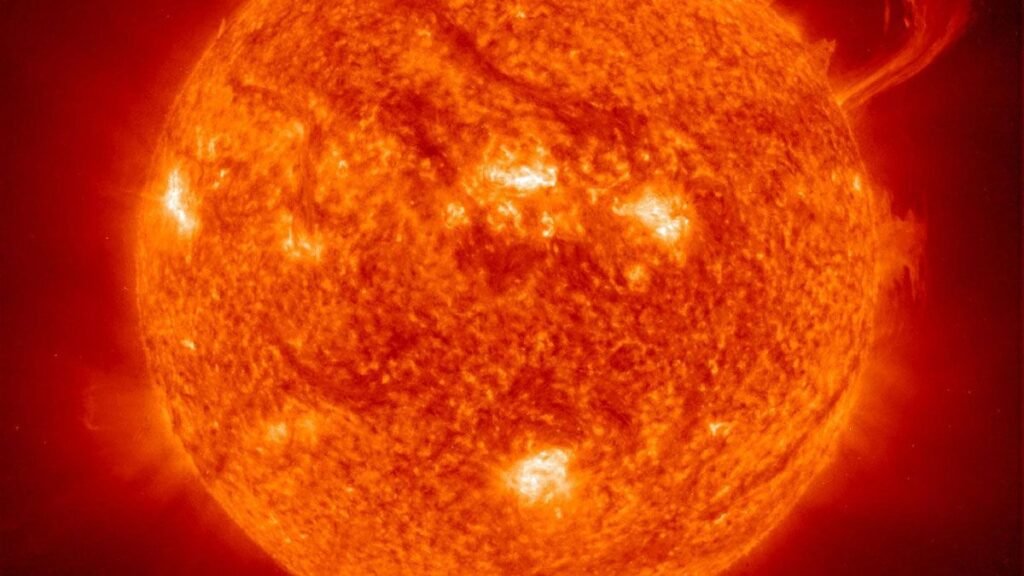
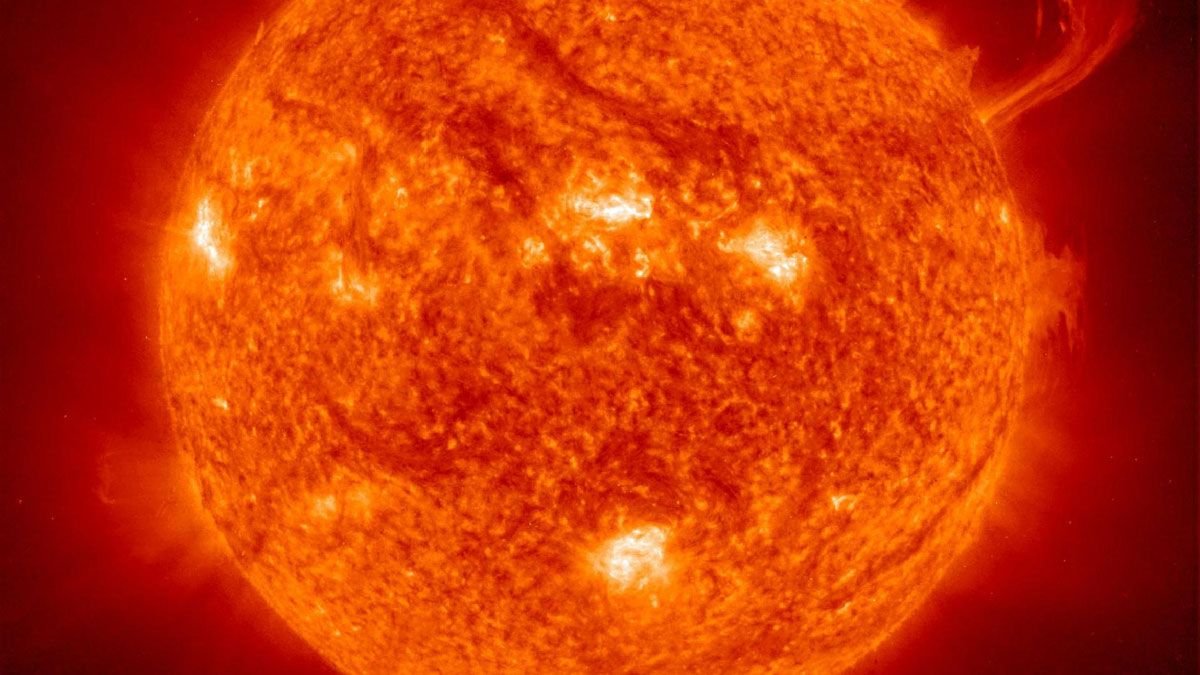
Solar Orbiter Witnesses a Flare’s Fiery Birth (Image Credits: Cdn.mos.cms.futurecdn.net)
ESA’s Solar Orbiter mission provided unprecedented views of a solar flare’s buildup, exposing how minor magnetic shifts snowball into massive eruptions on the sun’s surface.[1][2]
Solar Orbiter Witnesses a Flare’s Fiery Birth
On September 30, 2024, the spacecraft approached within 43 million kilometers of the sun and documented a medium-class flare over 40 minutes. Instruments captured details as fine as a few hundred kilometers across, with image frames updating every two seconds. A dark arch of twisted magnetic fields and plasma connected to a cross-shaped hub of intensifying activity. Small bursts of light marked initial reconnections, sparking a chain reaction that detached the arch and hurled it outward.[1]
Plasma rained down in giant blobs, forming fast-moving ribbons that deepened energy deposits even after the peak. Charged particles accelerated to 40-50% the speed of light. Researchers described the sequence as a rare stroke of luck during a planned observation campaign.[2]
The Science of Magnetic Reconnection Cascades
Solar flares erupt when stressed magnetic field lines snap and reform, converting stored energy into heat, light, and particle acceleration. This event revealed smaller instabilities accumulating like an avalanche, with each reconnection fueling the next. Twisted strands emerged rapidly, brightening the region before the main outburst at 23:47 UT. The process spread swiftly across space and time, challenging models of isolated eruptions.[3]
Lead researcher Pradeep Chitta of the Max Planck Institute for Solar System Research noted, “We were really very lucky to witness the precursor events of this large flare in such beautiful detail. We really were in the right place at the right time to catch the fine details of this flare.”[1]
Layered Data from Four Key Instruments
Solar Orbiter deployed multiple tools for a comprehensive view. The Extreme Ultraviolet Imager (EUI) tracked coronal changes in extreme ultraviolet light. The Spectral Imaging of the Coronal Environment (SPICE) analyzed plasma temperatures and flows. The Spectrometer/Telescope for Imaging X-rays (STIX) measured high-energy emissions, while the Polarimetric and Helioseismic Imager (PHI) mapped magnetic fields down to the photosphere.
- EUI: High-cadence images of filament destabilization.
- SPICE: Plasma blobs raining post-flare.
- STIX: X-ray spikes and particle speeds.
- PHI: Field line relaxation after peak.
These observations, detailed in a January 21, 2026, Astronomy & Astrophysics paper, confirmed energy transfer from fields to plasma throughout the atmosphere.[2]
Boosting Space Weather Forecasts
Powerful flares often spawn coronal mass ejections that disrupt satellites, power grids, and communications on Earth. By pinpointing avalanche precursors, scientists gain tools to predict flare escalation. Particles from such events pose radiation risks to astronauts and aviation. The findings also hint at similar dynamics on cooler stars with frequent outbursts.
ESA co-Project Scientist Miho Janvier stated, “This is one of the most exciting results from Solar Orbiter so far.” Future missions may seek higher-resolution X-ray data to refine these insights.[1]
Key Takeaways
- Avalanches of mini-reconnections drive large flares, starting small and building fast.
- Solar Orbiter’s proximity enabled two-second imaging of features hundreds of kilometers wide.
- Understanding this improves predictions for Earth-impacting space weather events.
Solar Orbiter’s capture of this magnetic drama underscores the sun’s volatile power and the value of close-range study. As researchers probe whether all flares follow this pattern, the mission paves the way for safer space exploration. What do you think this means for future solar forecasts? Tell us in the comments.