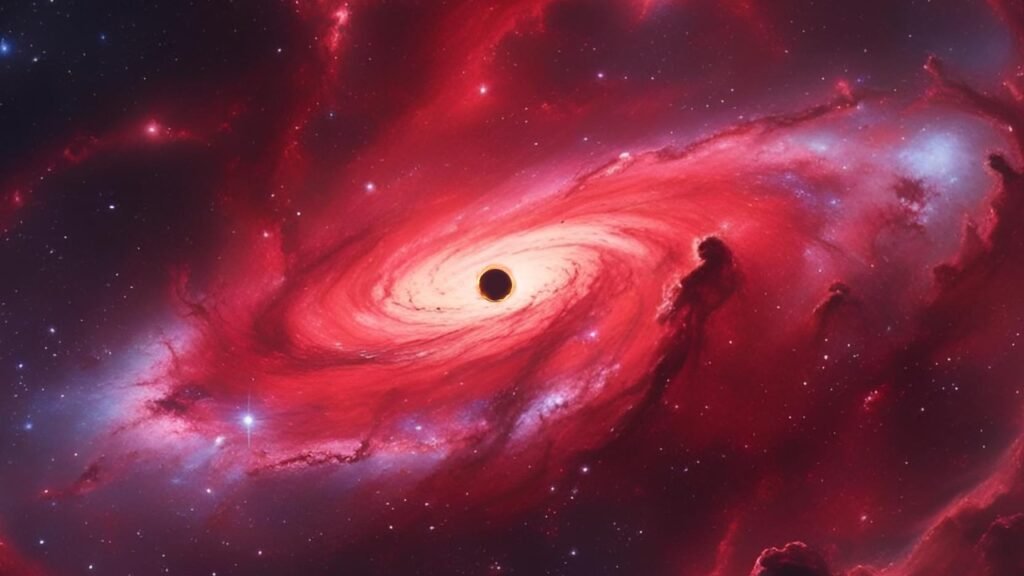

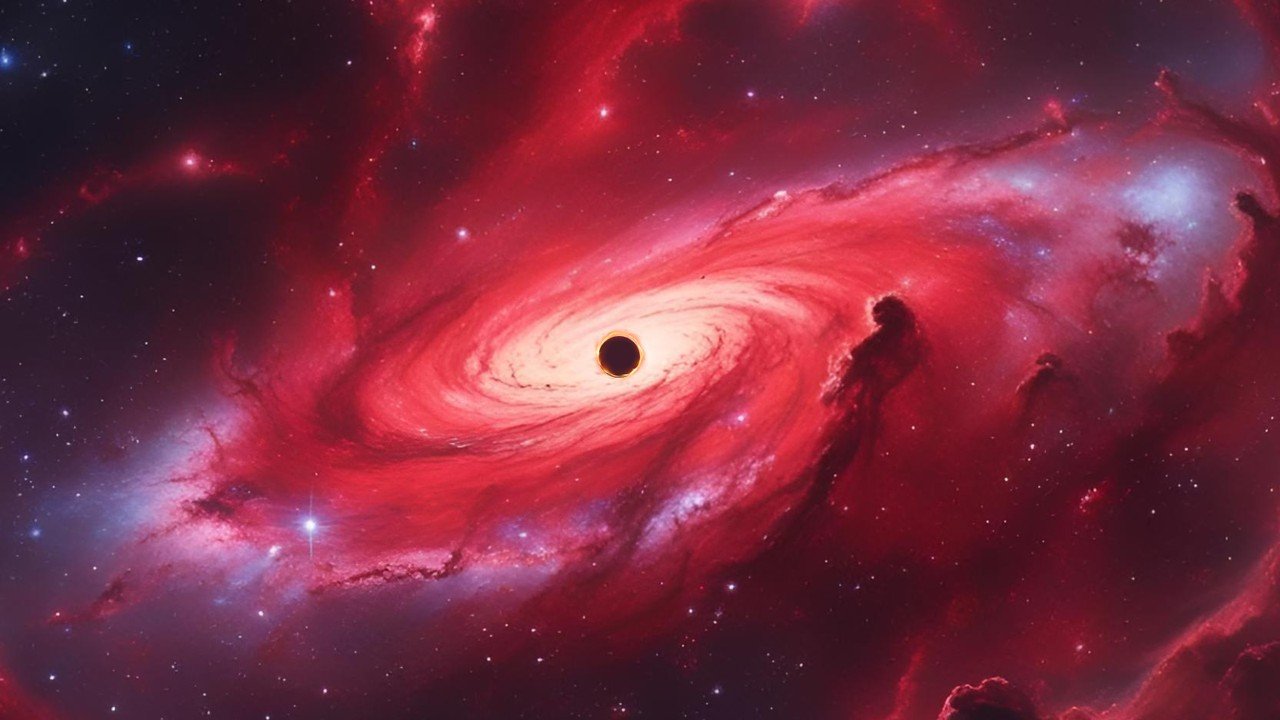
A Surprising Discovery Lights Up the Cosmos (Image Credits: Cdn.mos.cms.futurecdn.net)
The James Webb Space Telescope has unveiled a population of compact, ruby-red objects from the universe’s infancy that challenge long-held views on black hole formation.[1][2]
A Surprising Discovery Lights Up the Cosmos
Astronomers first noticed these “little red dots” (LRDs) in deep-field images captured by JWST during its early surveys.[3] Hundreds of them appeared as tiny, point-like specks at redshifts between 4 and 8, corresponding to a time roughly 700 million to 1.3 billion years after the Big Bang.
These objects stood out due to their unusual spectra: V-shaped profiles with sharp breaks near the Balmer limit, broad emission lines, and a red hue in optical wavelengths paired with blue ultraviolet continua.[2] Their compact morphology suggested sizes no larger than a few light-days to hundreds of parsecs, far smaller than typical galaxies of that era.
Properties That Defy Explanation
LRDs puzzled researchers with their brightness – some rivaling a trillion times the Sun’s luminosity – yet lacking telltale signs of star formation or standard active galactic nuclei.[3] Weak X-ray and radio emissions further complicated the picture, as did the apparent overmassive black holes implied by broad-line widths exceeding 1,000 km/s.
Surveys like JADES, CEERS, and RUBIES identified over 300 such candidates, revealing their abundance peaked around redshift 5 before declining.[4]
- Compact size: ∼0.1–1 kpc
- Redshift range: z ≈ 4–8
- Spectral features: Broad Hα, He lines; Balmer absorption
- Luminosity: Up to 1043 erg/s in Hα
- No strong star-formation indicators
The Direct-Collapse Black Hole Hypothesis
One leading theory posits LRDs as nurseries for direct-collapse black holes (DCBHs), massive seeds formed when pristine gas clouds in metal-poor halos collapsed directly into black holes of 104–105 solar masses.[2] Recent simulations showed accreting DCBHs produce spectra matching LRD observations: dense, ionized accretion flows create Balmer absorption screens, while reprocessed UV emission explains the red colors and weak X-rays.
Fabio Pacucci and colleagues argued in January 2026 that JWST captured these heavy seeds during long-lived (>100 million years) accretion phases driven by radiation pressure in atomic-cooling halos.[2] This scenario resolves the rapid growth needed for early supermassive black holes powering distant quasars.
Other studies supported LRDs as DCBH progenitors, linking their evolution to high-redshift environments where pristine conditions favored direct collapse over stellar remnants.[1]
Competing Views and Ongoing Debate
Alternative models suggest LRDs host young supermassive black holes shrouded in dense ionized cocoons, where electron scattering broadens lines and obscures emissions.[4] High-resolution JWST spectra of 12 LRDs revealed symmetric Hα profiles fitting Compton-thick gas (Ne ≈ 1024 cm−2), yielding corrected black hole masses of 105–107 solar masses.
These “black hole stars” fade as gas depletes, explaining LRDs’ disappearance after two billion years post-Big Bang.[3] Vadim Rusakov noted, “This cocoon makes these black holes look red and prevents much of their radiation from escaping.”[3]
| Theory | Key Feature | Explains |
|---|---|---|
| DCBH Nurseries | Direct gas collapse | Spectra, abundance, no stars |
| Ionized Cocoons | Electron scattering | Broad lines, weak X-rays |
Key Takeaways
- LRDs represent a new class of early-universe objects challenging black hole formation models.
- DCBH hypothesis links them to heavy seeds for quasars.
- Cocoon model revises masses via scattering effects.
Whether nurseries or cloaked powerhouses, LRDs offer vital clues to how supermassive black holes assembled so swiftly in cosmic dawn. Future JWST observations will test these ideas, potentially rewriting early galaxy evolution. What do you think these red specks reveal about the universe’s first giants? Share in the comments.