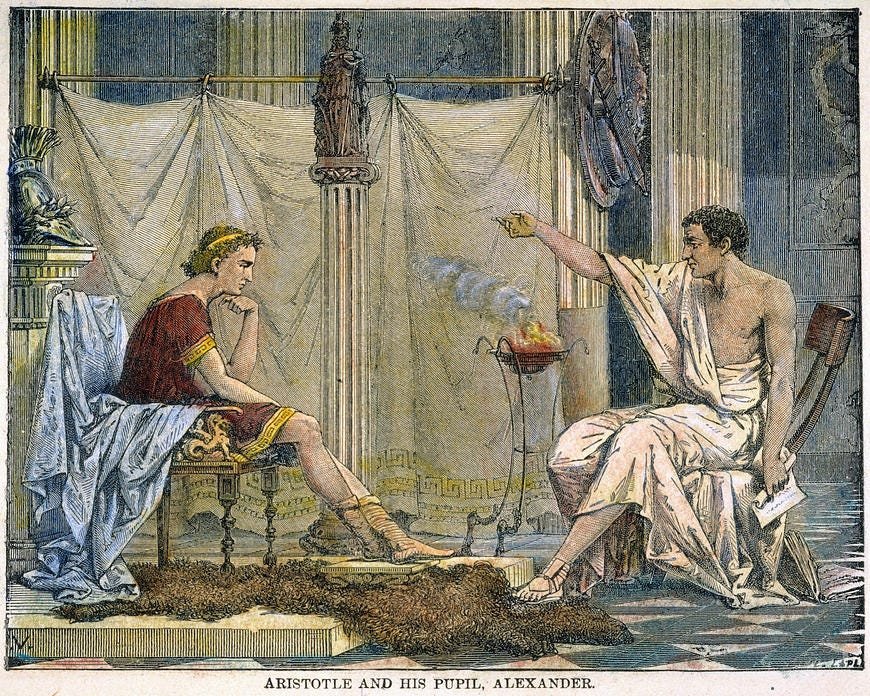
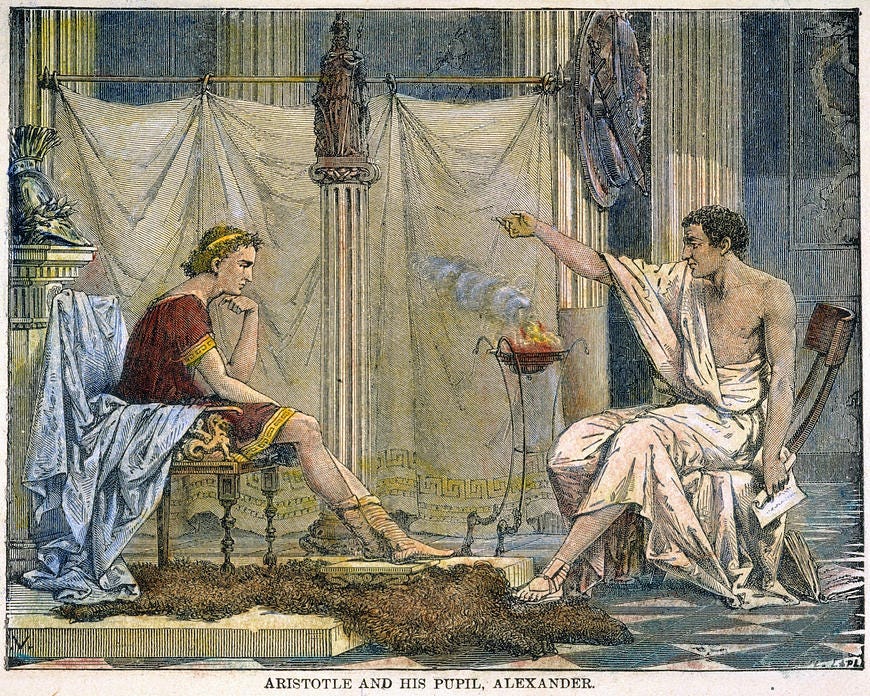
A Stationary Earth Anchors All Motion (Image Credits: Substackcdn.com)
Philosopher Aristotle crafted a vision of the universe that placed Earth at its core, surrounded by layers of perfect motion.
A Stationary Earth Anchors All Motion
Aristotle positioned Earth as the fixed center of the cosmos, rejecting any notion of it hurtling through space.[1][2] This geocentric model stemmed from observations like the circular shadow Earth cast during lunar eclipses, confirming its spherical shape.[3]
Celestial bodies, including the Sun, Moon, planets, and stars, revolved around this central sphere in eternal cycles. Such arrangement aligned with Aristotle’s belief in natural places for elements, where heavier substances settled inward. The universe appeared finite and spherical, mirroring the perfection Aristotle attributed to the cosmos.
Sublunary Chaos Versus Celestial Perfection
Beneath the Moon lay the sublunary realm, a domain of change and imperfection marked by birth, decay, and weather’s whims.[2][1] Earth, water, air, and fire composed this region, each seeking its natural position – earth downward, fire upward.
Above the Moon stretched the superlunary heavens, composed of aether, an unchangeable fifth element ensuring flawless uniformity.[4] Here, heavenly bodies executed pure circular paths, the only motion deemed eternal and self-sustaining.
Crystalline Spheres Drive the Dance of the Stars
To explain observed irregularities like retrograde planetary motion, Aristotle invoked up to 55 nested crystalline spheres.[2] These transparent orbs, rotating at varied speeds and angles, carried the wandering stars in their paths around Earth.
- Moon’s sphere formed the innermost celestial layer.
- Sun and five known planets – Mercury, Venus, Mars, Jupiter, Saturn – followed in sequence.
- The fixed stars occupied the outermost sphere, completing daily rotations.
- Unmoving realm beyond held divine mysteries.
This system preserved the illusion of uniform perfection despite earthly discrepancies.
The Prime Mover Sets Eternity in Motion
An unmoved Prime Mover initiated all celestial activity, thinking eternal thoughts that inspired spheres to turn without mechanical contact.[5] Aristotle argued that circular motion alone qualified as perfect, allowing bodies to remain unchanged indefinitely.[1]
Humans inhabited only Earth, as other worlds would contradict the unique centrality of our sphere. This divine hierarchy bridged physics and metaphysics, influencing thought for millennia.
Key Takeaways
- Earth served as the universe’s motionless center in Aristotle’s geocentric framework.
- Sublunary elements fueled change below the Moon; aether ensured celestial eternity above.
- Nested spheres accounted for heavenly motions, powered by an immaterial Prime Mover.
Aristotle’s model, though eclipsed by later discoveries, offered a profound synthesis of observation, logic, and philosophy that dominated Western cosmology for centuries. What aspects of his ancient vision resonate in modern science? Share your thoughts in the comments.