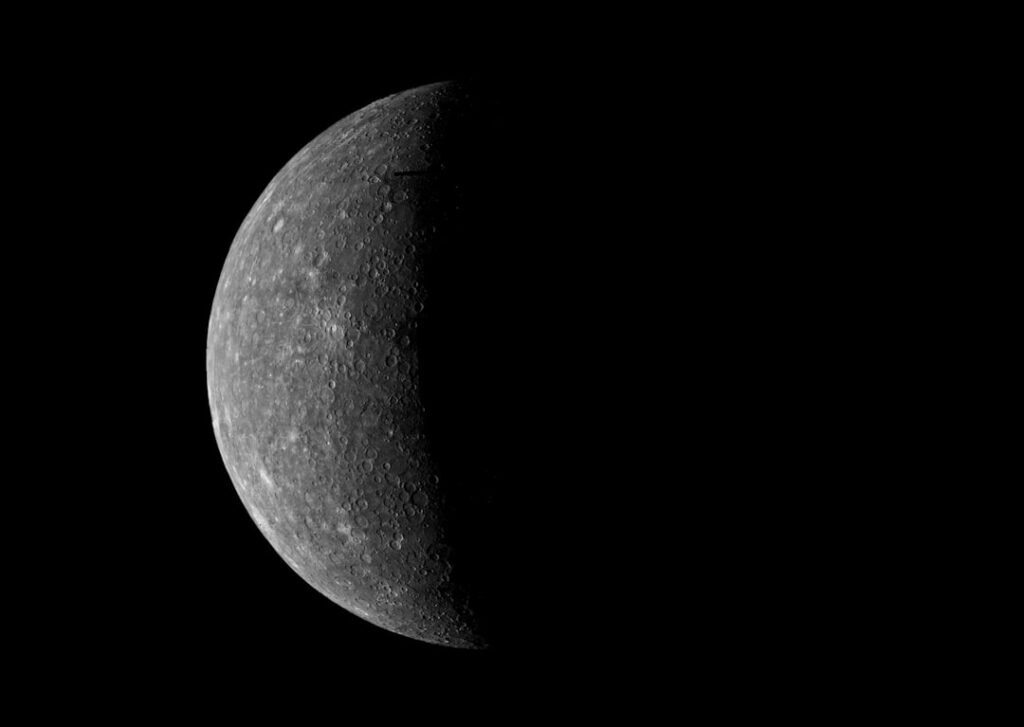

Unexpected Harmony in Mercury’s Magnetic Field (Image Credits: Unsplash)
Tokyo – Researchers revealed striking parallels in electromagnetic chorus waves between Mercury’s faint magnetosphere and Earth’s robust protective shield.
Unexpected Harmony in Mercury’s Magnetic Field
Chorus waves, those distinctive electromagnetic emissions familiar to scientists studying Earth’s space environment, have now been detected around Mercury. Despite the planet’s magnetosphere being vastly weaker—only about 1% as strong as Earth’s—these waves exhibited remarkably similar frequency patterns. The discovery challenges assumptions about how plasma behaves in varied magnetic environments.
International scientists analyzed data from six flybys of Mercury’s orbit. The observations spanned from 2021 to 2025, capturing dynamic plasma interactions in real time. This finding emerged from meticulous waveform analysis, highlighting a universal process at play across our solar system.
Key Missions Fuel the Breakthrough
The BepiColombo spacecraft’s Mercury Magnetospheric Orbiter, known as Mio, provided the critical Mercury-side data. During each flyby, Mio’s instruments recorded chorus wave signatures amid the planet’s tenuous plasma. These events offered rare glimpses into Mercury’s otherwise elusive magnetosphere.
Complementing this were decades of observations from Earth’s GEOTAIL satellite. Launched in 1992, GEOTAIL has cataloged countless chorus events in our planet’s magnetotail. By aligning datasets from both missions, researchers identified matching spectral characteristics, such as rising tones and frequency drifts.
The synergy between recent flyby data and long-term Earth records proved essential. It allowed for direct comparisons that previous studies could not achieve.
Unraveling Plasma Dynamics Across Scales
Chorus waves arise from instabilities in the plasma surrounding magnetized planets. Electrons accelerate and emit radio-like frequencies, often likened to birdsong due to their chirping quality. On Earth, these waves influence auroras and satellite communications.
At Mercury, the weaker field amplifies the surprise. Solar wind bombards the planet more intensely, yet chorus formation persists with Earth-like traits. This suggests fundamental physics governs wave generation, independent of magnetosphere strength.
- Frequency ranges closely matched between planets.
- Wave intensities scaled with local plasma density.
- Temporal structures showed identical modulation patterns.
- Occurrence tied to substorm-like activity in both environments.
- Spectral shapes confirmed shared generation mechanisms.
Broader Implications for Solar System Science
The study opens doors to understanding plasma behavior at other worlds. Similar waves might exist around Jupiter or Saturn, where magnetospheres dwarf Earth’s. It also refines models of space weather, crucial for spacecraft operations near Mercury.
Future BepiColombo orbits, set to begin in 2026, promise continuous monitoring. Enhanced data could reveal how chorus waves interact with Mercury’s exosphere and surface.
Key Takeaways
- Chorus waves in Mercury’s weak magnetosphere mirror Earth’s despite vast differences in scale.
- BepiColombo’s Mio and GEOTAIL data enabled unprecedented cross-planet comparisons.
- Findings point to universal plasma physics, aiding predictions for planetary environments.
This convergence of observations underscores the interconnected nature of magnetospheric phenomena. As missions delve deeper, such discoveries reshape our view of solar system dynamics. What surprises might the next flyby bring?