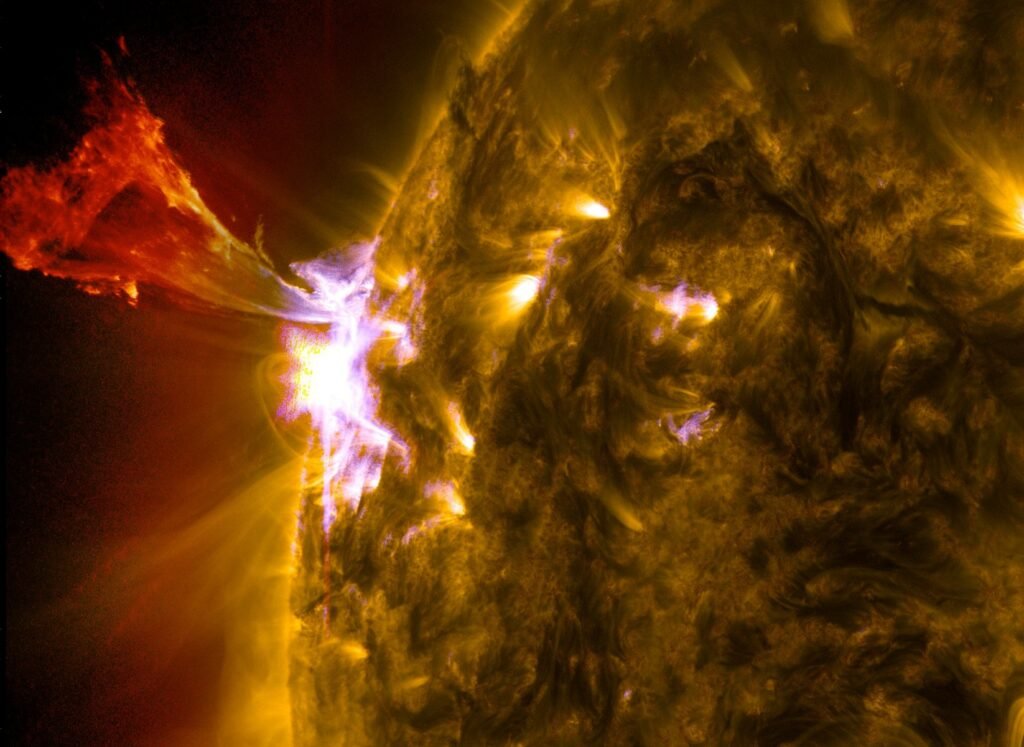


Tiny Wobbles Ignite Solar Fury (Image Credits: Upload.wikimedia.org)
Paris – The ESA-led Solar Orbiter spacecraft provided unprecedented details of a powerful solar flare, revealing how small magnetic disturbances cascaded into a massive eruption.[1][2]
Tiny Wobbles Ignite Solar Fury
A subtle shift in the Sun’s magnetic fields set off a chain reaction during an M7.7-class flare on 30 September 2024. Researchers likened the process to a snow avalanche, where initial weak disturbances rapidly escalated. Solar Orbiter observed this buildup over about 40 minutes, starting around 23:06 UT, as a dark filament of twisted fields connected to brightening cross-shaped loops.[3]
New magnetic strands emerged every two seconds, twisting like ropes before the structure destabilized. Reconnection events then multiplied, producing brighter outflows and culminating in the main flare at approximately 23:47 UT. The filament disconnected, hurling plasma into space at speeds up to 400 km/s. This cascade marked the flare’s “central engine,” challenging views of flares as single bursts.[1]
Four Instruments Paint Complete Picture
Solar Orbiter’s suite of tools delivered a multi-layered view from the corona to the photosphere. The Extreme Ultraviolet Imager (EUI) captured high-resolution images at 210 km scale every two seconds, zooming into reconnection sparks. The Spectral Imaging of the Coronal Environment (SPICE) and Spectrometer/Telescope for Imaging X-rays (STIX) tracked temperature shifts and particle acceleration across atmospheric layers.
The Polarimetric and Helioseismic Imager (PHI) revealed the flare’s imprint on the Sun’s surface. Together, these instruments monitored ultraviolet to X-ray emissions rising before the peak. Particles reached 40-50% the speed of light, or 431-540 million km/h, during the impulsive phase.[4]
- EUI: Coronal imagery at 2-second cadence, resolving filament dynamics.
- SPICE: Multi-thermal plasma analysis from 10,000 K to 1 million K.
- STIX: Hard X-ray sources tracing accelerated electrons.
- PHI: Photospheric magnetic field changes post-flare.
Raining Plasma and Energy Release
Ribbon-like streams of plasma blobs rained down through the atmosphere, even before the flare’s peak. These features signaled energy deposition from reconnection, intensifying as the avalanche progressed. High-energy X-rays pinpointed where particles dumped their energy into denser layers.
Post-flare, the magnetic loops relaxed, plasma cooled, and emissions faded. Yet the plasma rain persisted briefly, highlighting sustained effects. “These minutes before the flare are extremely important and Solar Orbiter gave us a window right into the foot of the flare where this avalanche process began,” said Pradeep Chitta, lead author from the Max Planck Institute for Solar System Research.[1]
Boost for Space Weather Forecasting
Such flares can spark geomagnetic storms, disrupting satellites and power grids. Understanding this avalanche mechanism improves predictions of particle hazards. The observations validated models for flare statistics across the Sun and stars, but questions remain about universality.
“Solar Orbiter’s observations unveil the central engine of a flare and emphasise the crucial role of an avalanche-like magnetic energy release,” noted Miho Janvier, ESA Solar Orbiter co-Project Scientist.[2] Future missions may need finer X-ray resolution to probe particle acceleration fully.
Key Takeaways
- Magnetic avalanches drive flares through cascading reconnections, not isolated events.
- Solar Orbiter’s 30 September 2024 data showed particles at near-relativistic speeds.
- Process links to space weather risks, aiding forecast models.
Solar Orbiter’s glimpse into the Sun’s explosive heart transforms flare science, proving small triggers yield colossal power. What do you think about these magnetic avalanches reshaping our solar understanding? Tell us in the comments.