Nearly a Thousand Nights Under the Stars (Image Credits: Cdn.mos.cms.futurecdn.net)
Astronomers analyzed six years of telescope data to map the distribution of matter across cosmic history, shedding unprecedented light on dark energy’s role in accelerating the universe’s growth.
Nearly a Thousand Nights Under the Stars
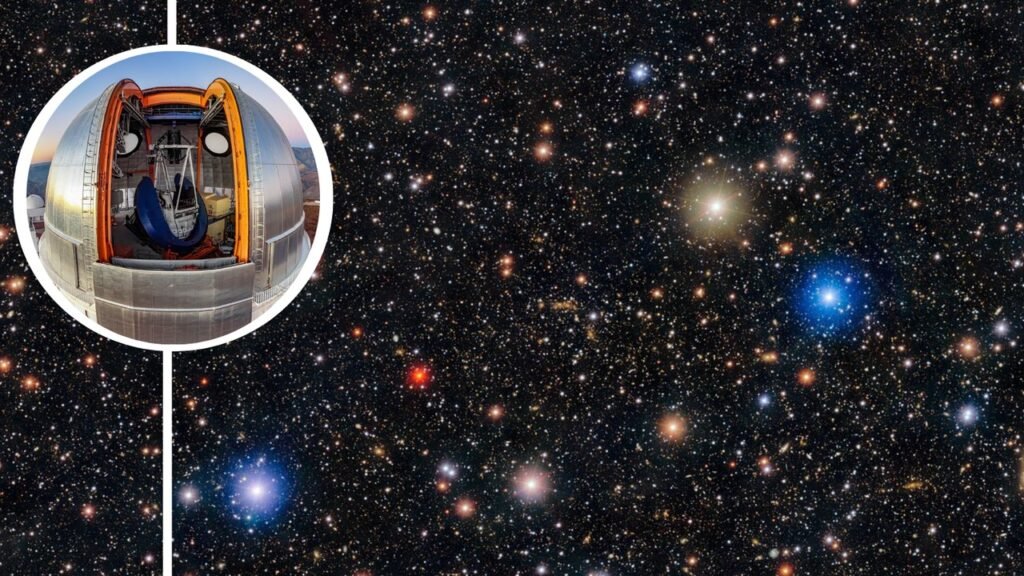
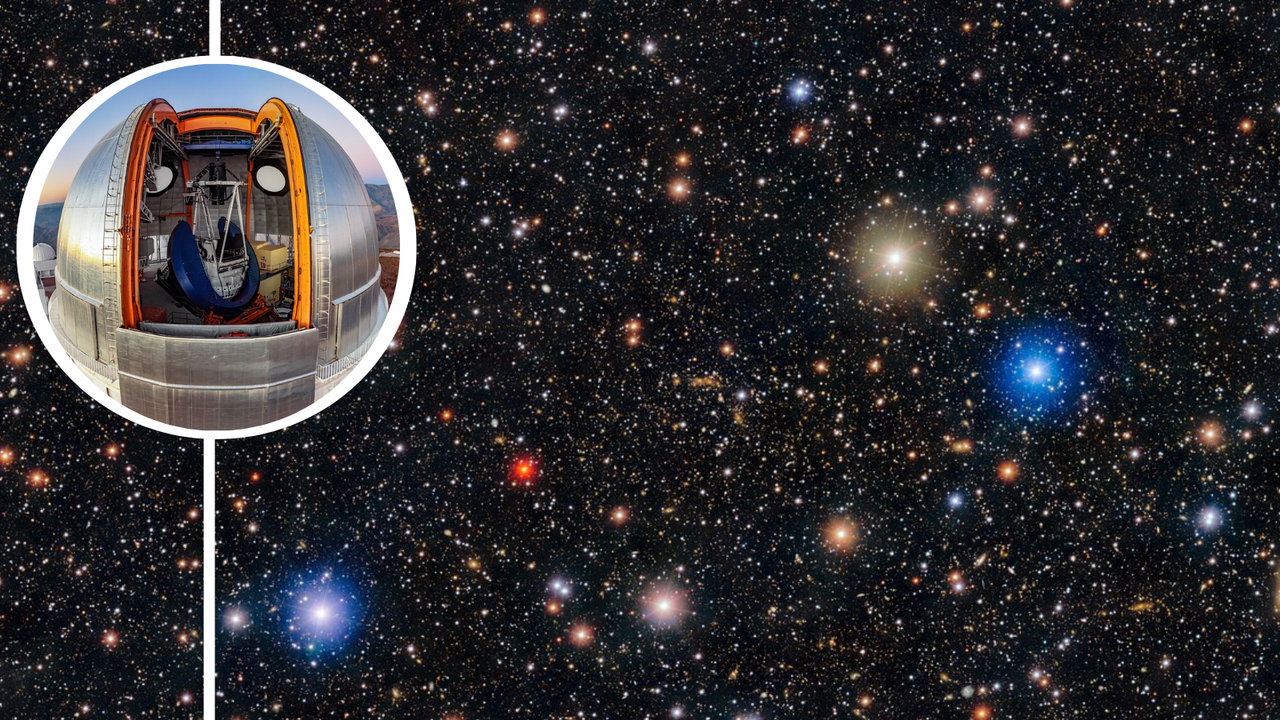
The Dark Energy Survey collaboration completed an ambitious project that spanned 758 nights of observation from 2013 to 2019. Researchers pointed the 570-megapixel Dark Energy Camera, mounted on the Víctor M. Blanco 4-meter telescope, at one-eighth of the southern sky. This effort captured details from 669 million galaxies located billions of light-years away.[1]
Team member Yuanyuan Zhang of NOIRLab described the moment as profound. “It is an incredible feeling to see these results based on all the data, and with all four probes that DES had planned,” she said. “This was something I would have only dared to dream about when DES started collecting data, and now the dream has come true.”[1]
Regina Rameika, Associate Director for the Office of High Energy Physics in the Department of Energy’s Office of Science, highlighted the breakthrough’s significance. “These results from DES shine new light on our understanding of the universe and its expansion,” she stated.[1]
Four Powerful Probes Illuminate the Dark
Scientists employed a quartet of techniques to reconstruct matter distribution over the past six billion years. Type Ia supernovae served as cosmic yardsticks, revealing expansion rates through their standardized brightness. Weak gravitational lensing detected subtle distortions in galaxy light caused by intervening mass.
Galaxy clustering measured how galaxies group together, while baryon acoustic oscillations traced sound waves from the early universe imprinted as density fluctuations 380,000 years after the Big Bang. These methods combined to test leading cosmological theories.
- Type Ia supernovae: Distance indicators from the 1998 discovery of acceleration.
- Weak gravitational lensing: Maps invisible mass via light bending.
- Galaxy clustering: Reveals large-scale structure formation.
- Baryon acoustic oscillations: Standard rulers from primordial sound waves.
Models Hold, But Tensions Linger
The findings aligned closely with the Lambda Cold Dark Matter (LCDM) model, where dark energy remains constant over time and constitutes about 68 percent of the universe’s energy and matter content. Results also accommodated the wCDM model, which permits evolving dark energy.
However, a notable discrepancy appeared in matter clustering. Observations showed less clumping in the modern universe than predictions from early-universe data suggested under both models. This “S8 tension” grew more evident with distance, challenging assumptions about cosmic evolution.[1]
| Model | Key Feature | DES Fit |
|---|---|---|
| LCDM | Constant dark energy | Strong alignment |
| wCDM | Evolving dark energy | Compatible |
Pathways to Deeper Mysteries
Dark energy overtook gravity’s pull between three and seven billion years after the Big Bang in our 13.8-billion-year-old universe. The DES work builds on 1998 supernova observations that first revealed this acceleration.
Future surveys promise even greater precision. Chris Davis, National Science Foundation Program Director, noted the potential. “DES has been transformative, and the Vera C. Rubin Observatory will take us even further,” he said. “Rubin’s unprecedented survey of the southern sky will enable new tests of gravity and shed light on dark energy.”14
The Vera C. Rubin Observatory’s Legacy Survey of Space and Time will observe around 20 billion galaxies, enhancing DES data.
Key Takeaways
- DES mapped 669 million galaxies over 758 nights for the clearest dark energy view yet.
- Four probes confirmed expansion models but highlighted matter-clustering discrepancies.
- Upcoming Rubin Observatory will build on this foundation for refined cosmic insights.
These results, detailed in a paper submitted to Physical Review D mark a pivotal step in unraveling the cosmos’s hidden dynamics. As tensions in our models persist, they invite bolder questions about the universe’s fate. What implications do these findings hold for your view of reality? Share your thoughts in the comments.