
Picture this. You’re standing in a world where towering monuments touched the sky, where engineering marvels defied imagination, where humanity carved its ambitions into stone and bronze. These weren’t just buildings. They were statements of power, divine devotion, and human ingenuity that echoed across centuries.
Then, they vanished. Swallowed by earthquakes, waves, war, or simply the relentless passage of time. Some left traces in ancient texts, descriptions written by travelers who marveled at their grandeur. Others disappeared so completely that we’re still not certain they ever existed at all. The search for these lost wonders has become one of history’s most compelling mysteries, sending archaeologists diving into harbors, excavating desert ruins, and piecing together fragments of forgotten civilizations. So where are they now? Let’s be real, some answers might surprise you.
The Hanging Gardens of Babylon: A Wonder in the Wrong City?
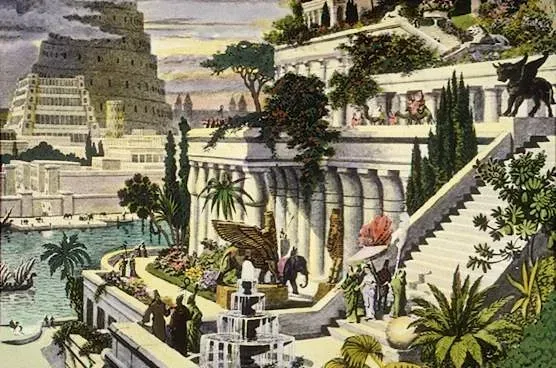
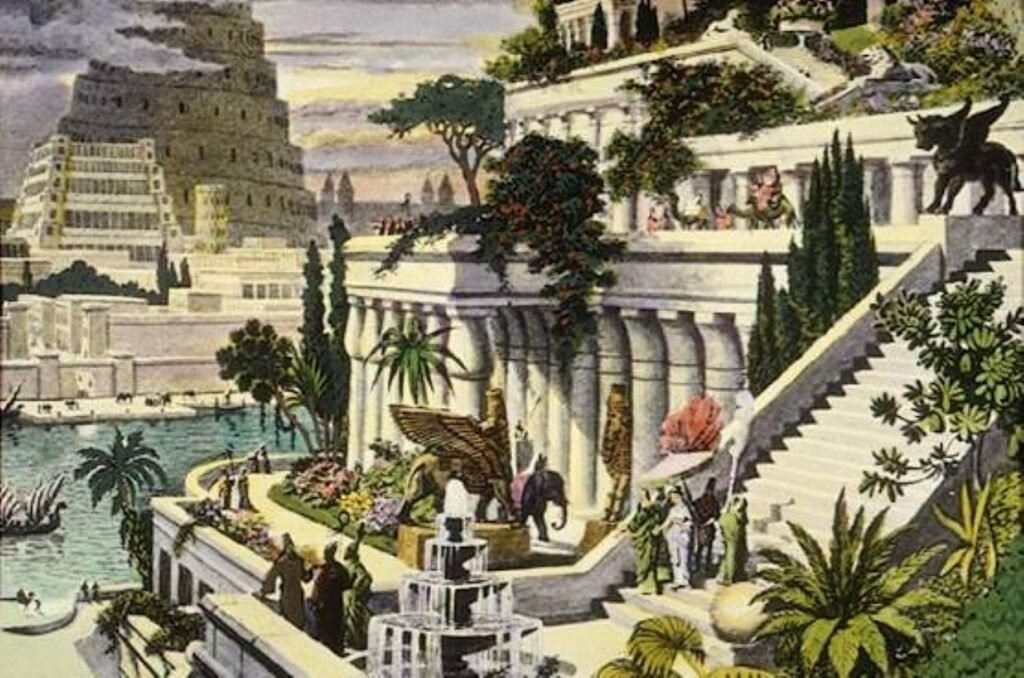
You’ve probably heard about the legendary terraced gardens supposedly built in ancient Babylon, near present-day Hillah in Iraq, yet after thorough excavation of the site, nothing of the gardens has been uncovered. Here’s the thing: no such monumental gardens are ever recorded as having been constructed in Babylon in native Mesopotamian sources. That’s a massive red flag for something supposedly built by one of history’s most documented kings.
Oxford scholar Stephanie Dalley has proposed that the Hanging Gardens were actually constructed in the Assyrian city of Nineveh, roughly 300 miles to the north of Babylon. She asserts the Assyrian king Sennacherib, not Nebuchadnezzar II, built the marvel in the early seventh century B.C., a century earlier than scholars had previously thought. What’s fascinating is that following the Assyrian conquering of Babylon in 689 B.C., Nineveh was referred to as the “New Babylon,” and Sennacherib even renamed the city gates after those of Babylon’s entrances. Talk about an identity crisis that lasted millennia. A 7th-century BC Assyrian inscription revealed Nineveh was home to an intricate system of waterways that would have transported water 50 miles to the gardens.
The Library of Alexandria: Buried Beneath a Modern City
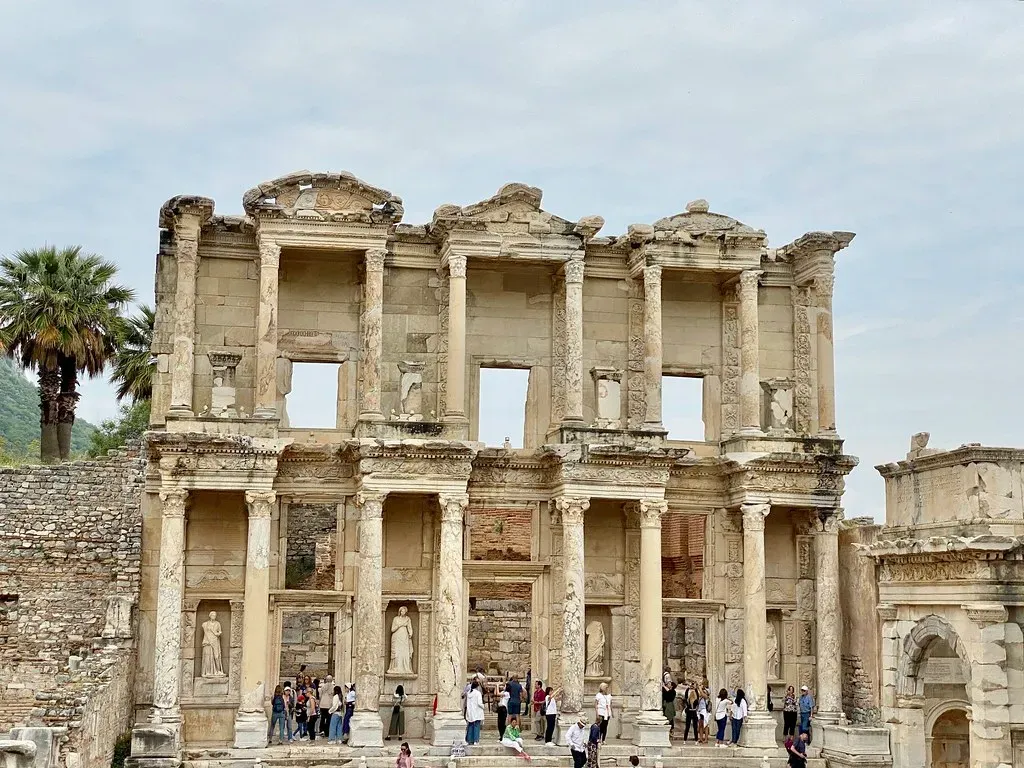
The Library of Alexandria in Egypt was one of the largest and most significant libraries of the ancient world, part of a larger research institution called the Mouseion, dedicated to the Muses. It’s hard to say for sure, but its loss represents one of humanity’s greatest intellectual tragedies. The Library’s membership appears to have ceased by the 260s AD, and between 270 and 275 AD, Alexandria saw a Palmyrene invasion and an imperial counterattack that probably destroyed whatever remained of the Library.
Today’s Alexandria sits literally on top of its ancient predecessor. While no definitive ruins of the original Library of Alexandria have been found, archaeologists have uncovered parts of the Mouseion complex, ancient lecture halls, and underground rooms believed to have been storage facilities or annexes. The remains of the Serapeum, a structure used by the Library for extra storage after it ran out of space, are still there in the city today, built in the Brucheion, or Royal Quarter, of Alexandria. Honestly, the modern city makes excavation nearly impossible. In 1992, the Royal Quarter – site of the Museum, Library, and Alexander’s tomb – began to reappear underwater. Rising sea levels and earthquakes have submerged much of what once stood proud.
The Colossus of Rhodes: Scattered Across the Harbor Floor
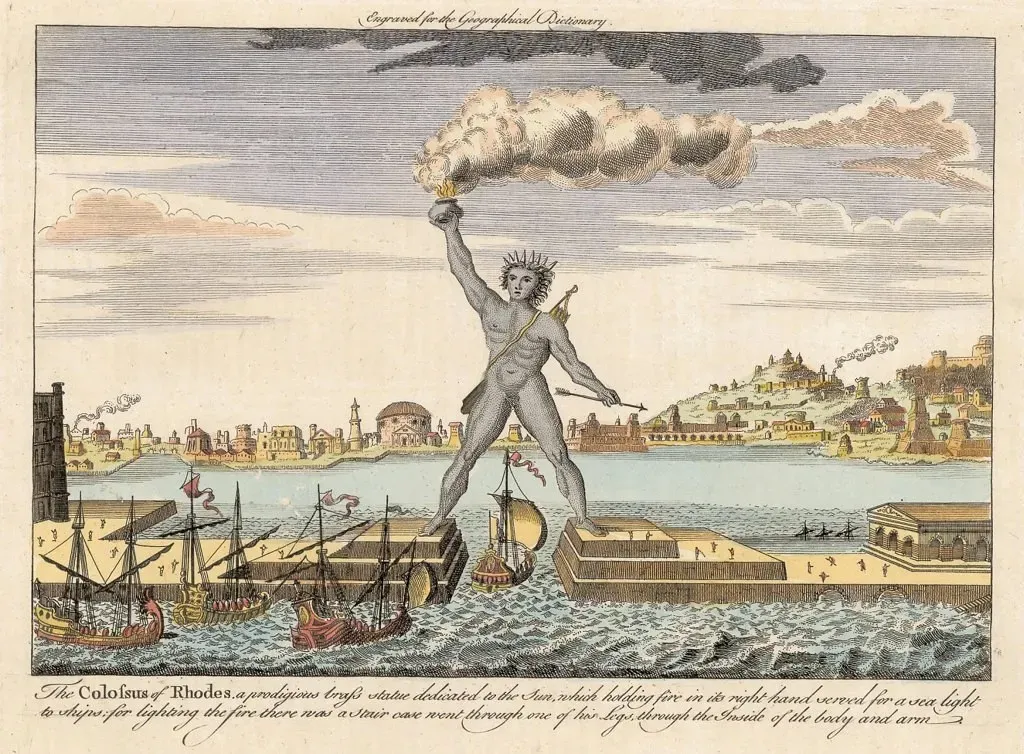
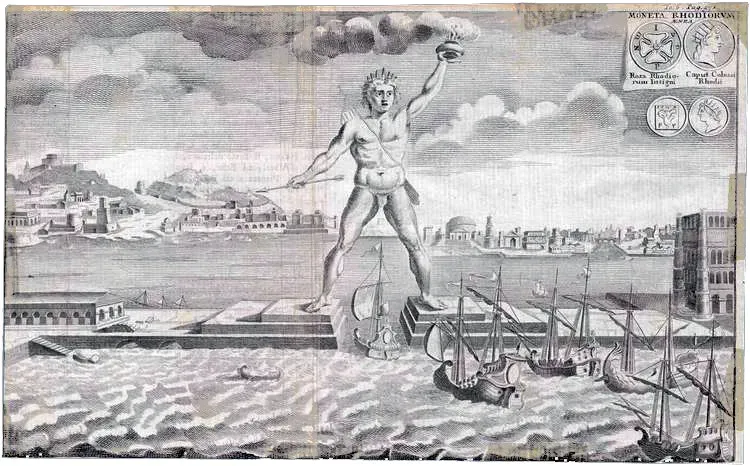
The Colossus of Rhodes was a statue of the Greek sun god Helios erected in the city of Rhodes around 280 BC, standing approximately 33 metres high. The statue stood for only about 54 years before it was toppled by a massive earthquake in 226 BCE. What happened next is equally remarkable: the broken statue lay on the ground for over 800 years before Arab conquerors sold the scrap metal during their invasion of Rhodes in 654 CE.
So where might pieces be now? No physical remains have been definitively identified. Archaeologist Ursula Vedder postulates that the Colossus was not located in the harbour area at all, but rather was part of the Acropolis of Rhodes on a hill that overlooks the port area, and a portion of its enormous stone foundation could have served as the supporting platform for the Colossus. I know it sounds crazy, but the location debate continues to this day. With no surviving remnants or ancient representations of the Colossus, myths have influenced debate about its appearance, location, and purpose. Any bronze fragments that survived the medieval scrap dealers were likely melted down centuries ago and now exist as coins, tools, or weapons scattered across the Mediterranean world.
The Lighthouse of Alexandria: Resting Beneath the Waves
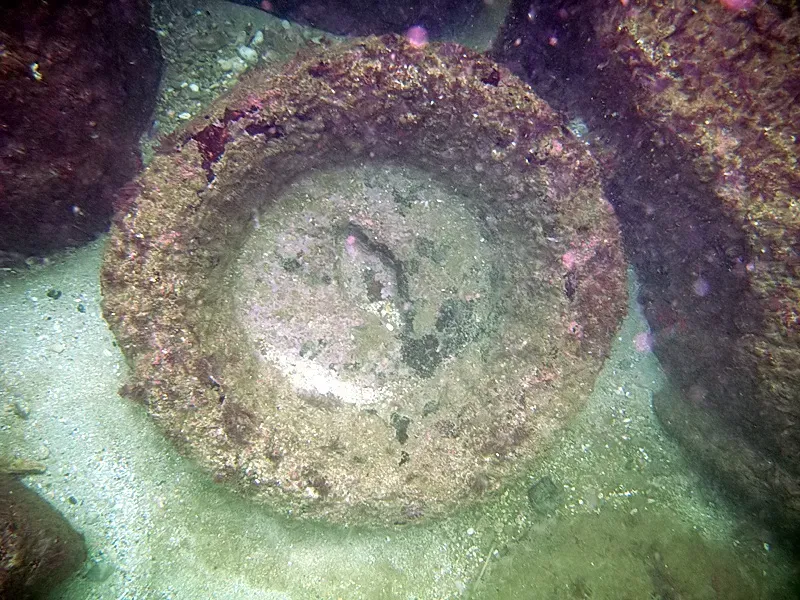
Unlike the Colossus, we actually know where this one ended up. The lighthouse was severely damaged by three earthquakes between 956 and 1303 AD, surviving in part until 1480, when the last of its remnant stones were used to build the Citadel of Qaitbay on the site. In 1994, a team of French archaeologists dived in the water of Alexandria’s Eastern Harbour and discovered some remains of the lighthouse on the sea floor.
The underwater discoveries have been stunning. Twenty-two blocks from the Lighthouse of Alexandria have been raised from the seabed as part of an undertaking known as the “PHAROS” project. Underwater excavations show that the Pharos must have collapsed towards the west leaving thousands of blocks on the seafloor, most of which are of shelly limestone and must have comprised the core of the building. A large amount of statuary was also discovered, including a colossal statue of a king dating to the 3rd century BCE thought to represent Ptolemy II, and a companion statue of a queen as Isis. You can dive and see the ruins. Let’s be real, how many people can say they’ve swum through one of the Seven Wonders?
The Temple of Artemis at Ephesus: Buried in Turkish Farmland
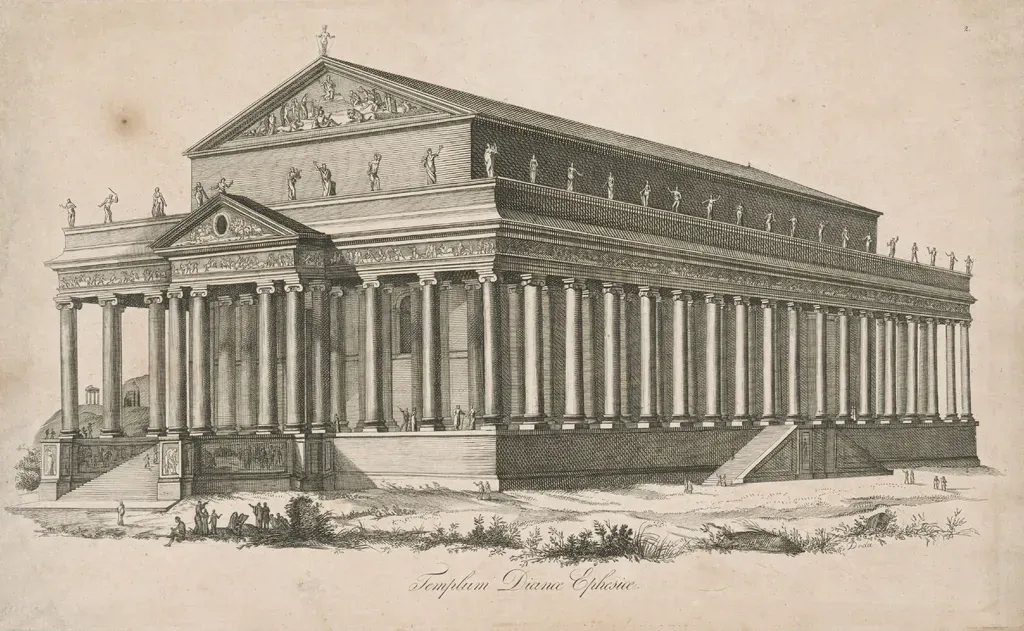
The Temple of Artemis at Ephesus was among the largest temples of antiquity – twice the size of the Parthenon, supported by more than a hundred marble columns – with the grand version celebrated as an Ancient Wonder built in the 4th century BC. Its story is darkly ironic. It was famously burned down in 356 BC by Herostratus, who admitted he had done it simply to gain fame. His wish came true, though probably not in the way he imagined.
Rebuilt even larger, it survived for six centuries before being closed by the Christian Emperor Theodosius I in 391 AD and then finally torn down a decade later, with only one reconstructed column now standing at the site in modern-day Selçuk, Turkey. The rest? Some of the temple’s sculptures are now preserved in the British Museum, where they offer a glimpse of its lost grandeur. Walking through the site today in Turkey, you’d hardly recognize that one of humanity’s greatest architectural achievements once stood there. Marshland has reclaimed much of the area, and what remains lies scattered beneath farmland and mud. Time and human ambition erased what took decades to build.
Conclusion
The ancient world built monuments that seemed eternal, designed to outlast empires and echo through the ages. Yet earthquakes shattered them, fires consumed them, and human hands dismantled them for scrap. What’s remarkable is that these lost wonders continue to capture our imagination precisely because they’re gone. Modern technology brings them back in fragments: underwater archaeology reveals sunken lighthouse blocks, cuneiform tablets point researchers toward misidentified gardens, and digital reconstructions let us glimpse what ancient travelers once saw.
The search isn’t over. New excavations unearth fresh clues, theories shift as scholars decode ancient texts, and occasionally, the seafloor gives up another secret. Perhaps the real wonder isn’t just what these monuments were, but what they still inspire us to seek. What do you think about these ancient mysteries? Did any of these locations surprise you?