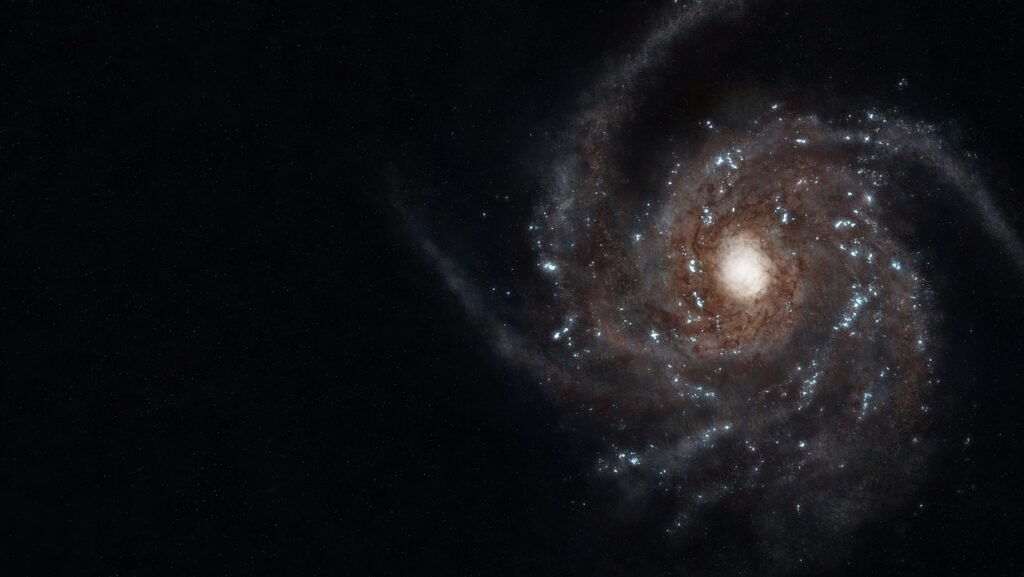

A Spur Between Giants (Image Credits: Pixabay)
Humanity’s quest to pinpoint its place within the vast Milky Way galaxy reveals a surprisingly modest home for our solar system.
A Spur Between Giants
Stargazers long puzzled over the Milky Way’s intricate structure until astronomers confirmed that the sun resides in a lesser-known feature called the Orion Arm. This arm sits between the galaxy’s more prominent spiral arms, acting as a bridge rather than a dominant force. Observations from telescopes and space probes painted this picture over decades of study.
The Orion Arm, sometimes termed a spur, stretches across a region rich in star-forming nebulae and young stars. It lacks the density of its neighbors but hosts familiar sights like the Orion Nebula. This positioning shields our solar system from the intense activity in the major arms while offering clear views of the galactic center.
Decoding the Milky Way’s Spiral Structure
Astronomers mapped the galaxy’s arms using radio waves, infrared light, and star density patterns. These methods pierced the dust obscuring visible light from our vantage point. The Milky Way features two primary spiral arms emerging from the central bar: the Perseus Arm and the Sagittarius Arm.
Our sun orbits about 26,000 light-years from the core in this intermediate zone. The galaxy rotates once every 225 million years, carrying the Orion Arm along its path. This location influences the types of stars and cosmic events visible from Earth.
Key Features of the Major Arms
The Perseus Arm lies outward from the Orion Arm, packed with star clusters and supernova remnants. It extends far into the galaxy’s outer reaches. Meanwhile, the Sagittarius Arm curves inward toward the bulge, teeming with molecular clouds.
Here is a breakdown of these structures:
- Perseus Arm: Hosts thousands of open clusters; spans the galaxy’s upper half from our view.
- Sagittarius Arm: Closer to the center; rich in gas and dust for new star birth.
- Orion Arm: Thinner and shorter; includes Earth’s neighborhood and landmarks like the Trapezium Cluster.
- Scutum-Centaurus Arm: Another inner arm, less visible from our position.
- Norma Arm: Farther in, tied to the galactic bar.
Why Location Matters in the Galaxy
Residing places the sun in a relatively stable zone, away from the chaotic star formation of major arms. This setup likely contributed to the solar system’s long-term habitability. Dust lanes and gas concentrations define arm boundaries, traced by hydrogen emissions.
Modern surveys, such as those from the Gaia spacecraft, refined these maps with precise stellar positions. Researchers continue to debate whether the Orion Arm qualifies as a full arm or merely a spur. Either way, it anchors our cosmic perspective.
Implications for Stargazing and Beyond
Understanding this position enhances night sky interpretations. Constellations like Orion highlight our arm’s namesake. Future missions aim to detail interstellar medium variations across arms.
Key Takeaways
- The sun occupies the Orion Arm, a minor feature between the Perseus and Sagittarius Arms.
- This spot offers a balanced view of galactic features without excessive interference.
- Ongoing observations refine our map of the Milky Way’s spiral architecture.
The Orion Arm reminds us that even in a grand spiral galaxy, our sun claims a subtle yet significant perch. What celestial neighborhood fascinates you most? Share your thoughts in the comments.