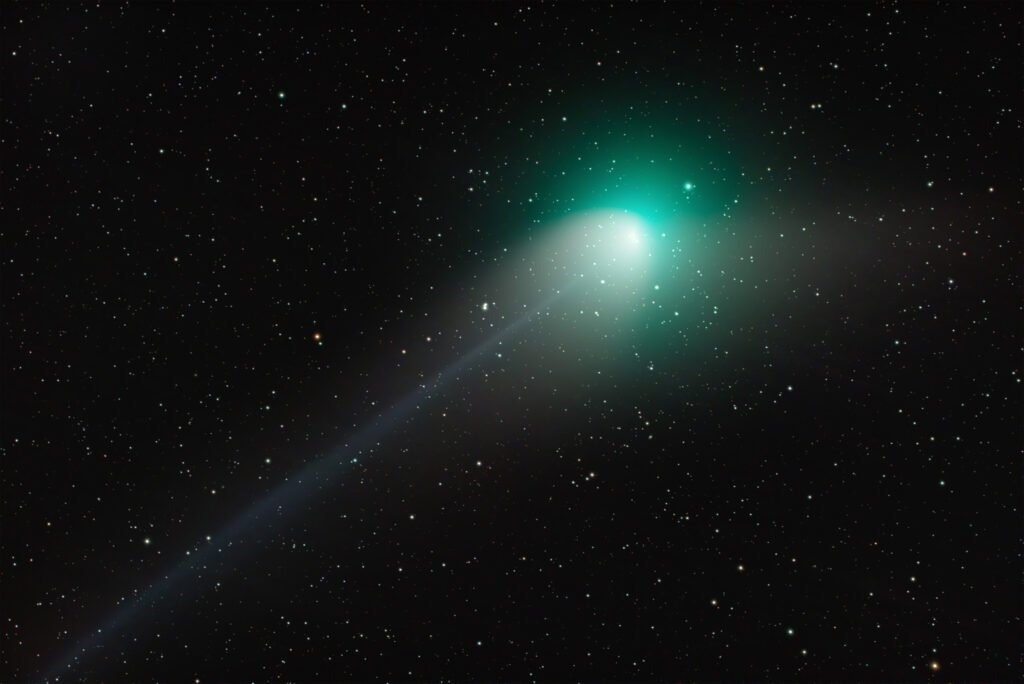


Sungrazers: Celestial Daredevils on Fiery Paths (Image Credits: Upload.wikimedia.org)
A newly discovered sungrazing comet, now officially named C/2026 A1, heads toward a perilous close encounter with the Sun in early April.
Sungrazers: Celestial Daredevils on Fiery Paths
Comets that venture perilously close to the Sun, known as sungrazers, captivate scientists with their bold trajectories. These icy wanderers often meet dramatic fates as intense solar heat vaporizes their nuclei. C/2026 A1 joins this intriguing family, recently earning its formal designation from astronomers. Such comets trace roots back to fragmented progenitors, releasing smaller siblings into the inner solar system. Observers have tracked dozens in recent decades, each offering clues about solar system origins.
The comet’s path promises a spectacle, though survival remains uncertain. Many sungrazers disintegrate entirely during perihelion, their passage reduced to fleeting streaks. Yet brighter examples have rewarded patient skywatchers with naked-eye views.
Trajectory and Timeline Unfold
C/2026 A1 will reach its closest solar approach in early April, skimming perilously near the star’s scorching corona. Discovery reports placed it on a hyperbolic orbit, suggesting an interstellar origin unbound by the Sun’s gravity. Telescopes first spotted the comet late last year, prompting rapid orbital calculations. Its inbound journey accelerates as it nears the inner solar system, building anticipation among stargazers worldwide.
Post-perihelion, the comet could swing outward, potentially visible from Earth under optimal conditions. Detailed ephemerides from observatories outline its positions through spring. For precise tracking, resources like EarthSky’s comet maps provide essential guidance.
Prospects for a Brilliant Sky Show
Early assessments suggest C/2026 A1 holds potential to brighten significantly, possibly rivaling prominent evening stars. Solar proximity intensifies outgassing, forming expansive tails that catch sunlight effectively. If the nucleus withstands tidal forces and heat, it could emerge as a prime target for binoculars or the unaided eye. Historical sungrazers like SOHO-6d have surprised with post-perihelion glows.
Factors such as dust production and gas emissions will determine peak magnitude. Weather and moonlight pose additional challenges for ground-based viewing. Still, northern hemisphere observers may catch it low in the western sky after sunset.
Essential Tips for Comet Spotting
Preparation enhances chances of witnessing this rare event. Select dark-sky sites away from city lights to maximize contrast. Binoculars or a small telescope prove ideal for early detection.
- Monitor apps like Stellarium or SkySafari for real-time positions.
- Time observations for twilight hours when the comet rises highest.
- Check updates from the International Comet Quarterly for magnitude forecasts.
- Use a star chart to distinguish the comet from planets or aircraft.
- Photograph with long exposures to capture faint tails.
Key Takeaways
- C/2026 A1 reaches perihelion in early April, with brightness potential for naked-eye viewing.
- Sungrazers face disintegration risks but offer stunning displays if they survive.
- Track via reliable sources for the best observing windows.
As C/2026 A1 races toward its solar rendezvous, it reminds us of the cosmos’s unpredictable beauty – one that demands vigilance from sky enthusiasts. Will this comet dazzle or fade? Share your predictions and observing plans in the comments.