Rare Event Captured in Historic Detail (Image Credits: Cdn.mos.cms.futurecdn.net)
Astronomers using the James Webb Space Telescope uncovered intricate details in the dusty remnants left behind by two stars that merged and erupted as a red nova over three centuries ago.
Rare Event Captured in Historic Detail
The collision of two stars produced a brilliant outburst visible from Earth in the 1670s, marking one of the first recorded red novae.
Unlike typical supernovae, this event involved lower-mass stars merging rather than a massive star’s core collapse. Researchers long puzzled over the faint object that lingered afterward. Now, JWST’s infrared gaze pierced the obscuring dust, exposing a complex structure at its core.
Previous observations with other telescopes hinted at bipolar outflows and shells of ejected material. However, the new data sharpened those views dramatically.
Unpacking the Stellar Wreckage
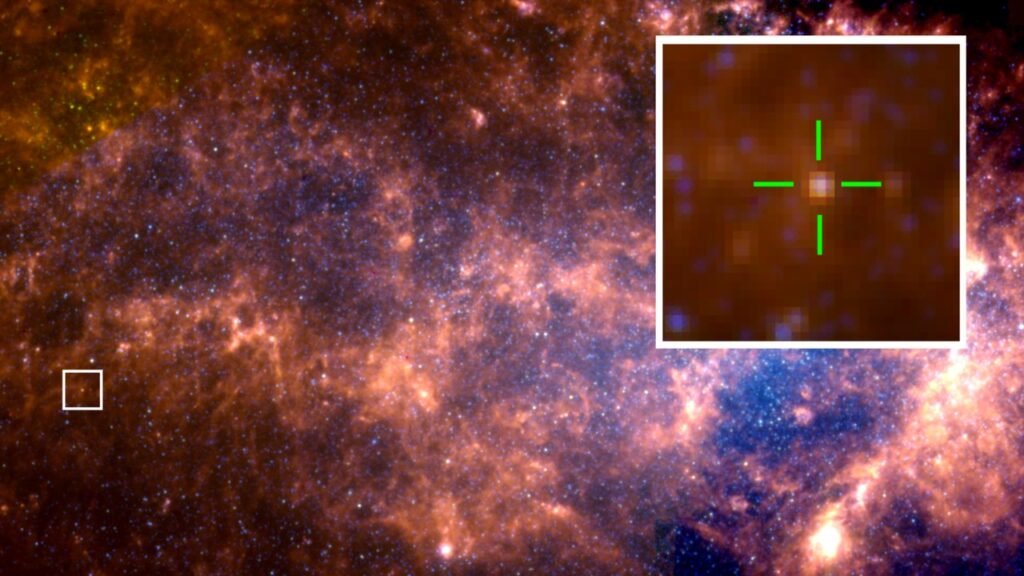
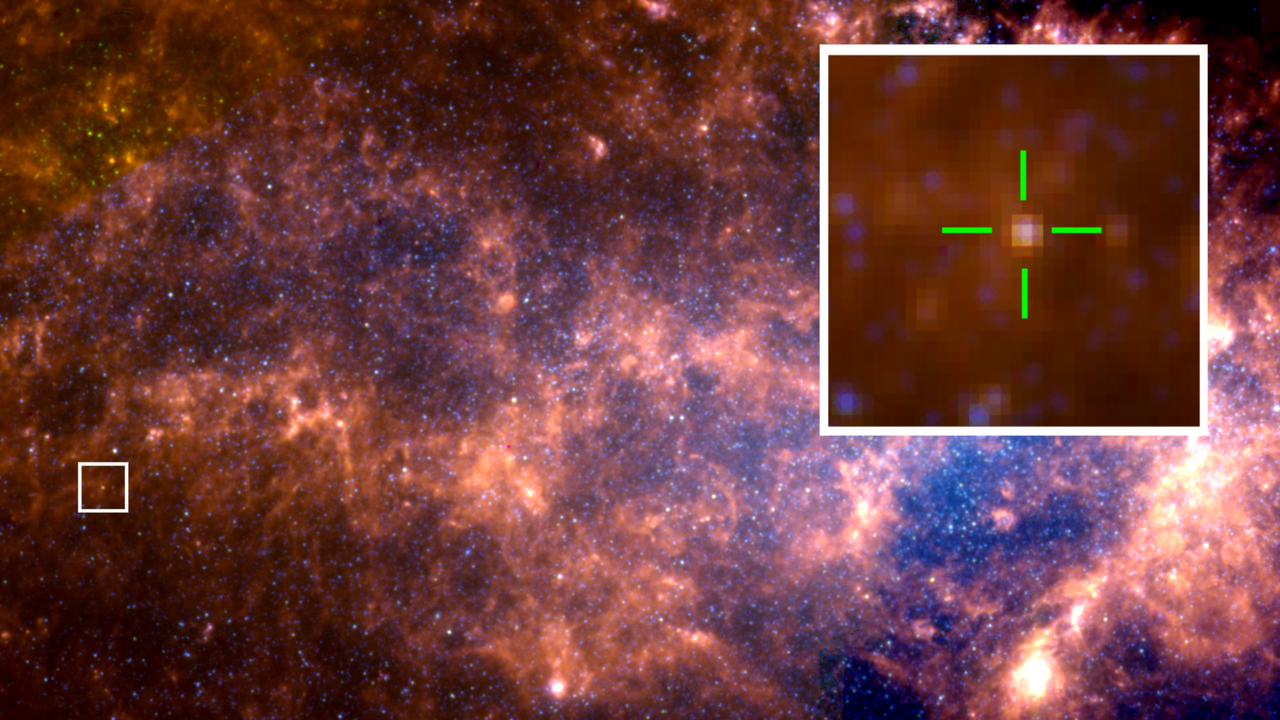
At the heart lies a compact source emitting strongly in the mid-infrared, suggesting ongoing processes like dust formation or molecular emissions.
Surrounding it, symmetrical lobes extend outward, shaped by the explosive ejection of material during the merger. Fine filaments and cavities reveal how the blast interacted with the surrounding interstellar medium.
These features indicate the stars orbited closely before spiraling together, shedding layers in the process. The telescope detected silicates and hydrocarbons in the dust, common signatures of violent stellar events.
- Bipolar lobes: Symmetrical structures pointing away from the center.
- Dusty torus: A doughnut-shaped ring of material near the core.
- Expanding shells: Layers of gas pushed outward at high speeds.
- Infrared excess: Glow from warm dust heated by the explosion’s energy.
- Central compact object: Possible remnant of the merged star system.
Insights into Star Mergers
Red novae offer a window into binary star evolution, a process that shapes many galaxies. This discovery confirms models predicting structured debris from such collisions.
Scientists noted the object’s slow fade since the 17th-century sighting, consistent with cooling ejecta. JWST’s sensitivity to cool dust and molecules provided data unattainable before.
The findings challenge earlier interpretations that viewed the remnant as a simple nebula. Instead, they point to a dynamic, multi-phase aftermath.
| Feature | Observed By | Key Insight |
|---|---|---|
| Bipolar Lobes | JWST NIRCam/MIRI | Symmetrical ejection from merger axis |
| Dust Torus | JWST MIRI | Obscures optical light, emits in infrared |
| Shells | Ground Telescopes + JWST | High-velocity expansion detected |
Broader Implications for Cosmic Explosions
This observation advances understanding of luminous red novae, a class distinct from classical novae or supernovae. Future studies may link such events to gamma-ray bursts or gravitational wave sources.
Astronomers anticipate more detections as JWST surveys distant galaxies for similar signatures.
- JWST exposed a structured dusty nebula unseen in prior wavelengths.
- The red nova arose from two stars’ merger, not a single star’s death.
- Detailed maps reveal bipolar outflows and a glowing central core.
These revelations from JWST not only rewrite the story of this ancient explosion but also guide predictions for future stellar mergers in our galaxy – what cosmic dramas await discovery next? Share your thoughts in the comments.