
Unexpected Brightness in the Dawn of Time (Image Credits: Pixabay)
Astronomers have proposed that voracious supermassive black holes gorging on gas could account for surprisingly bright galaxies detected in the universe’s infancy by the James Webb Space Telescope.
Unexpected Brightness in the Dawn of Time
The James Webb Space Telescope revealed galaxies that appeared far too luminous for their age, challenging models of cosmic evolution.
These objects, spotted just hundreds of millions of years after the Big Bang, glowed with an intensity that standard star formation processes struggled to explain. Researchers noted their compact size and extreme light output, prompting a reevaluation of early universe dynamics. One leading theory points to active galactic nuclei powered by black holes in overdrive.
The Role of Supermassive Black Holes
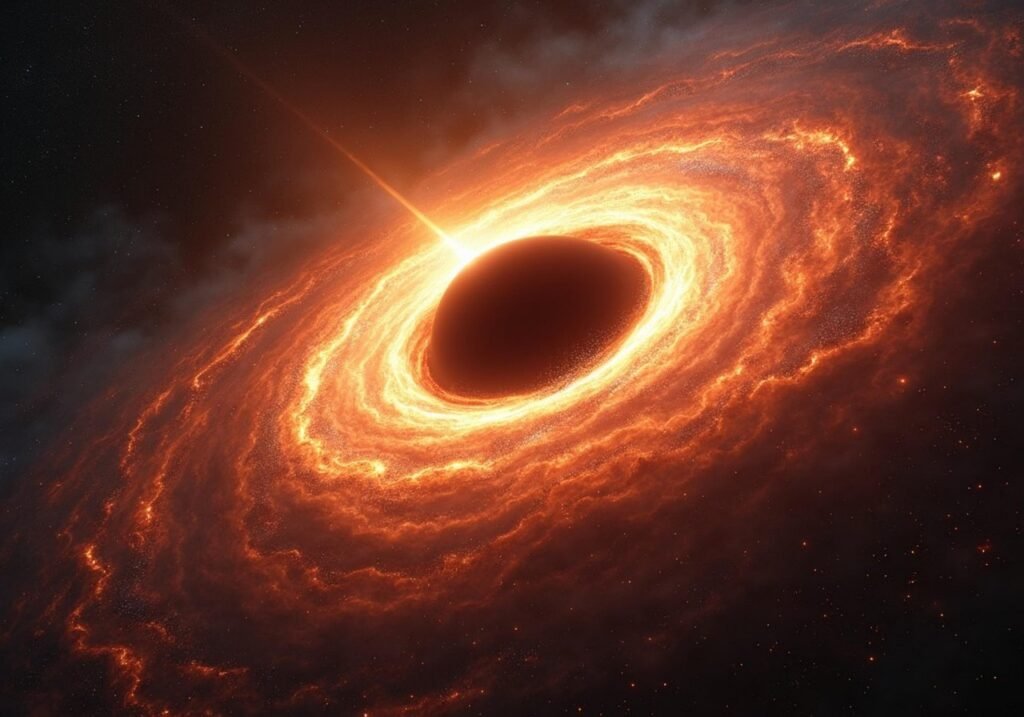
Supermassive black holes at galaxy centers may have triggered a “feeding frenzy” by rapidly consuming surrounding material. This process, known as accretion, releases tremendous energy as matter spirals inward, outshining entire galaxies.
During this phase, the black holes accreted gas at rates exceeding theoretical limits, yet observations suggested it happened. Such activity would heat gas and halt star formation temporarily, aligning with the dim cores seen in these distant galaxies. Scientists analyzed spectra from JWST, identifying signatures of hot, accreting material around these black holes.
- Compact red dots in JWST images indicate dense, obscured regions.
- High luminosity points to efficient energy release from accretion disks.
- Spectral lines reveal fast-moving gas inflows.
- Bursts of activity explain episodic brightness.
- Population studies show thousands of such candidates.
Challenging Long-Held Assumptions
Traditional views held that supermassive black holes grew slowly in the early universe, limited by feedback mechanisms that expelled gas. However, JWST data forced a rethink, suggesting these black holes formed and feasted much earlier than expected.
Simulations now incorporate super-Eddington accretion, where intake surpasses the Eddington limit by factors of 10 or more. This frenzy not only explains the light but also seeds galaxy growth, as ejected material fuels later starbursts.
| Standard Model | Feeding Frenzy Model |
|---|---|
| Slow, steady growth | Rapid, bursty accretion |
| Star-driven luminosity | Black hole-powered glow |
| Dim early galaxies | Bright, compact objects |
Implications for Cosmic History
If confirmed, this scenario reshapes our understanding of the first billion years. Black holes would emerge as dominant players, driving galaxy assembly rather than merely residing within them.
Future JWST observations will target deeper fields and infrared wavelengths to map these events across wider sky regions. Ground-based telescopes will follow up with high-resolution imaging.
Key Takeaways:
- JWST uncovered overly bright early galaxies defying expectations.
- Black hole accretion frenzies provide a plausible energy source.
- New models support super-Eddington growth rates.
This discovery underscores the telescope’s power to pierce cosmic veils, potentially rewriting the opening chapters of the universe’s story. What aspects of these findings intrigue you most? Share your thoughts in the comments.