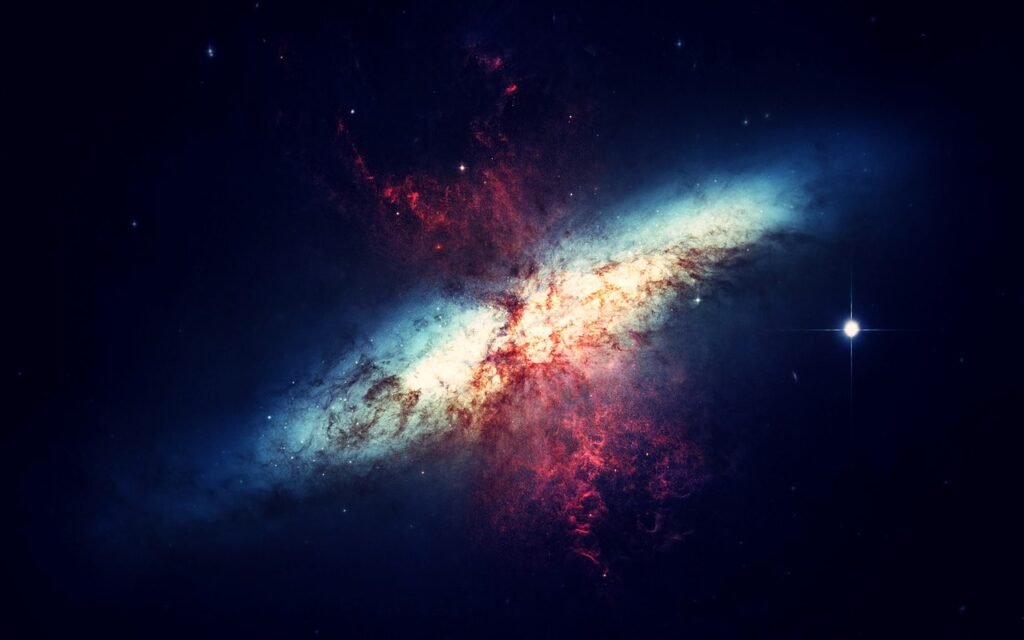

Fresh Clues from Distant Glows (Image Credits: Pixabay)
Astronomers uncovered evidence of a powerful outburst from the Milky Way’s supermassive black hole through light echoes propagating across the galaxy.
Fresh Clues from Distant Glows
These light echoes captured scientists’ attention by illuminating a dramatic event at the galaxy’s core. The reflections, bouncing off interstellar dust, carried signatures of intense energy released not long ago in astronomical terms. Researchers analyzed the patterns to trace the outburst back to the central black hole.
Such observations marked a breakthrough in understanding galactic activity. The echoes suggested the black hole unleashed a surge of radiation that scattered through space. This discovery challenged prior assumptions about the quiescence of the region.
Understanding Light Echoes in Action
Light echoes function like cosmic mirrors, where a sudden burst of light from an event travels outward and reflects off dust clouds at varying distances. Observers on Earth detect these delayed glows long after the original flare. In the Milky Way’s case, the echoes painted a picture of violence originating from the heart.
Astronomers relied on telescopes sensitive to specific wavelengths to map these reflections. The process revealed how the black hole’s activity rippled through the galactic disk. Key features included the echoes’ brightness and distribution, which aligned with models of explosive releases.
The Power of a Supermassive Black Hole
At the Milky Way’s center sits a supermassive black hole millions of times the sun’s mass. It typically remains dormant, accreting matter slowly. Yet the light echoes indicated a shift to high-energy output, possibly from disrupted gas inflows.
This eruption likely reshaped nearby gas and stars. Scientists noted the event’s scale rivaled those seen in distant quasars. The findings stemmed from coordinated observations across multiple instruments.
- Reflections off dust clouds delay light arrival by thousands of years.
- Brightness patterns match predictions for black hole flares.
- Distribution spans wide galactic regions, confirming central origin.
- Energy levels suggest massive particle acceleration.
- Timing places the event within recent galactic history.
Implications for Galactic Evolution
The outburst could explain structures like vast bubbles of hot gas flanking the galaxy. It highlighted how central black holes influence their host galaxies over time. Future studies might pinpoint the exact trigger, such as a star’s tidal disruption.
Experts view this as a window into episodic activity. The black hole now appears more dynamic than previously thought. Ongoing monitoring promises deeper insights into similar events elsewhere.
Key Takeaways
- Light echoes provide indirect evidence of past high-energy events.
- The Milky Way’s black hole showed violent activity surprisingly recently.
- These findings reshape views on galactic core dynamics.
This revelation underscores the unpredictable nature of supermassive black holes and invites further exploration of our cosmic neighborhood. What surprises might the Milky Way’s center hold next? Share your thoughts in the comments.