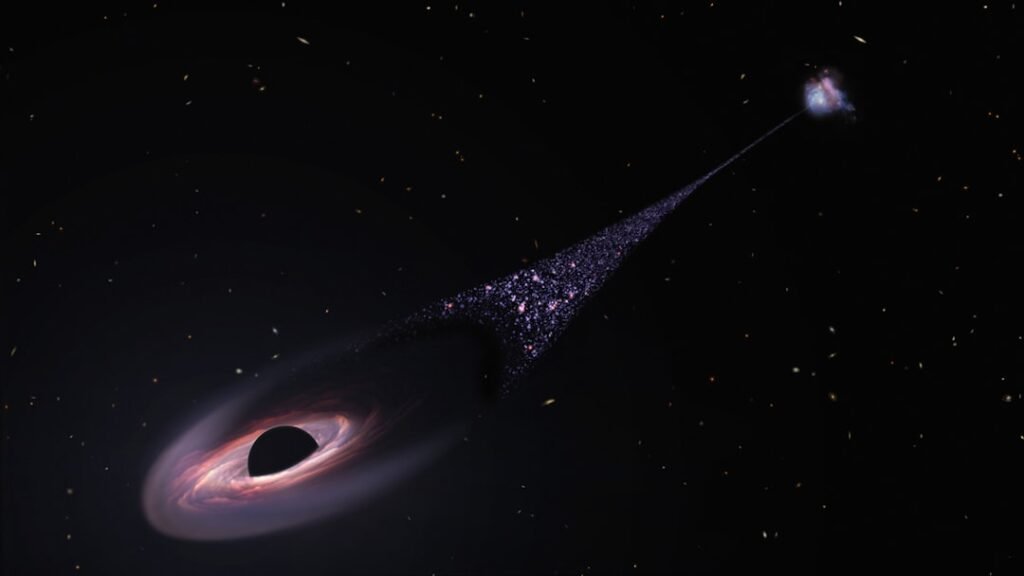

Probing the Dawn of Black Holes (Image Credits: Unsplash)
Maynooth, Ireland – Physicists at Maynooth University published a new paper detailing the expansion of light seed black holes during the universe’s formative stages.
Probing the Dawn of Black Holes
Light seed black holes represent a key puzzle in cosmology, emerging as relatively small progenitors in the universe’s infancy. These entities, far lighter than their massive counterparts today, challenged scientists with questions about their survival and growth. The recent work from Maynooth University offers fresh insights into this process.
Researchers Daxal H. Mehta, John A. Regan, and Lewis Prole from the Department of Physics led the study. Their analysis focused on how these lightweight seeds evolved amid the chaotic conditions of the early universe. Traditional models struggled to explain their persistence, yet this paper provides a pathway forward.
Mechanisms Behind Rapid Expansion
The study examined accretion processes that fueled the growth of these black holes. In the dense, gas-rich environment post-Big Bang, light seeds encountered abundant material for consumption. This influx allowed them to bulk up quickly, transitioning toward supermassive status.
Several factors influenced their development:
- High-density gas clouds surrounding the seeds accelerated infall rates.
- Radiative feedback from forming stars nearby shaped accretion dynamics.
- Merger events with other compact objects boosted their mass substantially.
- Environmental turbulence prevented premature stalling of growth.
- Cosmic expansion rates dictated the available timescale for buildup.
Such mechanisms highlight the resilience of light seeds against dilution in an expanding cosmos.
Challenging Established Theories
Prior research emphasized heavy seed black holes from direct collapse of massive clouds. Light seeds, however, stem from remnants of the first stars, starting at lower masses. The Maynooth paper bridges this gap by modeling sustained growth phases.
Simulations in the study revealed that under specific early universe conditions, light seeds matched observed quasar masses within a billion years. This finding reframes debates on black hole formation timelines. Observatories like the James Webb Space Telescope now stand poised to test these predictions directly.
Resonance in Irish Scientific Circles
The research garnered swift attention from Irish media outlets. Coverage emphasized the contributions from Maynooth University’s physics team. This development underscores Ireland’s growing role in astrophysics.
Local reports highlighted the paper’s potential to influence global models of cosmic evolution. The university’s news release amplified the story, drawing interest from broader scientific communities. Such visibility fosters collaboration and funding opportunities.
Key Takeaways
- Light seed black holes grew rapidly through gas accretion in the early universe.
- Maynooth’s models support their role as precursors to supermassive black holes.
- Findings align with observations from modern telescopes, urging further validation.
This research not only deepens our grasp of cosmic origins but also invites scrutiny of the universe’s hidden architects. What implications do you see for future black hole hunts? Share your thoughts in the comments.