
The Hidden Era Before Stars Ignited (Image Credits: Pixabay)
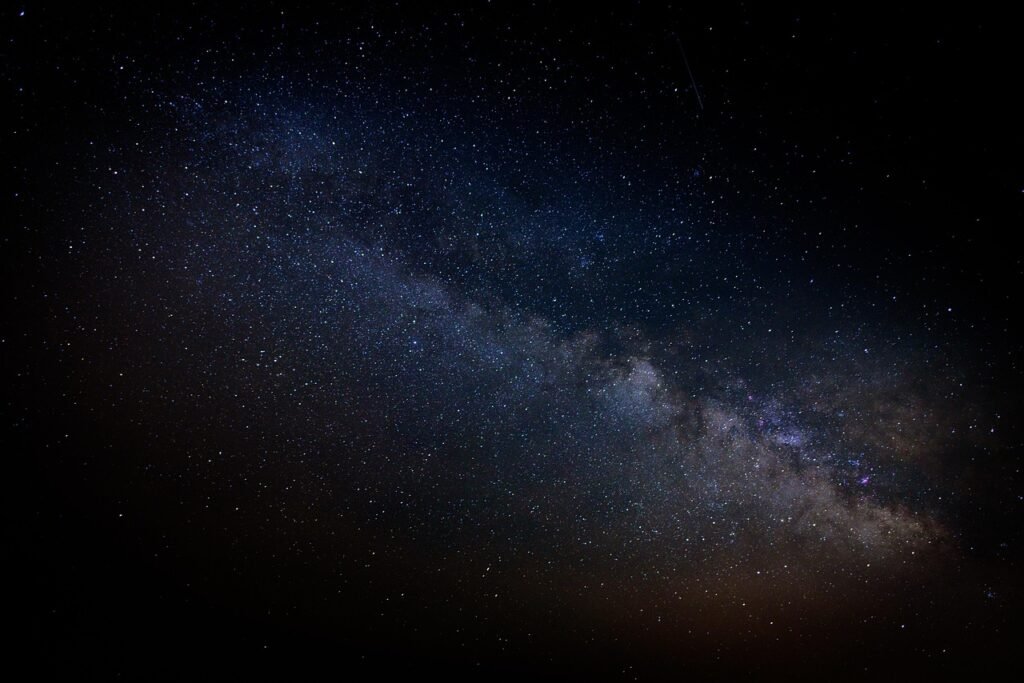
In the vast silence following the Big Bang, the universe lingered in obscurity for hundreds of millions of years, a time when neutral hydrogen atoms filled the void and whispered faint radio emissions that persist to this day.
The Hidden Era Before Stars Ignited
Researchers have long puzzled over the universe’s “dark ages,” a phase that stretched from about 380,000 years after the Big Bang until roughly 100 million years later, when the first stars began to form. During this period, the cosmos consisted mostly of hydrogen gas, which absorbed and re-emitted energy in subtle ways. Recent simulations indicate that dark matter, the invisible scaffold holding galaxies together, influenced this gas by forming dense clumps that gravitationally pulled in surrounding hydrogen.
These interactions altered the gas’s behavior, producing variations in the 21-centimeter radio waves – a specific wavelength tied to hydrogen’s spin transitions. The changes left subtle imprints, like fingerprints, on the signals that traveled billions of years to reach Earth. Astrophysicists now see this as a potential breakthrough, as the signals offer a direct glimpse into dark matter’s role in the early universe’s structure.
Dark Matter’s Subtle Influence on Ancient Signals
Dark matter, which accounts for about 85 percent of the universe’s mass, has evaded direct detection despite decades of experiments. In the cosmic dark ages, however, its gravitational pull created pockets where hydrogen density increased, boosting radio emissions in predictable patterns. A study from Tel Aviv University modeled these effects, predicting that the radio waves would carry unique signatures based on dark matter’s particle properties, such as mass and interaction strength.
Unlike modern cosmic microwave background radiation, which provides a uniform snapshot, these radio signals reveal dynamic processes on smaller scales. The simulations suggest the alterations could be as small as a few percent, yet measurable with advanced instruments. This approach shifts focus from particle colliders to astronomical observations, broadening the hunt for dark matter’s nature.
Moon Telescopes: The Next Frontier for Detection
Earth’s atmosphere and radio interference pose significant challenges to capturing these faint signals, prompting scientists to look skyward – specifically to the Moon. The far side of the lunar surface offers a radio-quiet haven, shielded from solar and terrestrial noise. Upcoming missions, like NASA’s LuSEE-Night experiment, aim to deploy compact radio telescopes there to listen for the 21-centimeter line from the dark ages.
These instruments will operate in the low-frequency range, scanning for the telltale distortions caused by dark matter clumps. Japanese researchers have already simulated the expected signals, showing how lunar setups could isolate them from foreground noise. Deployment on the Moon not only enhances sensitivity but also tests technologies for future cosmic surveys.
Implications for Understanding the Universe
Detecting these signals could resolve key questions about dark matter’s distribution in the primordial universe, informing models of galaxy formation. It might also distinguish between competing theories, such as whether dark matter consists of weakly interacting massive particles or lighter candidates like axions. For instance, the strength of the radio perturbations would vary with dark matter’s velocity and clustering tendencies during the dark ages.
While ground-based arrays like the Hydrogen Epoch of Reionization Array have made progress, lunar observations promise unprecedented clarity. The findings could bridge gaps in our knowledge of the universe’s evolution, from its infancy to the structured cosmos we observe today.
Key Takeaways
- Dark matter clumps in the early universe altered hydrogen’s radio emissions, creating detectable patterns.
- Lunar radio telescopes, free from Earth’s interference, offer the best chance to observe these ancient signals.
- Success could reveal dark matter’s properties and refine theories of cosmic structure formation.
As astronomers gear up for lunar missions, these faint echoes from the universe’s hidden past stand poised to illuminate one of its greatest enigmas, potentially reshaping our cosmic worldview. What mysteries of the dark ages intrigue you most? Share your thoughts in the comments below.