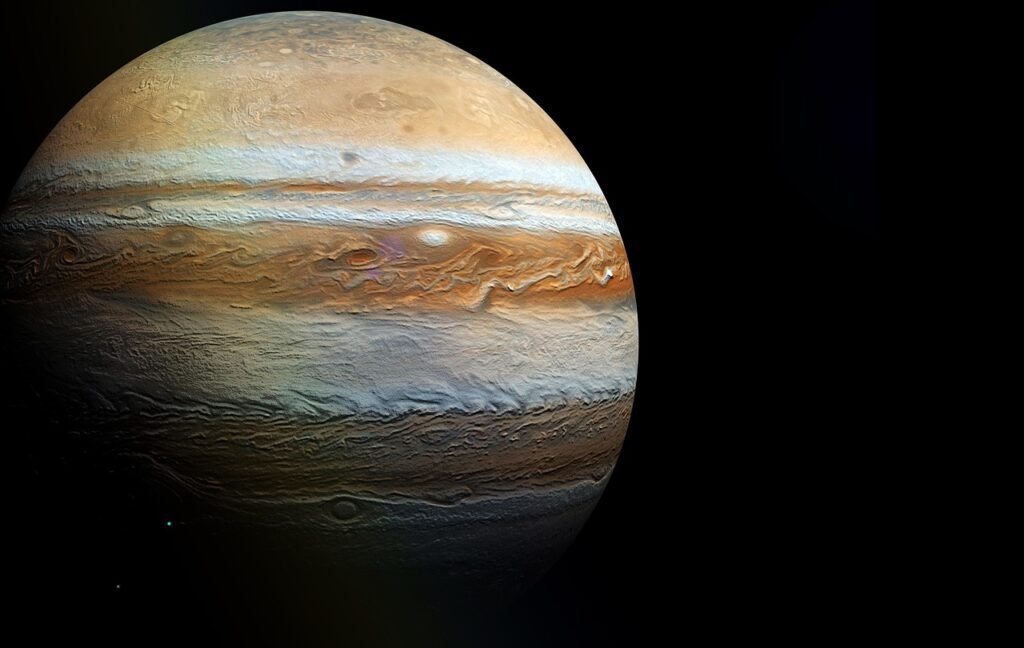

A Deeper Dive into the Gas Giant (Image Credits: Pixabay)
Chicago – Researchers from the University of Chicago and NASA’s Jet Propulsion Laboratory have harnessed advanced computer simulations to explore the hidden layers of Jupiter’s atmosphere, shedding light on the gas giant’s chemical composition far below its iconic swirling clouds.
A Deeper Dive into the Gas Giant
The turbulent clouds of Jupiter have long captivated astronomers, but their density has thwarted direct observations of what lies beneath. No probe has penetrated deep enough to quantify elements like water and oxygen, leaving scientists to rely on indirect methods. Recent work changes that dynamic.
Led by experts in planetary science, the study integrates chemical kinetics and hydrodynamic modeling to simulate Jupiter’s atmospheric processes. These models account for the planet’s rapid rotation, intense gravity, and complex weather patterns. By doing so, they provide the most detailed picture yet of the deep atmosphere.
The effort builds on data from missions like Juno, which has orbited Jupiter since 2016 and gathered gravity and magnetic field measurements. Yet, the simulations go further, predicting chemical distributions that spacecraft alone cannot reach.
Surprising Oxygen Levels Emerge
One of the study’s boldest findings centers on oxygen abundance. The models indicate that Jupiter harbors roughly 1.5 times more oxygen than the sun, a modest but significant excess. This challenges earlier assumptions about the planet’s makeup.
Oxygen, tied closely to water vapor, plays a key role in atmospheric dynamics. On Jupiter, it influences cloud formation and storm behavior. The elevated levels suggest processes that concentrated these elements during the planet’s early history.
Previous estimates varied widely, with some suggesting oxygen scarcity. The new simulations resolve this by coupling one-dimensional chemical transport with two-dimensional fluid dynamics. They reveal a supersolar oxygen profile that aligns with observed cloud structures.
Modeling the Unseen Depths
Creating these models required blending multiple scientific disciplines. Researchers simulated vertical mixing, temperature gradients, and chemical reactions over depths spanning hundreds of kilometers. The approach mimics how ammonia, water, and other compounds interact under Jupiter’s extreme pressures.
Key to the success was incorporating Juno’s gravity data, which hints at wind patterns extending deep into the interior. The models show these winds organize in cylindrical bands parallel to the planet’s spin axis, affecting element distribution.
Validation came from comparing outputs to visible cloud features and infrared spectra. Where discrepancies arose, the team refined parameters, ensuring the simulations matched real-world observations.
Insights into Jupiter’s Origins
This oxygen discovery offers clues about how Jupiter formed 4.6 billion years ago. The gas giant likely accreted from a protoplanetary disk rich in ices and volatiles. The excess oxygen points to efficient capture of water-rich materials during its rapid growth.
Such findings resonate beyond Jupiter. They inform models of exoplanets and other solar system bodies, like Saturn. Understanding oxygen helps predict habitability factors in distant worlds.
- The simulations support a water abundance consistent with meteoritic compositions in the early solar system.
- They explain why Jupiter’s deep atmosphere remains dynamically active, fueling its famous storms.
- Future missions could test these predictions with direct sampling or enhanced remote sensing.
- The work highlights the value of interdisciplinary modeling in planetary exploration.
- Oxygen’s role underscores the planet’s role as a snapshot of solar system formation.
Key Takeaways
- Jupiter’s oxygen levels exceed the sun’s by 1.5 times, reshaping views of its interior.
- Advanced models combine chemistry and physics to simulate inaccessible depths.
- These insights bridge gaps in data from probes like Juno and advance formation theories.
As astronomers continue to unravel Jupiter’s secrets, this study marks a milestone in virtual exploration. It demonstrates how computational power can unlock cosmic mysteries without leaving Earth. What aspects of Jupiter’s atmosphere intrigue you most? Share your thoughts in the comments.