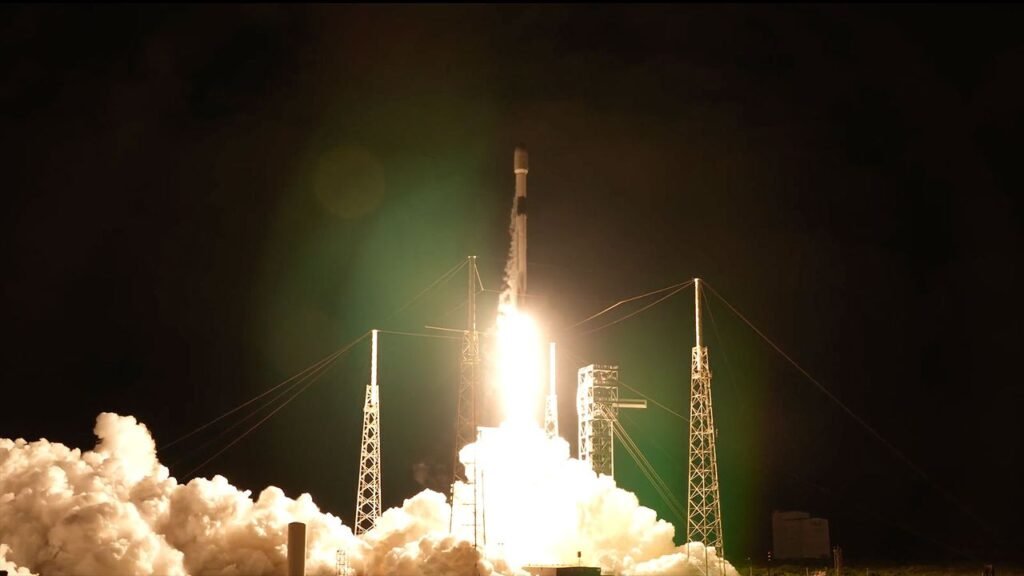
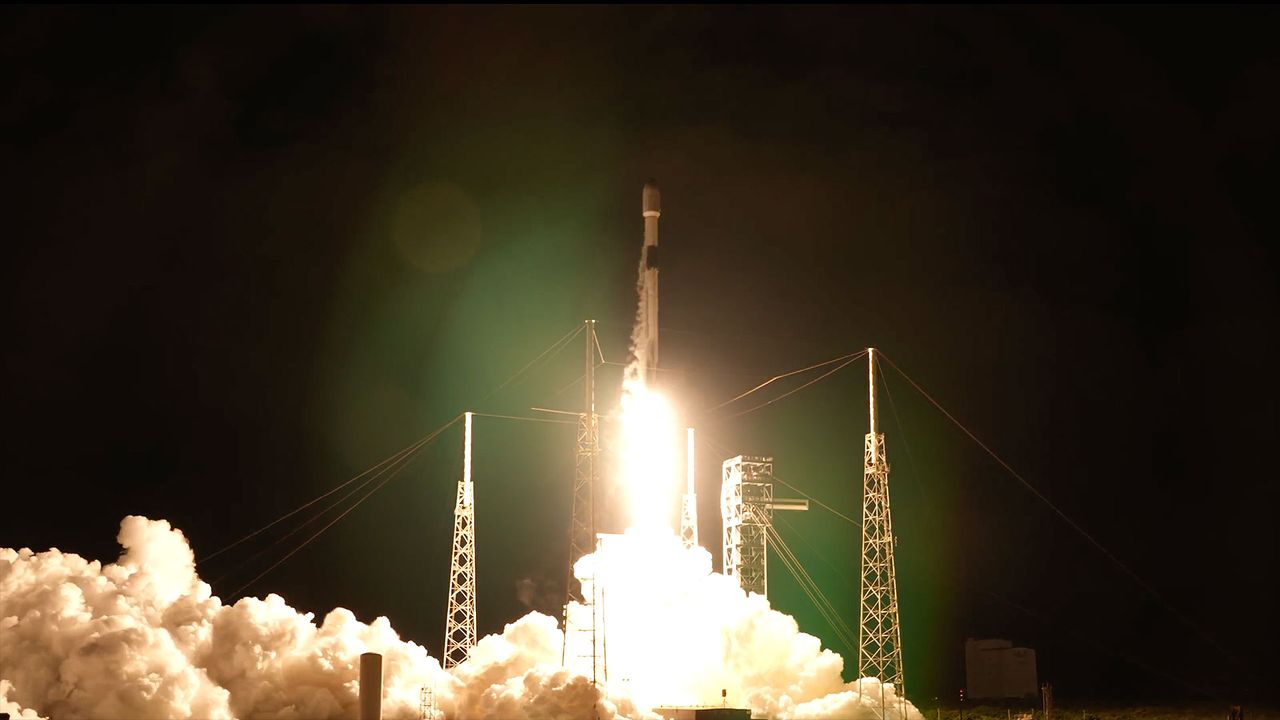
A Routine Yet Remarkable Liftoff (Image Credits: Cdn.mos.cms.futurecdn.net)
Cape Canaveral Space Force Station, Florida – SpaceX marked another step in its mission to provide worldwide internet access as a Falcon 9 rocket successfully deployed 29 Starlink satellites into orbit on Sunday evening.
A Routine Yet Remarkable Liftoff
The launch, designated as the Starlink 6-100 mission, took place at 7:01 p.m. EST from Launch Complex 40. Spectators along Florida’s Space Coast gathered to witness the Falcon 9’s bright plume light up the night sky, a familiar sight that underscores SpaceX’s rapid pace of operations. The rocket’s first stage, on its 20th flight, separated cleanly about eight minutes after liftoff and returned to Earth for a precise landing on a droneship stationed in the Atlantic Ocean.
This reusability remains a cornerstone of SpaceX’s strategy, allowing the company to reduce costs and increase launch frequency. The mission highlighted the reliability of the Falcon 9 design, which has now flown hundreds of times since its debut. Engineers monitored the ascent closely, ensuring the upper stage carried the satellites to their target low-Earth orbit altitude of around 340 miles.
Enhancing Global Broadband Reach
Each of the 29 satellites contributes to the growing Starlink network, which aims to deliver high-speed internet to remote and underserved areas. These spacecraft, equipped with advanced phased-array antennas, will enable seamless data transmission once activated and positioned in their orbital slots. SpaceX has deployed thousands of such satellites over the past few years, transforming how people connect in regions previously cut off from reliable service.
The addition of these satellites brings the constellation closer to full operational capacity. Users in various countries already benefit from Starlink’s capabilities, including maritime and aviation applications. As the network expands, download speeds could reach up to 220 Mbps, with latency under 20 milliseconds in optimal conditions.
Behind the Scenes of Satellite Deployment
Following separation from the Falcon 9’s upper stage, the satellites began their individual deployment sequence. Each one unfolded its solar arrays and initiated propulsion systems to maneuver into formation. Ground teams at SpaceX’s mission control in Hawthorne, California, confirmed successful separation and early health checks on the spacecraft.
This batch includes optimizations for direct-to-cell connectivity, a feature that allows Starlink to partner with mobile providers for texting and data services without traditional infrastructure. The process involved precise timing to avoid collisions in the crowded orbital environment. SpaceX continues to refine these deployments to support sustainable space operations.
Implications for Space Industry Growth
The Florida launch site has become a hub for Starlink missions, benefiting from its equatorial advantages for efficient orbits. SpaceX’s schedule shows no signs of slowing, with multiple launches planned in the coming weeks. This activity not only boosts the local economy through jobs and tourism but also positions the U.S. as a leader in commercial spaceflight.
Regulatory approvals from the Federal Communications Commission ensure the satellites comply with international space debris guidelines. Competitors in the satellite internet sector watch these developments closely, as Starlink’s scale influences market dynamics. The mission’s success reinforces investor confidence in SpaceX’s long-term vision.
Key Takeaways
- SpaceX launched 29 Starlink satellites on January 18, 2026, from Cape Canaveral.
- The Falcon 9 first stage achieved a record reuse, landing on a droneship.
- This deployment advances global internet access for remote communities.
As SpaceX pushes the boundaries of accessible space technology, this launch serves as a reminder of how private innovation is reshaping connectivity worldwide. What impact do you see Starlink having on daily life? Share your thoughts in the comments.