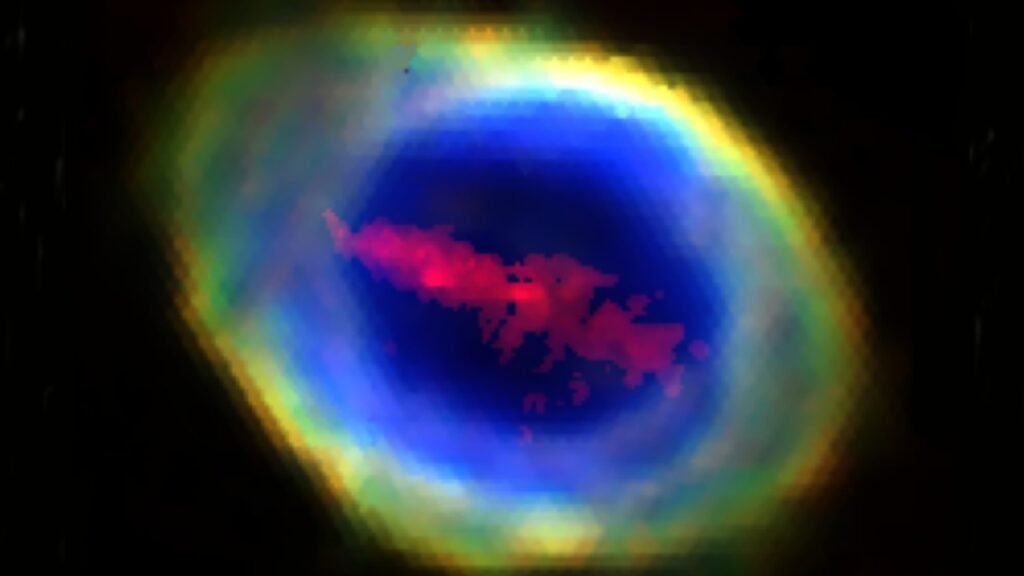
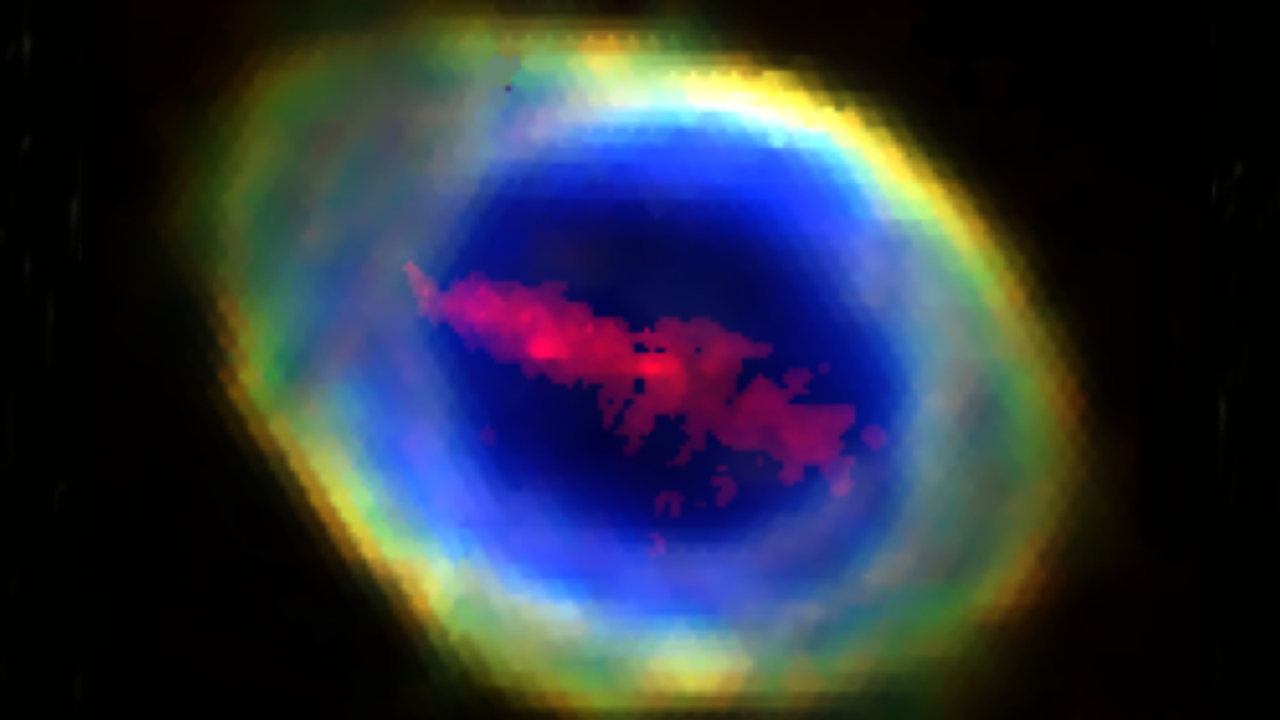
The Surprising Find at the Nebula’s Core (Image Credits: Cdn.mos.cms.futurecdn.net)
Astronomers recently unveiled an unexpected elongated cloud of iron atoms nestled within one of the sky’s most recognizable cosmic structures, prompting fresh questions about stellar evolution and planetary fates.
The Surprising Find at the Nebula’s Core
Researchers detected a bar-shaped formation of ionized iron atoms inside the Ring Nebula, a discovery that stunned the scientific community with its scale and composition. This structure stretches across a distance equivalent to 500 times Pluto’s orbit around the Sun, containing a mass of iron comparable to that of Mars. The feature appeared in detailed mappings that revealed its position fitting snugly within the nebula’s inner elliptical layer. Experts described the bar as a strip of plasma glowing with light from four-times-ionized iron, visible only through advanced spectroscopic analysis. The revelation came from observations conducted in late 2025, marking a significant advancement in our view of this ancient cosmic remnant.
The detection highlighted the nebula’s complex internal dynamics, where heavy elements like iron play a hidden role. Previously, images from telescopes such as the James Webb Space Telescope had showcased the nebula’s outer rings, but this inner anomaly required specialized instruments to uncover. Astronomers noted that the bar’s orientation aligns with the nebula’s overall structure, suggesting it formed during key phases of the parent star’s death throes. This find not only enriches our understanding of the Ring Nebula but also invites speculation about similar hidden features in other planetary nebulae.
Unpacking the Iconic Ring Nebula
The Ring Nebula, cataloged as Messier 57, resides about 2,300 light-years away in the constellation Lyra and formed when a sun-like star exhausted its nuclear fuel and ejected its outer layers. First observed in 1779 by French astronomer Charles Messier, it spans roughly one light-year and glows in vibrant hues of oxygen and other ionized gases. At its center lies a white dwarf, the stellar core that continues to illuminate the surrounding shell, creating the signature ring-like appearance. This planetary nebula serves as a snapshot of what awaits our own Sun in about five billion years, offering a preview of cosmic recycling on a grand scale.
Recent studies have layered new details onto this familiar object, revealing intricate filaments and dust concentrations that previous observations missed. The nebula’s elliptical shape and layered structure indicate interactions between the dying star’s winds and earlier stellar ejections. Iron, typically locked in stellar cores or planetary crusts, rarely dominates such visible features, making this discovery particularly intriguing. As a well-studied target, the Ring Nebula now stands as a testing ground for theories on how dying stars sculpt their environments.
Origins: Theories Behind the Iron Formation
Scientists proposed several explanations for the iron bar’s existence, each tying back to the violent processes that birthed the nebula. One leading idea suggests the structure arose during the parent star’s collapse, when intense stellar winds compressed and ionized iron-rich material into a linear shape. Another theory points to the remnants of a rocky planet that ventured too close to the star and vaporized, leaving behind a trail of metallic plasma. These scenarios underscore the nebula’s role as a graveyard for both stellar and planetary debris.
A third possibility involves magnetic fields or asymmetric ejections that funneled iron atoms into this bar-like configuration over millennia. To explore these hypotheses, researchers examined emission lines from the iron plasma, confirming its high ionization state consistent with exposure to the central white dwarf’s ultraviolet radiation. While no single theory fully accounts for the feature’s size and purity, the discovery aligns with models of post-main-sequence stellar activity. Further modeling will likely refine these ideas, potentially revealing patterns in other nebulae.
Implications for Cosmic and Earthly Futures
This iron bar could illuminate broader questions about heavy element distribution in dying stellar systems, where metals like iron seed future star formation. Observations suggest such structures might influence how nebulae evolve, affecting the chemical makeup of interstellar clouds. For Earth, the find evokes parallels to our planet’s eventual fate as the Sun expands, potentially engulfing inner worlds and dispersing their materials into space. Astronomers emphasized the need for more data to connect these ancient events to modern planetary science.
The discovery also demonstrates the power of new observational tools in peeling back cosmic layers. Instruments like Weave, mounted on the William Herschel Telescope in La Palma, enabled this level of detail by mapping velocities and compositions across wide fields. As similar surveys expand, they may uncover more iron features, challenging assumptions about nebula uniformity. Ultimately, this work bridges stellar archaeology with predictions for our solar system’s endgame.
Key Takeaways
- The iron bar spans 500 times Pluto’s orbital diameter and holds Mars-equivalent mass.
- Possible origins include stellar collapse or a vaporized planet’s remnants.
- This find enhances models of planetary nebulae and future stellar deaths like our Sun’s.
In the vast theater of the universe, the Ring Nebula’s iron bar reminds us that even familiar celestial wonders harbor secrets waiting to be decoded, urging continued exploration of the stars’ final acts. What mysteries might the next observation reveal about our cosmic neighborhood?