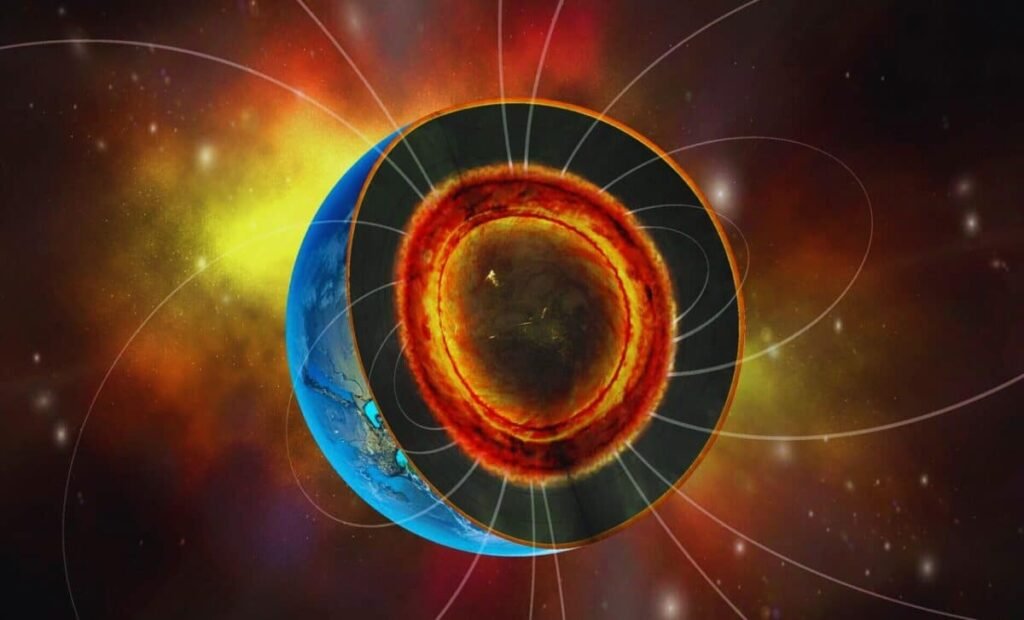

Unearthing the Role of Basal Magma Oceans (Image Credits: Dailygalaxy.com)
Deep within the cores of distant rocky worlds, layers of molten rock may hold the key to planetary survival against relentless stellar radiation.
Unearthing the Role of Basal Magma Oceans
Researchers recently uncovered evidence that vast underground reservoirs of magma could generate protective magnetic fields on super-Earths. Led by Miki Nakajima at the University of Rochester, a study published in Nature Astronomy explored how these basal magma oceans form under extreme pressures. The team analyzed conditions inside massive exoplanets, where rock melts into a conductive fluid far below the surface. This process differs from Earth’s dynamo, driven by liquid iron in the outer core. Instead, the magma itself becomes electrically charged, setting the stage for dynamic field generation.
The findings stemmed from laboratory experiments simulating high-pressure environments. Scientists subjected materials like magnesium-iron oxide to intense conditions mimicking planetary interiors. Results showed that at depths equivalent to thousands of kilometers, the magma gains metallic properties. This conductivity enables convective currents to produce magnetism strong enough to deflect charged particles from host stars. Such mechanisms could extend the lifespan of atmospheres on worlds orbiting active stars.
From Pressure to Protection: The Science of Magma Dynamos
Super-Earths, often 1.5 to 10 times Earth’s mass, face harsher radiation than our planet due to closer orbits around their stars. Traditional models assumed their magnetic fields weakened over time without a metallic core dynamo. However, the new research proposes that basal magma oceans persist for billions of years, acting as natural barriers. Convection in these molten layers creates electric currents, much like a self-sustaining generator. This could prevent atmospheric stripping, a common fate for unprotected exoplanets.
Experiments revealed thresholds where magma transitions to a conductive state around 200 to 300 gigapascals of pressure. At these levels, electrons delocalize, turning the fluid metallic. The study estimated field strengths comparable to Jupiter’s, sufficient to envelop the planet. Observations of exoplanets like those in the TRAPPIST-1 system might soon test these predictions with upcoming telescopes. Understanding this process refines searches for habitable zones beyond our solar system.
Parallels with Earth’s Fiery Past
Earth’s history offers clues to these alien phenomena, as remnants of an ancient magma ocean linger in the mantle. Formed during the planet’s accretion phase, this global melt persisted for hundreds of millions of years before solidifying. Seismic data today detects low-velocity zones that may trace back to that era, influencing heat flow and volcanism. Similar dynamics likely shaped early super-Earths, where impacts and radioactive decay kept interiors molten longer.
Unlike Earth, larger exoplanets retain heat more efficiently, allowing basal layers to stay liquid indefinitely. This stability fosters long-term magnetic protection, potentially cradling conditions for life. Models of magma ocean evolution suggest water and volatiles could mix into these depths, hiding resources from surface detection. Such hidden oceans challenge assumptions about barren rocky worlds, hinting at subsurface habitability.
Broader Implications for Cosmic Habitability
The discovery expands the criteria for potentially livable exoplanets, focusing on internal structures rather than surface features alone. Rocky worlds without visible water might still harbor protective shields beneath their crusts. This shifts priorities in exoplanet surveys toward those with signs of internal activity, like induced magnetic fields detected by spacecraft.
- Magma oceans enable dynamo action without relying on core convection.
- They could preserve atmospheres against stellar winds for eons.
- Larger planets benefit most, as pressure sustains molten states.
- Earth’s legacy shows these features evolve over geological time.
- Future missions may probe similar layers on Venus or Mars analogs.
Key Takeaways
- Basal magma oceans generate magnetic fields via conductive convection in super-Earths.
- These shields block radiation, enhancing atmospheric retention and habitability prospects.
- Earth’s ancient magma remnants underscore the long-term role of molten interiors in planetary evolution.
As astronomers peer deeper into the universe, these molten guardians reveal how life might endure in unexpected places. The interplay of pressure, heat, and magnetism paints a resilient picture of cosmic worlds. What hidden defenses do you imagine protect other planets? Share your thoughts in the comments.