You probably glanced at your smartphone this morning, grabbed your coffee, and got on with your day. Simple routine, right? Honestly, nothing’s truly simple anymore. We’re surrounded by objects that seem mundane at first glance, but beneath their familiar exteriors lies a web of engineering brilliance, centuries of innovation, and scientific complexity that would boggle your mind if you stopped to think about it. Most of us never do.
Here’s the thing: modern life has made us complacent. We take for granted the marvels sitting right under our noses. That little device in your pocket or the humble zipper on your jacket has more engineering sophistication than you’d imagine possible. So let’s dive in and unpack some of the everyday items you’ve been completely underestimating.
Your Smartphone Is Basically Science Fiction Made Real

The science of smartphones encompasses principles from electronics, materials science, and telecommunications, making them one of the most complex everyday objects we use. Think about it for a second. Your phone contains billions of transistors etched onto microchips smaller than your fingernail, each one performing calculations at speeds that would have seemed impossible just decades ago.
Smartphones rely on multiple sensors, such as accelerometers and gyroscopes, to detect movement and orientation. They’re constantly talking to satellites orbiting Earth, processing your voice commands, capturing high-resolution images, and connecting you to a global network of information. Yet you probably just used yours to scroll through social media without giving it a second thought. The manufacturing process alone involves extracting rare earth minerals from across the globe, precision engineering that borders on the microscopic, and supply chains spanning dozens of countries.
The Washing Machine Hides Physics Genius

The washing machine is a complex system that integrates multiple mechanical engineering concepts to perform its function efficiently. You toss in your dirty clothes, add some detergent, press a button, and walk away. Easy, right? Wrong. What’s happening inside that drum is a carefully orchestrated symphony of physics and chemistry.
The washing process involves a combination of mechanical agitation, water, and detergent to remove dirt from clothes. The drum rotates, creating centrifugal force that pushes water and detergent through the fabric, loosening and removing dirt. The science behind washing machines includes fluid dynamics, mechanical engineering, and chemistry, all working together. Motors spin at precisely calculated speeds, sensors monitor water levels and temperature, and the whole system has to balance loads to prevent your machine from literally walking across the floor. Modern machines even have computer chips that adjust cycles based on fabric type and soil level.
Zippers Are Mechanical Marvels You Completely Ignore

Let’s be real, when was the last time you appreciated your zipper? A zipper is one of the most common household objects, used to bind two pieces of cloth or flexible material together, finding use in shoes, clothes, and bags. You zip up your jacket hundreds of times without thinking twice.
The modern zipper consists of a set of interlocking teeth made of metal or plastic operated by a manual slider. When moved up, the slider forces the teeth into a particular position, which is strongly bound. The frictional force between the teeth prevents them from being pulled apart easily, along with the interlocking position. The precision required to manufacture those tiny teeth so they interlock perfectly every single time is genuinely impressive. Gideon Sundbäck was granted the patent for a separable fastener once in 1913 and for an improvement on the original design in 1917. It took years of refinement to create something so reliable we never give it credit.
Light Switches Solved a Dangerous Problem

Flipping a light switch feels like the most basic action imaginable. You’ve probably done it thousands of times this year alone without considering what’s actually happening. I know it sounds crazy, but those simple switches are solving a problem that used to cause fires.
The first light switch we see today was invented in 1884 by English engineer John Henry Holmes. This design was based on quick-break technology, which ensured that the contacts to complete the circuit would come apart or together quickly. The short time didn’t permit the sparks to form in the gap, solving the problem of arcing. Early switches created electrical arcs that could ignite flammable gases or cause fires. The solution required understanding electrical engineering principles and materials science to create contacts that break connection fast enough to prevent sparking. The toggle switches we see today were invented by William J. Newton in 1916. Since then, many design features have been added, such as fuses, circuit breakers, and special coatings.
Aluminum Cans Are Engineered to Perfection

You grab a soda from the fridge, pop the tab, and recycle the can later. Seems straightforward. But that aluminum can represents one of the most optimized pieces of packaging engineering ever created. Every millimeter of that can has been scrutinized and refined over decades.
The walls are incredibly thin, just thick enough to hold carbonated liquid under pressure without rupturing. The pull tab acts as a lever system, transitioning from one class of lever to another as you open it, requiring just the right amount of force to break the seal without being too difficult. The top is engineered differently from the sides, the bottom has a specific curved shape to distribute pressure, and the whole thing is manufactured in fractions of a second. The can itself probably costs pennies to make, yet the engineering knowledge embedded in it is worth millions.
Your Coffee Contains Global Complexity

Stuff: The Secret Lives of Everyday Things deconstructs the American Dream by unraveling the hidden costs behind the objects around us. From our morning cup of Columbian coffee to our South Korean-made sneakers, the book traces the environmental impact of consumer decisions. That morning coffee you barely think about has traveled thousands of miles and passed through dozens of hands before reaching your cup.
Coffee beans are grown in specific climates, harvested by hand in many cases, processed through complex drying and roasting procedures that require precise temperature control, shipped across oceans, ground to exact specifications, and brewed using water heated to optimal temperatures. The entire supply chain involves farmers, traders, roasters, distributors, and baristas, each contributing specialized knowledge. Even the humble coffee filter uses principles of fluid dynamics and material science to extract flavor while filtering out grounds. Your five-minute morning ritual is the endpoint of a global network of staggering complexity.
Keys and Locks Are Older and Smarter Than You’d Guess

You probably carry keys every day without considering their ingenious design. The ones that opened the wooden locks of the massive marble and bronze doors of the Greeks and Egyptians could be three feet in length, and so heavy that they were commonly carried slung over the shoulder. Modern keys are much more compact but no less sophisticated.
That small piece of cut metal in your pocket contains a unique pattern that manipulates spring-loaded pins inside a lock cylinder to precise heights. Get even one pin wrong and the lock won’t turn. The mathematics of how many unique key combinations are possible, combined with the metallurgy needed to create durable keys that won’t bend or break, makes this ancient technology remarkably refined. Modern smart locks add layers of encryption, wireless communication, and battery management on top of the mechanical complexity. Yet we just stick them in doors and expect them to work flawlessly for years.
Even a Simple Wire Represents Massive Industry
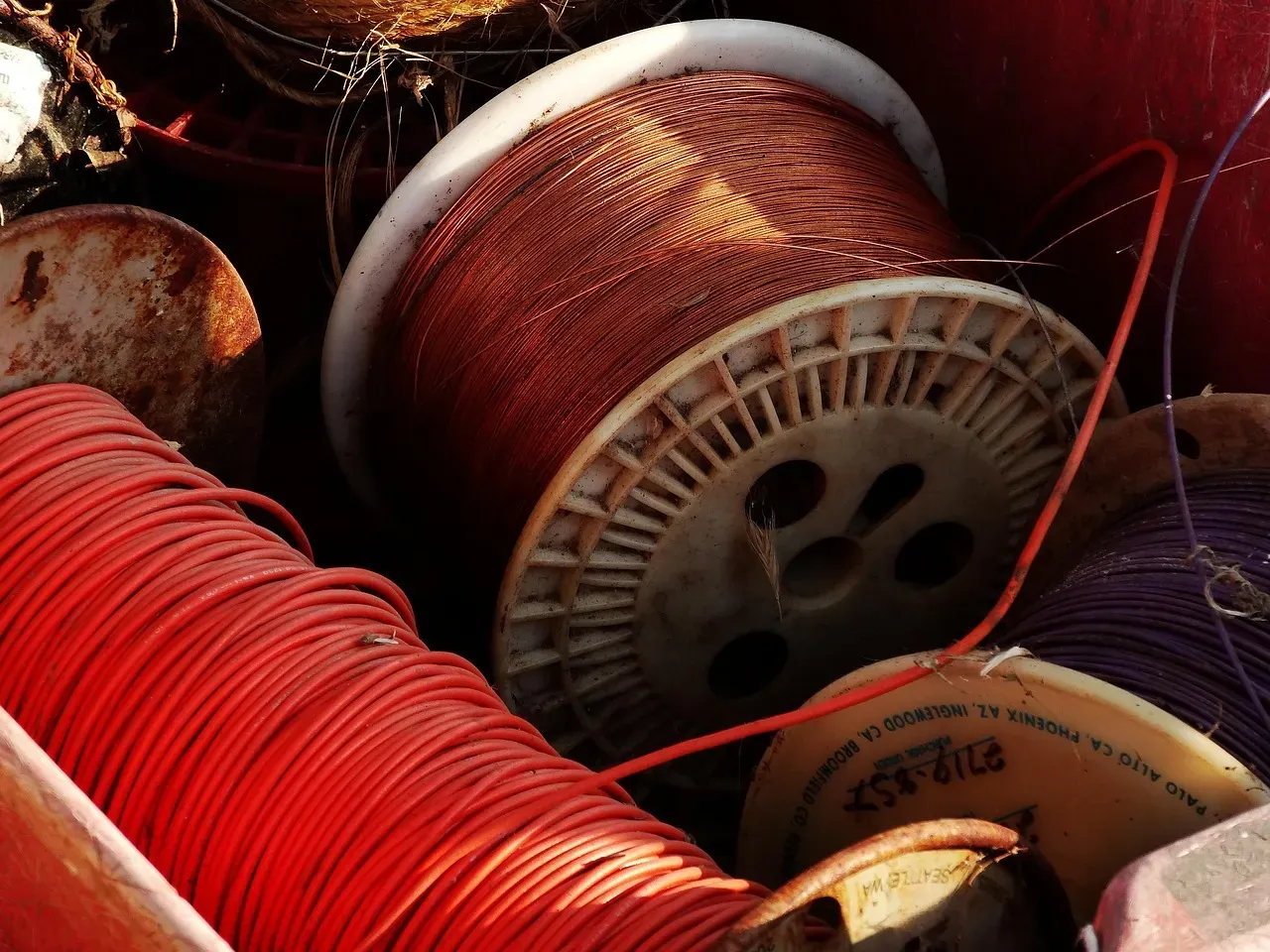
Maybe it was the solder fumes, but I started thinking about what it actually took to create that spool of wire – everything from the geologists and miners extracting ore, through all the metallurgy, industrial engineering, and plastics work. And I started to marvel at all the work and expertise it took. Something as basic as electrical wire connects you to a vast industrial ecosystem.
It made me wonder whether that spool of wire was actually a piece of technology on par in sophistication with all the software built every day. Almost every day I’ll look at some commonplace object and think this is actually so complex, no single human has all the knowledge to create it. Mining copper ore, refining it to purity, drawing it into precise gauges, insulating it with carefully formulated plastics, and winding it onto spools all require specialized knowledge and equipment. The standardization alone, ensuring that wire gauge and electrical resistance are consistent worldwide, represents centuries of collaborative engineering standards. That disposable-seeming component embodies human civilization’s collective technical achievement.
Your Refrigerator Battles Thermodynamics Daily

The science of thermodynamics governs cooking methods, influencing how heat is transferred, how food is refrigerated, and the efficiency of pressure cooking. Your fridge sits there humming quietly in your kitchen, and you barely notice it until it breaks. Inside that box, a constant war against entropy is being waged.
Refrigerators use refrigerant gases that compress and expand in cycles, absorbing heat from inside the unit and expelling it outside. The compressor, heat exchangers, insulation materials, and temperature sensors all have to work in harmony. The door seal has to be precise enough to prevent warm air infiltration while still allowing you to open it easily. Modern fridges have computer controls managing defrost cycles, optimizing energy consumption, and monitoring temperatures across different zones. Your fridge might be far more efficient and advanced than before, but it might only last one third as long. The engineering compromises between efficiency, cost, and durability are constantly being recalculated.
Conclusion: Complexity Hiding in Plain Sight

The everyday objects we use often go unnoticed, yet they are underpinned by complex scientific principles and technological innovations. By understanding the science behind these items, we can develop a deeper appreciation for the marvels that make our daily lives more convenient. Once you start seeing the hidden complexity around you, it’s hard to stop.
Every mundane object in your home represents thousands of hours of research, development, testing, and refinement. We live in a world where the accumulated knowledge of human civilization is embedded in the simplest items we use without thinking. Next time you zip up your jacket, flip a light switch, or grab something from the fridge, take just a moment to appreciate the invisible genius that made it possible. What everyday object surprised you the most? Maybe it’s time we all paid a little more attention to the remarkable ordinary.