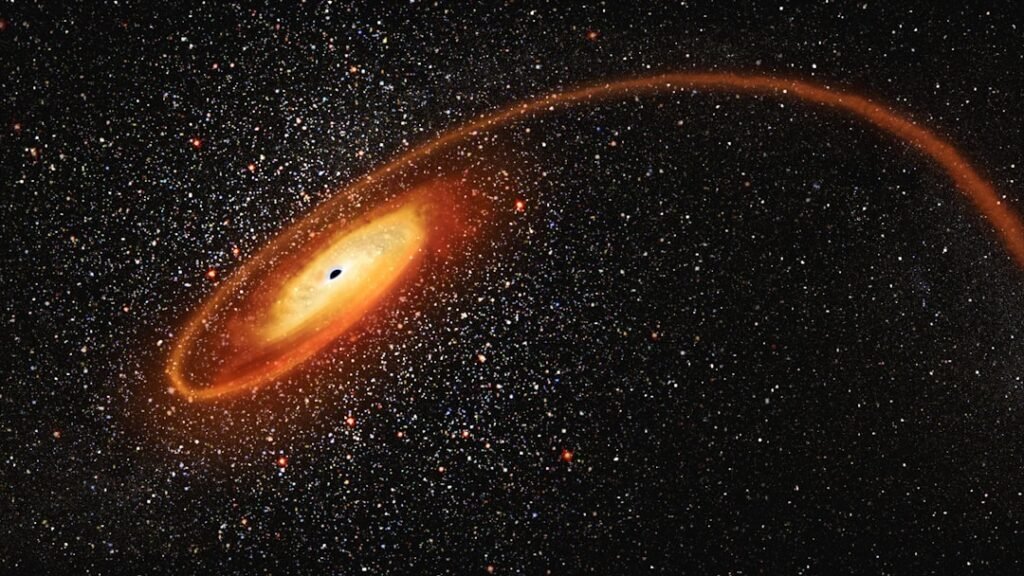

A Puzzling Phenomenon Emerges (Image Credits: Unsplash)
Berlin, Germany – Astronomers continue to decode the faint crimson specks that punctuate the James Webb Space Telescope’s glimpses into the universe’s infancy, shedding light on phenomena that shaped cosmic evolution.
A Puzzling Phenomenon Emerges
Compact and strikingly red, these sources first caught attention in the telescope’s deep-field images shortly after its science operations commenced in late 2021. Positioned about 1.5 million kilometers from Earth, the James Webb Space Telescope captured these anomalies amid the glow of the early universe, when it was merely hundreds of millions of years old. Researchers noted their intense hue, a result of light stretched by the cosmos’s expansion, and their tendency to fade from view roughly a billion years later. This transient behavior sparked intense debate, as traditional models struggled to explain such compact, luminous objects so soon after the Big Bang.
The dots appeared scattered across vast surveys, defying easy classification as distant galaxies or stars. Early analyses suggested they might represent the building blocks of larger structures, but their small size and rapid disappearance hinted at something more dynamic. Teams worldwide scrutinized spectra from these points, revealing unusual emission lines that pointed to extreme physical processes at work.
Black Holes in Disguise
Recent investigations have pinpointed these little red dots as young supermassive black holes, each enveloped in thick cocoons of ionized gas. Studies published in early 2026 confirmed that the redness stems not just from redshift but from dense gaseous shrouds that obscure and scatter light, much like a cosmic veil. These black holes, hundreds of times less massive than their modern counterparts, grew voraciously during this brief phase, feeding on surrounding material at rates far exceeding expectations.
The cocoons act as both nurseries and camouflage, allowing the black holes to balloon in size while hiding their true ferocity from direct observation. Spectral data from the telescope showed broad emission features indicative of high-velocity gas inflows, supporting the idea of rapid accretion. This revelation aligns with observations of similar objects, dubbed “big red dots” in some cases, which exhibit comparable traits at slightly later epochs.
Reshaping Theories of Cosmic Growth
The identification of these dots as embryonic black holes challenges long-held views on how supermassive entities formed in the universe’s first billion years. Previously, scientists posited slower, seed-based growth from stellar remnants, but the evidence now suggests explosive early development driven by abundant gas reservoirs. This process likely played a key role in seeding the quasars that later illuminated the cosmic web.
By comparing spectra across multiple dots, researchers found consistent patterns in line widths and gas densities, reinforcing their shared origins. The findings imply that such rapid growth episodes were common in the dense, turbulent environment of the young universe, influencing galaxy formation from the outset.
- These black holes formed when the universe was under 500 million years old.
- Their gas cocoons cause the red appearance and temporary visibility.
- Growth rates could reach hundreds of solar masses per year during peak phases.
- Similarities to known distant quasars suggest an evolutionary link.
- Observations span redshift values from 6 to 10, probing the reionization era.
Looking Deeper into the Cosmos
With these insights, astronomers now plan targeted follow-ups using the James Webb Space Telescope’s advanced instruments to map the cocoons in greater detail. Enhanced resolution could reveal the black holes’ spin rates and surrounding star formation, providing a fuller picture of their lifecycle. Collaborations between institutions, including those in Europe and the United States, aim to cross-reference data with upcoming surveys from other observatories.
These efforts promise to refine models of black hole seeding and merger events, potentially explaining the ubiquity of supermassive black holes in mature galaxies today. As the telescope accumulates more data, the little red dots may yield even more surprises about the universe’s formative years.
Key Takeaways
- Little red dots represent a short-lived stage of supermassive black hole growth in the early universe.
- Dense gas cocoons explain their compact, red appearance and eventual disappearance.
- This discovery upends theories on black hole formation, highlighting rapid accretion processes.
The unveiling of these hidden giants underscores the James Webb Space Telescope’s power to rewrite cosmic history, one red dot at a time. What implications do you see for our understanding of the universe’s origins? Share your thoughts in the comments.