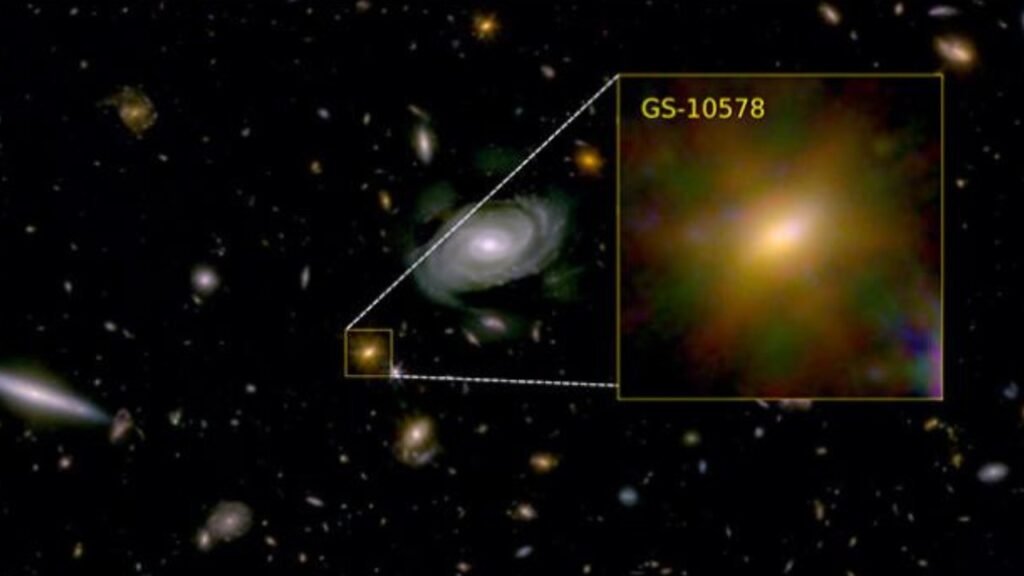
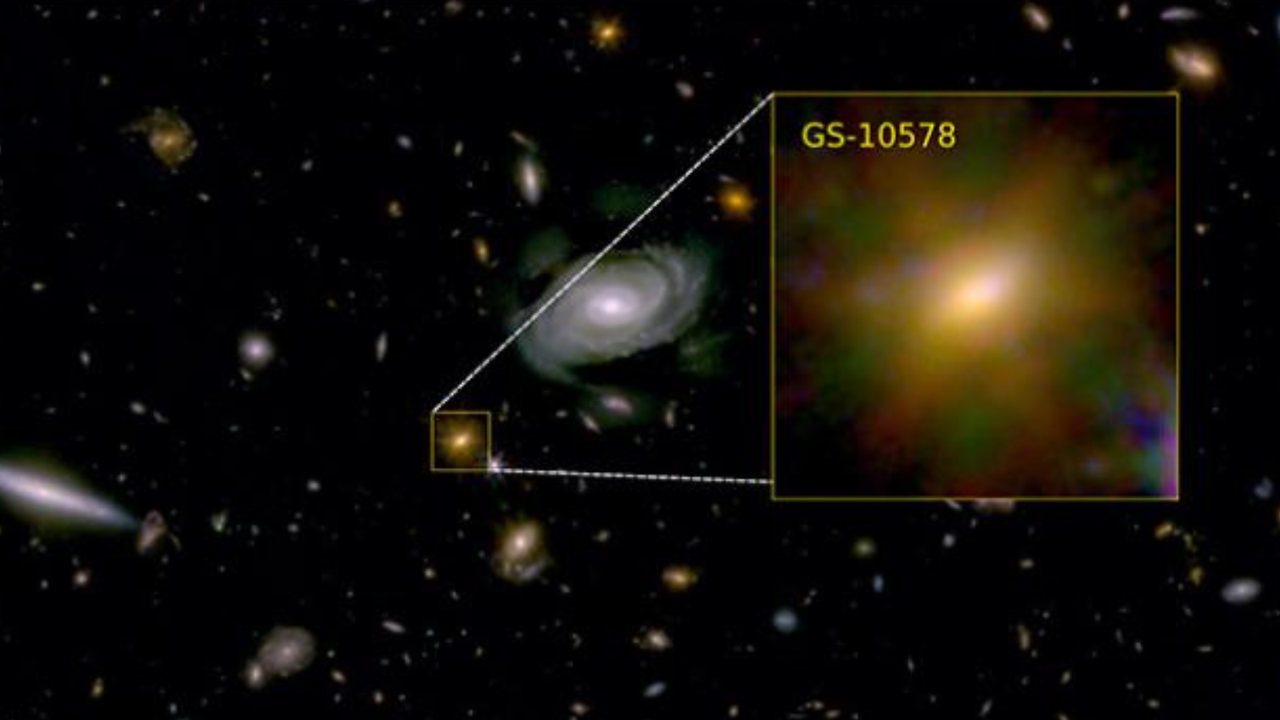
A Surprising Snapshot from the Early Cosmos (Image Credits: Cdn.mos.cms.futurecdn.net)
Astronomers using the James Webb Space Telescope have uncovered evidence of a supermassive black hole gradually depriving an early universe galaxy of the resources needed for star formation, marking one of the oldest examples of a quenched galaxy observed to date.
A Surprising Snapshot from the Early Cosmos
The James Webb Space Telescope captured detailed images and spectra of a galaxy known as Pablo’s Galaxy, or GS-10578, which existed when the universe was just 1.5 billion years old. This distant object, located billions of light-years away, appeared unusually passive for its era, with minimal ongoing star birth. Researchers noted that the galaxy’s core hosted a growing supermassive black hole, which seemed to play a pivotal role in its transformation from active to quiescent.
Previous observations from other telescopes had hinted at this scenario, but JWST’s infrared capabilities provided the clarity needed to confirm the process. The telescope’s data revealed a lack of cold gas and dust in the galaxy’s central regions, essential ingredients for creating new stars. Instead, the environment showed signs of heating and disruption, pointing to the black hole’s influence over time.
The Mechanism Behind the Galaxy’s Decline
Supermassive black holes at the hearts of galaxies can accrete material, releasing intense energy in the form of radiation and outflows. In Pablo’s Galaxy, this activity heated the surrounding gas to temperatures that prevented it from cooling and collapsing into stars. Over hundreds of millions of years, the black hole effectively blocked fresh supplies of interstellar medium from reaching star-forming zones.
Unlike violent mergers or sudden ejections, the quenching here unfolded gradually. JWST observations indicated that the black hole’s feedback slowly expelled or ionized the gas, reducing the galaxy’s fuel reserves. This “death by a thousand cuts” left Pablo’s Galaxy starved, with star formation rates dropping to near zero by the time it was imaged.
Key Observations from JWST Data
The telescope’s instruments detected specific signatures that supported this narrative. For instance, spectra showed elevated temperatures in the interstellar medium, consistent with black hole heating. Emission lines also suggested outflows carrying away potential star-forming material, further depleting the galaxy’s resources.
To illustrate the findings, astronomers compiled the following key indicators from the data:
- Low levels of molecular gas, crucial for star formation, in the galaxy’s disk.
- Strong ionization from the black hole’s accretion disk, affecting nearby clouds.
- Minimal dust content, which normally shields and cools gas for new stars.
- Redshift measurements confirming the galaxy’s age at around 1.5 billion years post-Big Bang.
- Compact central structure, indicating the black hole’s dominance over the core.
These elements combined to paint a picture of sustained suppression rather than abrupt termination.
Implications for Galaxy Evolution in the Early Universe
This discovery challenges models of how early galaxies transitioned to quiescence. In the young universe, rapid star formation dominated, yet Pablo’s Galaxy demonstrated that black hole feedback could halt this process surprisingly soon after formation. Such mechanisms might explain the scarcity of massive, star-forming galaxies in later cosmic epochs.
Future observations could target similar objects to determine if this slow starvation represents a common pathway. JWST’s ability to peer through cosmic dust has already transformed our understanding, suggesting that many ancient galaxies met similar fates through subtle, prolonged interactions with their central black holes.
Broader Insights into Cosmic Quenching
The findings from Pablo’s Galaxy underscore the intricate balance between growth and suppression in galactic evolution. While black holes drive some galaxies toward frenzy, in this case, they enforced a quiet end. Researchers emphasized that this process likely occurred across the early universe, shaping the large-scale structure we observe today.
Key Takeaways
- JWST confirmed a supermassive black hole’s role in slowly starving Pablo’s Galaxy of star-forming gas.
- The galaxy, one of the earliest quenched examples, dates to 1.5 billion years after the Big Bang.
- This gradual feedback mechanism highlights a non-violent path to galactic quiescence.
As JWST continues to reveal the hidden dynamics of the cosmos, discoveries like this one remind us of the delicate forces at play in galaxy lifecycles. What aspects of early universe evolution intrigue you most? Share your thoughts in the comments below.