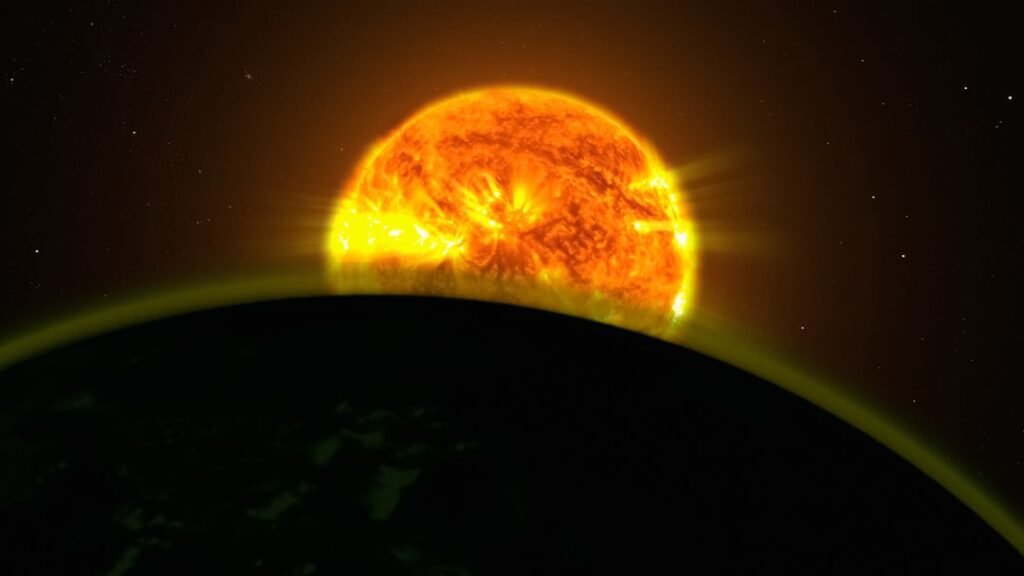

The Power of Planetary Transits (Image Credits: Unsplash)
Astronomers have long dreamed of finding evidence of life beyond Earth, and recent advances in telescope technology are bringing that goal closer by analyzing the atmospheres of distant planets.
The Power of Planetary Transits
Imagine a distant world slipping across the face of its star, momentarily dimming the light we observe from billions of miles away. This transit method has revolutionized exoplanet studies since the launch of space telescopes like Kepler and now the James Webb Space Telescope. When a planet passes in front of its host star, a tiny fraction of the starlight filters through the planet’s atmosphere. Scientists capture this light and break it down into its spectral components, revealing the chemical makeup of the air above.
Such observations occurred with remarkable precision in recent years, allowing researchers to identify gases like water vapor and carbon dioxide on worlds far from our solar system. The technique relies on the unique fingerprints each molecule leaves in the light spectrum – absorption lines that act like barcodes for atmospheric contents. Though transits happen infrequently for any given planet, repeated measurements build a detailed profile over time. This approach has confirmed thousands of exoplanets and opened the door to hunting for signs of biology.
Identifying Biosignatures in the Stars
One intriguing detection came from the exoplanet K2-18b, where instruments spotted potential biosignature gases that sparked global excitement among scientists. Biosignatures are molecules or patterns that, on Earth, arise from living processes, such as oxygen produced by photosynthesis or methane from microbial activity. In alien atmospheres, combinations like these could hint at life, especially if they defy non-biological explanations. Researchers now focus on hycean worlds – planets with hydrogen-rich atmospheres over water oceans – as prime candidates for habitability.
However, caution tempers enthusiasm; recent follow-up studies on K2-18b suggested some signals might stem from abiotic sources, underscoring the need for multiple lines of evidence. Advanced models weigh probabilities, considering factors like planetary temperature and stellar radiation. Polarized light from reflected starlight offers another tool, potentially revealing photosynthetic activity through unique signatures. These methods combine spectroscopy with atmospheric modeling to distinguish life from geology.
Overcoming Detection Hurdles
Spotting faint signals from exoplanet atmospheres demands cutting-edge instruments amid vast cosmic distances. The James Webb Space Telescope has pushed boundaries by resolving molecules in protoplanetary disks and mature planetary systems alike. Yet challenges persist: many exoplanets orbit faint red dwarf stars, where flares can obscure data, and thick atmospheres might hide surface conditions.
Teams develop frameworks to evaluate detections, prioritizing contexts like chemical disequilibria that life might sustain. For instance, sulfur compounds or complex organics, once found in young stellar environments, inform what to seek on formed planets. Ground-based observatories complement space missions, providing broader surveys. As technology evolves, false positives decrease, refining the search for truly anomalous atmospheres.
Future Missions and the Quest Ahead
Upcoming observatories like the Nancy Grace Roman Space Telescope will survey thousands more transiting exoplanets, expanding the dataset for atmospheric analysis. NASA’s ongoing efforts target not just our solar system but distant worlds, probing for ethanol, acetic acid, and other prebiotic molecules that could signal life’s building blocks. International collaborations ensure diverse perspectives, from European Space Agency contributions to global data sharing.
These missions aim to answer whether habitable zones host biology, with mid-infrared observations key for detecting gases like methyl bromide around cooler stars. Progress builds incrementally, as each spectrum adds to our understanding of possible alien ecosystems. The field advances through persistent observation and interdisciplinary science.
Key Takeaways
- Astronomers use the transit method and spectroscopy to analyze exoplanet atmospheres for biosignatures like oxygen and methane.
- Recent detections on planets like K2-18b highlight potential life signs, though abiotic explanations remain possible.
- Future telescopes will enhance resolution, reducing uncertainties in identifying habitable worlds.
The search for extraterrestrial life through atmospheric signatures represents humanity’s boldest step into the unknown, blending astronomy, chemistry, and astrobiology to probe the cosmos. As detections grow more sophisticated, the line between speculation and evidence blurs, inviting us to wonder about our place in a potentially teeming universe. What signs of life might the next observation reveal? Share your thoughts in the comments below.