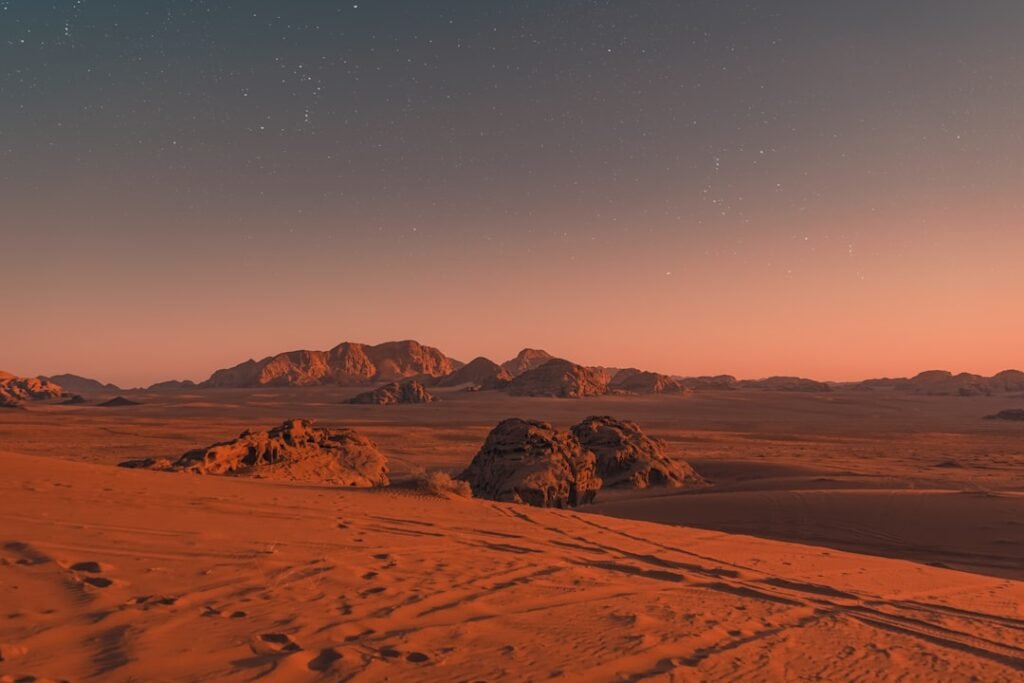

The Enigma of Persistent Water on a Cold Mars (Image Credits: Unsplash)
Gale Crater, Mars – Scientists have uncovered a mechanism that allowed ancient lakes on the Red Planet to remain liquid for extended periods, challenging previous assumptions about its harsh early climate.
The Enigma of Persistent Water on a Cold Mars
Early Mars boasted a network of lakes and rivers, as evidenced by rover explorations and orbital imagery, yet climate models long suggested the planet’s surface temperatures plummeted below freezing soon after its wetter phase. Researchers grappled with this contradiction: geological features in craters like Gale pointed to prolonged water activity, but how could liquid persist in such frigid conditions? A breakthrough study from Rice University addressed this by simulating the planet’s ancient environment, revealing that seasonal ice layers played a crucial role. These thin coverings acted as insulators, trapping heat and preventing full freeze-over. The findings, published recently, indicate that small bodies of water could have stayed unfrozen beneath the ice for up to 50 years or more.
This discovery reframes our view of Mars’ habitability window. Instead of brief, warm interludes, the planet may have supported stable aquatic environments during colder epochs. The model incorporated variables like atmospheric pressure, solar luminosity, and orbital eccentricity to recreate plausible scenarios. Such persistence would have provided ample time for chemical reactions essential to life, extending the timeline for potential microbial development.
Modeling the Ice-Water Balance
The new research employed a sophisticated semi-analytical model to map surface temperatures across Mars’ latitudes under varying conditions. It demonstrated that during the Hesperian period, when Gale Crater formed, average temperatures hovered well below zero, but localized warming from geothermal sources or seasonal thaws could sustain liquid layers. A thin ice sheet, forming annually and melting partially in summer, would shield the water below from evaporating or sublimating too quickly. This setup mirrored conditions in Earth’s Antarctic subglacial lakes, offering an Earth-based analog for Martian processes.
Key to the model’s success was accounting for Mars’ thin atmosphere and lower gravity, which influenced ice formation rates. Simulations showed that lakes up to a few meters deep could maintain liquid cores for decades, aligning with sediment layers observed by NASA’s Curiosity rover. The study ruled out thicker, permanent ice caps, which would have stifled water circulation. Instead, dynamic seasonal cycles emerged as the enabler, fostering environments where minerals could dissolve and redeposit over time.
Curiosity’s Role in Gale Crater Discoveries
NASA’s Curiosity rover, which landed in Gale Crater in 2012, has meticulously documented layered sediments that speak to a once-vibrant lake system spanning hundreds of millions of years. The rover’s instruments detected ripple marks and chemical signatures indicative of flowing water, not just frozen remnants. Recent analyses of these findings, combined with the new model, suggest the crater hosted ice-covered lakes that fluctuated with climate shifts from drier to wetter phases. Groundwater seepage likely contributed, dissolving rocks and transporting nutrients even after surface waters receded.
Explorations at sites like Pahrump Hills revealed transitions in rock compositions, hinting at evolving conditions beneath the ice. The rover’s data confirmed that while the lake eventually dried, its legacy endured in the stratified mound of Mount Sharp. This evidence bolsters the idea that Gale served as a long-term oasis, potentially preserving biosignatures if life ever arose.
Broader Implications for Mars Exploration
The persistence of liquid water under ice expands possibilities for where to search for signs of ancient life on Mars. Future missions could target similar crater sites, using drills to sample subsurface layers shielded from radiation. This research also informs models of planetary habitability beyond our solar system, showing how marginal conditions might still support life.
Understanding these dynamics could guide resource utilization for human exploration, as subsurface ice might yield accessible water today. The study’s authors emphasized that while Mars transitioned to its current arid state billions of years ago, echoes of its watery past linger in craters like Gale.
Key Takeaways
- Thin seasonal ice insulated ancient Martian lakes, allowing liquid water to last decades in sub-freezing climates.
- Rice University’s model resolves discrepancies between geological evidence and cold paleoclimate simulations.
- Findings from Gale Crater enhance prospects for detecting microbial fossils in Mars’ subsurface.
As this research peels back layers of Mars’ icy history, it invites us to reconsider the Red Planet’s potential as a cradle for life. What secrets might future rovers unearth in these frozen archives? Share your thoughts in the comments below.