

Most of us grow up thinking of light as something simple: you flip a switch, a room brightens, your eyes take in the scene and that’s that. But the deeper physicists have dug into the nature of light, the stranger and more magical the story has become. The light hitting your eyes right now does not behave like anything in everyday life. It slips between being a wave and a particle, it arrives in tiny indivisible packets, and it obeys rules that seem to ignore common sense.
Once you mix this with how your eyes and brain actually build your experience of reality, things get even weirder. You’re not just seeing what’s “out there”; you’re seeing a quantum-filtered, biologically-edited, brain-constructed version of the world. When I first really learned this, it felt a bit like finding out the “real world” was a movie set and I’d been watching a carefully cut trailer my whole life. Let’s pull back the curtain and look at what light really is, and what that means for how you see everything around you.
The Shock: Light Is Both a Wave and a Particle
Here’s the first surprise: light refuses to pick a side. In some experiments, it behaves like a smooth wave, spreading out, interfering, and forming beautiful ripple patterns. In others, it acts like a stream of tiny bullets called photons, hitting screens in distinct spots, one at a time, as if it were made of solid beads. The strange part is that both descriptions are true; neither one alone fully captures what light does at the smallest scales. This is not just a philosophical puzzle; it has been nailed down again and again in carefully controlled experiments.
The classic example is the double-slit experiment, where single photons are sent toward a barrier with two tiny openings. If you don’t try to track which slit they pass through, they build up an interference pattern like waves on water. If you try to “watch” which slit each photon goes through, the interference disappears and they behave like ordinary particles. In simple terms, the way you observe light changes how it shows up, as if the universe is stubbornly refusing to act until you decide how you want to look at it.
Photons: Tiny Energy Packets That Power Vision
Light doesn’t come in a smooth, continuous flow; it arrives in discrete chunks called photons. Each photon carries a specific amount of energy that depends on its color, with higher energy photons corresponding to bluer light and lower energy ones to redder light. When a photon hits the retina at the back of your eye, it can trigger a molecular change in a pigment called retinal inside proteins known as opsins. That tiny molecular switch is the first step in turning light into an electrical signal your brain can understand. It’s like a microscopic on–off button that flips whenever a photon lands in the right place.
Here’s the crazy part: your eyes are sensitive enough to detect incredibly small numbers of photons. Under very dark conditions, individual rod cells in your retina can respond to single photons, and behavioral experiments suggest that a human can sometimes notice when only a handful of photons arrive. That means your conscious experience of a dim star in the sky might literally be built from just a few particles of light that have traveled for years across space. When you stand outside on a clear night, you’re catching ancient, vanishingly small packets of energy and somehow turning them into a feeling of awe.
Your Eyes Are Quantum Detectors (With Built-In Limits)

Biologists and physicists have increasingly started to see the retina as a kind of quantum measurement device. Photons arrive in a super-tiny, probabilistic way, and your photoreceptor cells either respond or they don’t. That response is not perfectly smooth or continuous, because the underlying reality is grainy and quantized. At very low light levels, randomness in which photons actually hit your eye introduces visual “noise” in your experience. In other words, some of the graininess you might notice in dim light is not just your imagination or a bad camera sensor; it’s the boundary where biology meets quantum physics.
There’s also a hard quantum limit to how much visual information you can get from a scene. Because light comes in discrete photons, you simply cannot extract more detail than the number of photons that reach your eye allows. If too few photons arrive from a small object, no amount of “trying to see better” will reveal it, just like no amount of squinting lets you read text that never printed on the page. Every moment, your visual system is quietly working against these limits, integrating photons over short periods of time and across small regions to build a stable picture out of a fundamentally jumpy input.
Color Is Not in Light: It’s in Your Brain
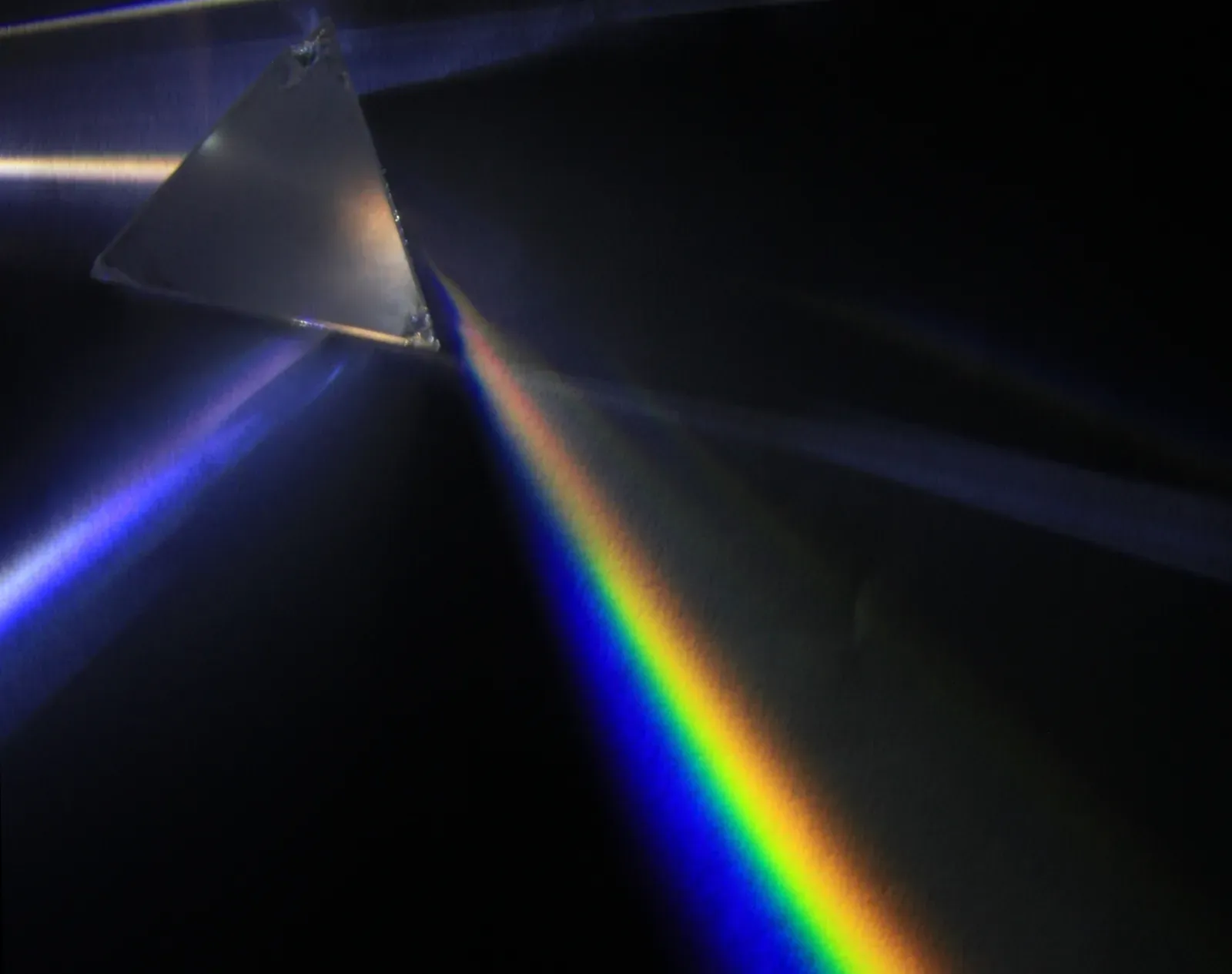
Many people assume that “red” or “blue” are properties that light itself simply possesses, like weight or temperature. At a basic level, light only has wavelength or frequency, which describes how stretched out or compressed its electromagnetic wave is. Your eyes contain three main types of cone cells, each tuned to respond best to different ranges of wavelengths. When light hits the cones, each type responds with a certain strength depending on the photon energies coming in. Your brain then compares the activity across these three channels and constructs what you experience as color. The color you feel is not a direct property of the light; it’s a neural interpretation of quantum energy differences.
This becomes clear when you look at optical illusions or clever color tricks where two areas with different physical light spectra look like the same color, or vice versa. Your brain is constantly making educated guesses about what color something “should” be under different lighting conditions, adjusting on the fly for shadows, reflections, and bright highlights. A famous example is when half the internet argued about the color of a particular dress in a viral photo a few years back. The disagreement came from brains making different assumptions about the lighting context, not from the pixels changing on the screen. At a deep level, color is your brain’s best guess about the structure of light in the world, not a simple readout of raw quantum data.
The Quantum Blur: Why You Can’t See Perfect Detail
Even if your eyes were flawlessly built, there are fundamental reasons you’ll never see infinite detail. Light behaves like a wave, and waves always spread and blur when they pass through openings like your pupil. This diffraction sets a hard limit on the sharpness of images; if two points of light are too close together, their wave patterns overlap and your eye can’t tell them apart. This concept is what also constrains telescopes and microscopes: you can’t resolve details smaller than a certain size because the light itself does not carry separable information beyond that point.
On top of that, the quantum nature of light makes the act of measuring extremely small structures tricky. For the tiniest objects, you’d need high-energy photons with very short wavelengths to see them clearly, but those same photons can disturb or damage what you’re trying to look at. It’s like trying to examine a delicate snowflake with a high-pressure water hose: you might get more detail, but you also risk blasting your target apart. Many cutting-edge imaging techniques in biology and physics are basically clever ways of dancing around these quantum and wave-based limits, squeezing out as much information as possible without wrecking the thing you want to observe.
Time, Motion, and the Brain’s Quantum “Best Guess”
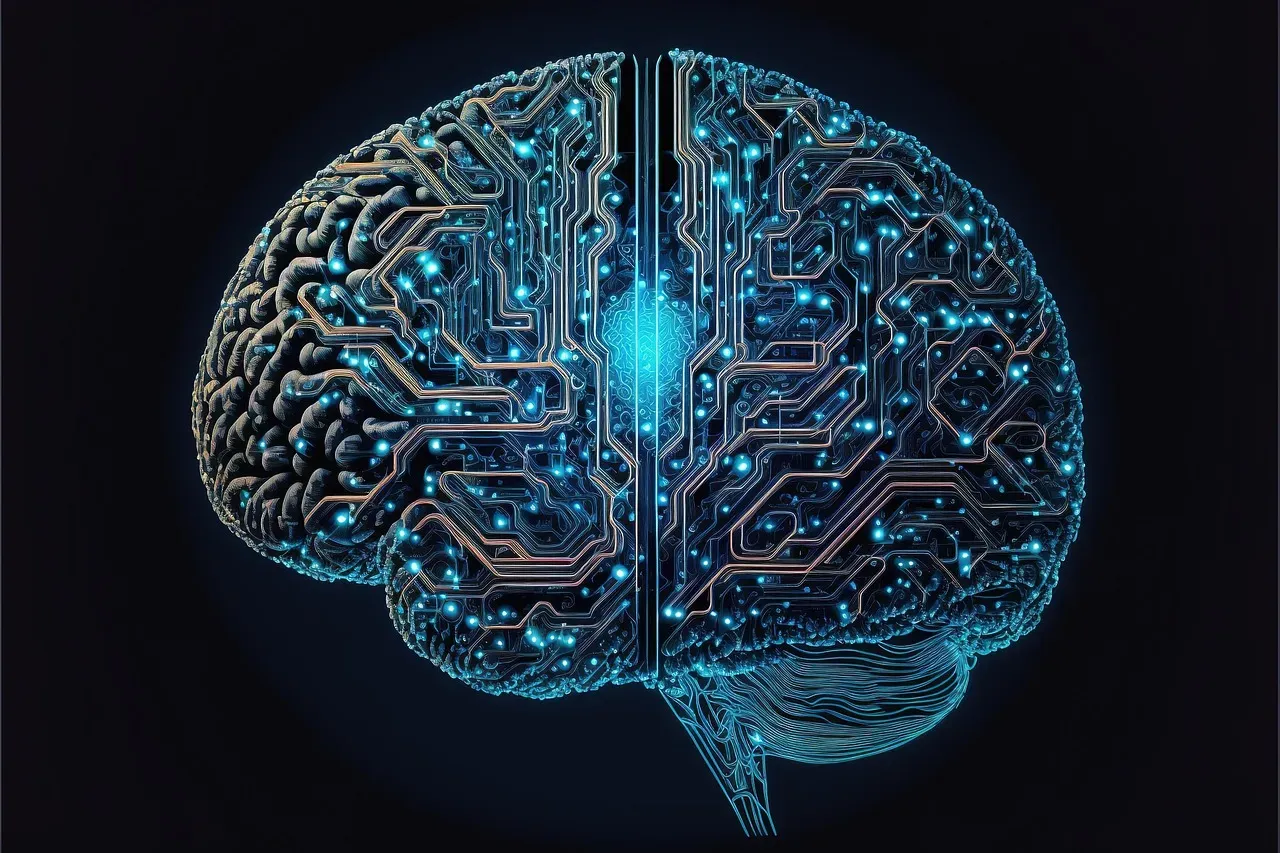
Your brain doesn’t experience the world in single frozen snapshots; it stitches together streams of photons over time. Each photoreceptor responds over a small time window, and your visual system effectively averages and predicts between these quantum events. This is part of why you see smooth motion in movies: a sequence of still images shown rapidly tricks your brain into perceiving continuous movement. Deep down, you’re always a fraction of a second behind reality, because your brain is waiting for enough incoming information to form a coherent picture. It then fills in the gaps so you don’t feel like you’re constantly watching a flickering slideshow.
There’s also evidence that your brain leans heavily on prediction, using prior experience to guess what will happen next and updating when reality disagrees. Some researchers describe perception as more like a controlled hallucination than a direct recording of the outside world. At the quantum level, the exact arrival times and paths of photons are probabilistic and jittery, yet your experience feels smooth and stable. Your brain acts like a skilled editor, cutting out the random noise and stitching together a story that makes sense, even when the raw sensory feed is messy and incomplete.
Quantum Technology Is Already Changing How We See
The weirdness of light is no longer just a topic in physics lectures; it’s starting to shape everyday technology. Quantum dots, which are tiny semiconductor particles only a few nanometers across, are used in modern displays to produce extremely pure, vivid colors. Their color depends directly on their size, because quantum rules determine which photon energies they can emit. Quantum sensors are being developed to measure incredibly small changes in light, gravity, or magnetic fields, enabling new kinds of imaging and navigation that would have sounded like science fiction a generation ago. All of this relies on the fact that light and matter interact in precise, quantized ways.
There’s also active work in quantum communication and quantum networks that encode information in single photons or in subtle properties like polarization and phase. These systems exploit the strange rules of quantum mechanics to make messages more secure or to link distant devices in new ways. While this may sound far removed from your own eyes, it shares the same core story: reality at small scales runs on discrete, probabilistic events, not on smooth, continuous flows. The same quantum quirks that limit how clearly you can see also open doors to technologies that can observe and manipulate light with astonishing precision.
Seeing Is Stranger Than Believing

Light is not the simple, invisible stuff we casually imagine washing over the world. It is a quantum phenomenon that dances between waves and particles, arriving in tiny packets that your retinas convert into electrical whispers for your brain. The colors, shapes, and motions you experience are the end result of a long chain of events that starts with single photons and ends with your brain’s best, sometimes biased, reconstruction of reality. At every stage, from diffraction limits to neural processing, the quantum rules of light dictate what you can and cannot see.
Once you realize this, ordinary sight feels anything but ordinary. That ray of sunlight sliding across your floor, the glow of your phone screen, the faint glimmer of a distant star – all of it is built on subtle quantum interactions that your brain quietly turns into a seamless, understandable world. You’re not just looking at reality; you’re partnered with it, decoding and shaping it with every blink. The next time you open your eyes, will you still think light is simple?